
Views: 222 Author: Farwise Lighting Publish Time: 2026-10-20 Origin: Site


Content Menu
● What Does an Addressable LED Strip IC Do?
● Built-In IC vs. External IC LED Strips
● Main Addressable LED Strip IC Types Explained
>> Single-Data Addressable LED Strips
>> Clocked Addressable LED Strips
>> Backup-Data Addressable LED Strips
● How to Choose Addressable LED Strip IC Types for Furniture
>> Start With the Lighting Task
>> Evaluate White Light Separately
>> Confirm the Complete Control Chain
● Addressable LED Silicone Strip Lights: What Changes?
● A Better Approval Method: Test a Furniture Mock-Up
>> Review the Visible Experience
>> Approve a Repeatable Reference
● Troubleshooting Addressable LED Strip Problems
● OEM and ODM Planning With Farwise Technology Co., Ltd.
● Build the System Around the Finished Application
>> 1.Which addressable LED strip IC is best for furniture lighting?
>> 2.Are clock lines and backup-data lines interchangeable?
>> 3.Does every addressable strip control each LED individually?
>> 4.Can addressable LED silicone strip lights be cut?
>> 5.Can different addressable IC types use the same controller?
>> 6.Does backup-data control prevent every downstream failure?
Choosing between addressable LED strip IC types starts with understanding how the lighting should behave. A flowing accent beneath a bed, a coordinated retail display, and everyday wardrobe illumination have different priorities. The right integrated circuit helps deliver the intended effect, but it must work with the controller, power system, installation, and maintenance plan.
My recommended starting point is compatibility, rather than a popular chip name. Addressable LED strips can control individual LEDs or groups of LEDs, depending on their construction. That distinction determines how precisely an effect moves across the illuminated surface.
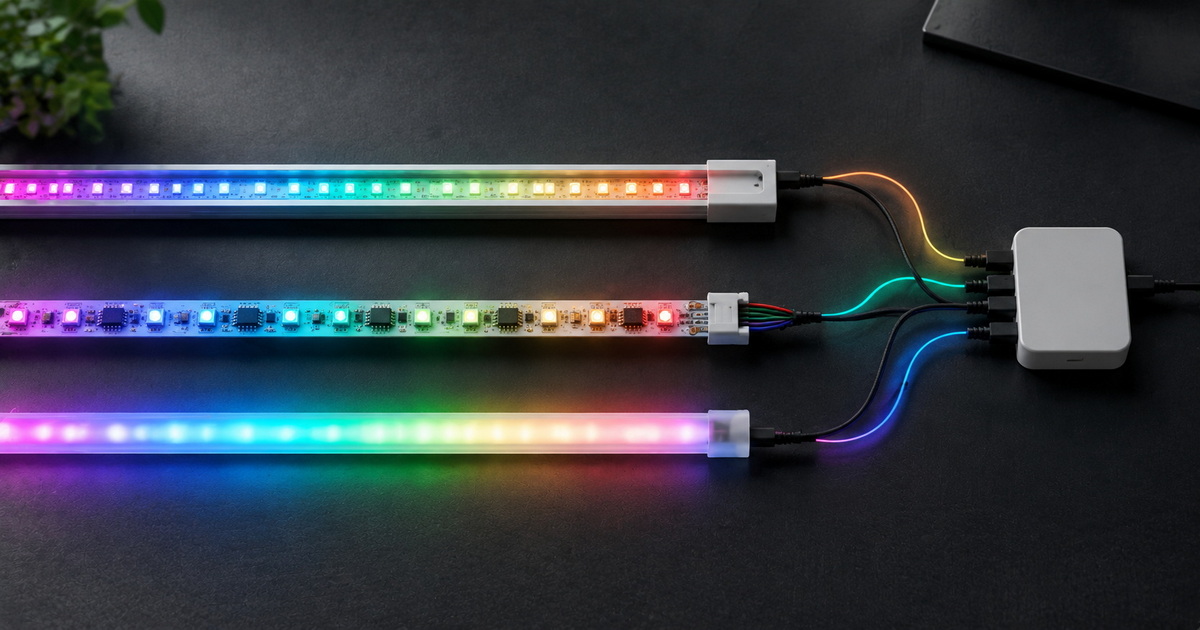
An integrated circuit, or IC, interprets control instructions and adjusts the connected light sources. Instead of making the entire strip display the same appearance, an addressable system can assign different colors or brightness levels to separate sections.
The controllable section is commonly called a pixel. However, a pixel does not always mean one physical LED. Some strips control individual emitters; others control several together.
For buyers, the important question is simple: how will the smallest controllable section look in the finished furniture?
A product description that says "addressable" is not enough. Ask the supplier to demonstrate the intended effect on the actual strip and controller combination.
A built-in IC sits inside the LED package. Familiar examples include WS2812B and certain SK6812 products.
This arrangement integrates the light source and control electronics into a compact assembly. However, the package alone does not establish the finished strip's cutting arrangement or overall serviceability.
For furniture projects, assess the assembled lighting component rather than assuming that an integrated chip guarantees easier installation.
An external IC sits separately on the strip's circuit board. WS2811 is a familiar example.
External-driver designs can control groups of LEDs, making the visible segmentation important when evaluating moving effects.
Neither construction is automatically superior. My purchasing recommendation is to compare the finished lighting effect, connection design, replacement method, and documented controller support.
The following comparison focuses on control approaches and purchasing considerations rather than product specifications.
| Control approach | Familiar examples | Main purchasing question |
|---|---|---|
| Single-data control | WS2812B, selected SK6812 products | Does the controller support the exact protocol and color arrangement? |
| Clocked control | APA102, SK9822 | Does the controller provide both data and clock outputs? |
| Backup-data control | WS2813, WS2815 | What failures can the documented backup path bypass? |
| External-driver control | WS2811 | Does the controllable grouping suit the intended effect? |
| Direct DMX control | Dedicated DMX-compatible designs | Is the strip genuinely DMX-controlled, or does it require conversion? |
These categories describe different aspects of a product and can overlap. External-driver construction, for example, describes component placement rather than a separate communication standard.
WS2812B-style products use a timing-sensitive data signal. The controller sends instructions through a chain of pixels, with each stage passing information onward.
If a failure interrupts that forwarding function, downstream pixels may stop receiving valid instructions. However, a failed light-emitting element does not necessarily mean the data circuit has also failed.
Before purchase, verify the exact supported chip variant. Also confirm color ordering: incorrect settings can make an otherwise functioning strip display the wrong colors.
APA102 and SK9822 use separate data and clock signals. The clock helps coordinate how the receiving electronics interpret incoming information.
These products differ from timing-sensitive single-data designs. A compatible controller must provide the appropriate clocked output.
Do not assume that similar control behavior makes different chips visually interchangeable. Pololu specifically notes that color differences can make mixing SK9822 and APA102C products undesirable within one installation.
For repeat furniture orders, this supports a practical rule: approve component substitutions before production.
WS2813 and WS2815 families include backup-data arrangements intended to preserve downstream communication under supported failure conditions.
A backup-data line is not a clock line. Although both designs may have additional connections, those connections perform different jobs.
Backup signaling also does not repair a failed emitter, restore missing power, or protect every damaged connection. Treat it as a specific resilience feature, not a promise of uninterrupted operation.
Direct DMX strips use a different control interface from typical pixel-controller outputs. Alternatively, a DMX-to-pixel converter can receive DMX instructions and generate a supported pixel protocol.
This distinction matters when coordinating lighting with an existing control system.
Ask where conversion occurs, who configures addressing, and which party supports commissioning. "DMX compatible" should describe a documented connection path, not an unexplained marketing label.
Before selecting a chip, decide whether addressable control adds useful functionality.
An animated display may benefit from independently controlled sections. A wardrobe intended only for consistent illumination may not need pixel-level effects.
My recommendation is to define the essential user experience first:
- What should happen when someone approaches or opens the furniture?
- Should the lighting remain static or display movement?
- How should it behave after power returns?
- Can the user operate it without an application?
- Who will maintain the system?
These questions help avoid purchasing complexity that the finished product does not need.
RGB color mixing and a dedicated white channel are different approaches. RGBW products add a separate white emitter, but the complete strip and controller must support that channel arrangement.
For cabinets and wardrobes, I recommend approving white-light appearance independently from decorative effects.
Review clothing, wood finishes, work surfaces, and nearby lighting in a physical sample. An attractive animation does not establish that the everyday lighting is suitable.
Do not approve the strip in isolation. Request confirmation of:
- Exact chip family and production variant.
- Controller support and required configuration.
- Color-channel arrangement.
- Data direction and connection labeling.
- Startup behavior and saved settings.
- Compatibility with the proposed switching or automation method.
Power arrangements, signal levels, and grounding also affect reliability. Follow the selected equipment's documentation rather than treating all addressable products as electrically interchangeable.
LED silicone strip lights add another layer of purchasing decisions. The silicone construction does not identify the control protocol, so buyers should confirm the electrical design separately.

For furniture integration, my recommendation is to review the mechanical assembly alongside the lighting sample:
- Which direction may the product bend?
- How will it enter and leave the furniture?
- Where will connections and end caps sit?
- Can installers access the controller?
- Can a damaged section be replaced without dismantling the cabinet?
Flexible neon-style products must bend only in their specified direction. Forcing the wrong bend can damage internal components.
Cutting also creates an opening that needs the appropriate finishing and sealing method. A silicone exterior should not be treated as proof that a modified assembly remains suitable for moisture exposure.
For bathroom cabinetry, request documentation for the intended environment and completed connection arrangement.
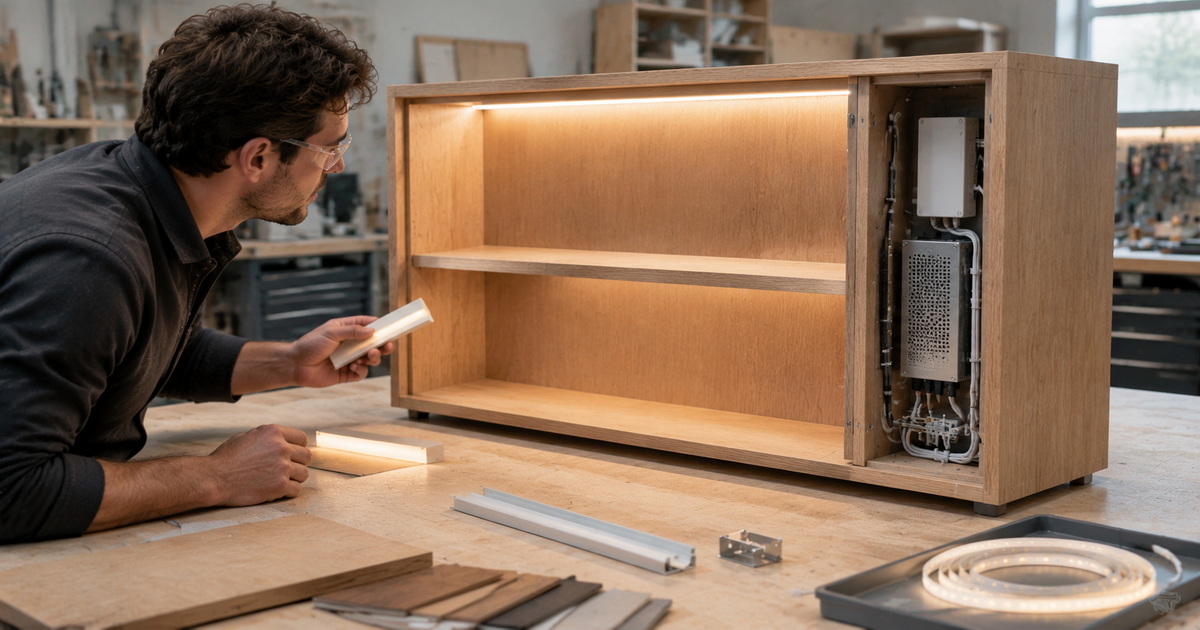
A short demonstration on a workbench does not establish how a complete installation will perform.
My recommended approval method is a furniture mock-up using the proposed strip, controller, connections, cable routing, mounting method, and power supply.
Check the lighting from normal viewing positions:
- Are individual points distracting?
- Do moving effects appear smooth across joints?
- Does the white scene suit surrounding finishes?
- Is the light uncomfortable when viewed from a bed?
- Does illumination reveal the intended cabinet contents?
Record observations against agreed acceptance criteria rather than relying on "looks good."
Test ordinary actions, not just demonstration effects:
1. Switch the system off and on.
2. Activate the planned door or occupancy control.
3. Change between decorative and functional scenes.
4. Confirm the expected behavior after an interruption.
5. Check that routine operation remains understandable.
Retain an approved sample and configuration record.
For production purchasing, I recommend recording the component identification, controller settings, assembly drawings, connection method, and accepted appearance.
This makes later substitutions easier to evaluate and gives both buyer and manufacturer a shared reference.
Flickering, incorrect colors, and unstable effects can arise from configuration, power delivery, connections, or signal integrity. They do not automatically indicate a defective IC.
| Symptom | Initial investigation |
|---|---|
| Colors appear incorrect | Confirm protocol selection and color ordering |
| Pixels flicker unpredictably | Inspect connections, signal routing, and power stability |
| Only part of the installation responds | Check layout configuration and the affected connection path |
| Bench sample works but installed system fails | Compare installed cabling and surrounding interference sources |
| Problems begin after a component change | Compare the replacement against the approved configuration |
A useful diagnostic method is to simplify the system. Connect a known-good sample directly to the controller using the manufacturer's recommended arrangement. Then reintroduce project components individually.
This approach helps distinguish a strip fault from a wiring or integration problem. Electrical modifications should follow supplier instructions and be handled by appropriately qualified personnel.
Farwise Technology Co., Ltd. brings sixteen years of LED lighting manufacturing experience, according to the company information supplied for this article.
Its stated product scope includes LED silicone strip lights and furniture lighting for cabinets, wardrobes, bathroom cabinets, and bedroom furniture. Its OEM and ODM services support customization of dimensions, functions, lighting solutions, and appearance.
For an addressable lighting inquiry, my recommendation is to provide:
- Furniture drawings and installation locations.
- Intended everyday and decorative lighting behaviors.
- Preferred control method.
- Environmental conditions.
- Cable routes and access requirements.
- Appearance and sample-approval expectations.
Ask Farwise to confirm the appropriate strip, IC, controller, and assembly approach for the project. Specific addressable configurations should be reviewed before being included in a purchasing specification.
The best addressable LED strip IC is the one that supports the required behavior within a documented, maintainable system.
Start with the lighting task. Confirm the control architecture. Approve the complete assembly in real furniture. Then preserve that approved configuration through production.
Send Farwise Technology Co., Ltd. your furniture drawings, lighting objectives, control preferences, and customization requirements. Request an application review and sample plan before committing to volume production.
There is no universal choice. Select the control approach around the required effects, controller compatibility, white-light needs, installation arrangement, and maintenance access. Approve the complete assembly rather than choosing by chip name alone.
No. A clock line coordinates data reception in a clocked protocol. A backup-data line provides an alternative communication path under supported conditions. Their connection requirements and functions differ.
No. Some products control individual LEDs, while others control groups. Confirm the smallest controllable section and inspect how it affects the intended animation.
Suitable products can be cut at their designated locations. Follow the specific cutting and termination instructions, and restore the required end protection. Do not assume the original environmental protection remains unchanged after modification.
Sometimes. A controller may support multiple protocols, but its outputs and settings must match the selected strip. Confirm the exact supported product and channel arrangement before purchase.
No. It addresses particular communication failures. It does not restore power, repair damaged emitters, or bypass every possible wiring fault. Check the specific product's documented behavior.
1. - SignliteLED, "Complete Guide to Addressable LED Strip IC Types," by Jacky Tang, August 23, 2024. Original article reviewed for its classifications, terminology, and purchasing guidance. [signliteled]
2. - Adafruit, "NeoPixel Überguide," including "Basic Connections" and "Best Practices." Technical support for pixel control, RGBW distinctions, grounding, signal compatibility, and connection precautions. [learn.adafruit]
3. - Worldsemi, "WS2813" manufacturer datasheet, hosted by TME. Primary technical support for main-data and backup-data behavior. [tme]
4. - Pololu, SK9822 and APA102C addressable-strip documentation. Support for separate clock and data signaling, controller requirements, and cautions about mixing visually different products. [pololu]
5. - ENTTEC Support, "Identify LED Pixel Strip Type by Its Solder Pads" and "Pixel Flickering Guide." Support for distinguishing control interfaces and systematically diagnosing installation problems. [support.enttec]
6. - GLLS, "How To Properly Bend LED Neon Flex." Support for respecting product-specific bending direction. [glls]
7. - WeLoveLeds, "How to Cut LED Neon Flex." Support for designated cutting locations and appropriate end sealing. [weloveleds.co]
8. - Farwise Technology Co., Ltd., company information supplied in the project brief. Source for manufacturing experience, application scope, and customization services. No customer reviews, independent test reports, or public company source were supplied.


