
Views: 222 Author: Farwise Lighting Publish Time: 2026-10-23 Origin: Site


Content Menu
● COB Flexible LED Strip vs Rigid LED Light Bar: The Main Difference
>> Quick Comparison for Furniture Applications
● Light Quality: Continuous Appearance Is Only Part of the Comparison
>> Where COB Flexible LED Strips Have an Advantage
>> Where Rigid LED Light Bars Can Compete
>> Evaluate Materials Under the Actual Lighting
● Installation: Adaptability Versus Repeatable Assembly
>> COB Flexible LED Strip Installation
>> Rigid LED Light Bar Installation
● Heat Management and Service Life: Avoid Format-Based Assumptions
● Controls, Dimming, and System Compatibility
● Which Format Fits Each Furniture Application?
>> Kitchen Cabinets: Balance Appearance and Service Access
>> Wardrobes: Consider Shadows and Door Operation
>> Bathroom Vanities: Specify Environmental Suitability Separately
>> Bedroom Furniture: Prioritize Concealment and Comfort
● Three Often-Overlooked Procurement Decisions
>> 1. Compare the Installed System, Not the Light Source
>> 2. Make Replacement a Design Requirement
>> 3. Separate Documented Compliance From Marketing Language
● A Practical Sample-Approval Workflow
● Working With Farwise Technology Co., Ltd.
● Start With Your Furniture Design
>> 1.Is a COB flexible LED strip better than a rigid LED light bar?
>> 2.Can rigid LED light bars provide smooth illumination?
>> 3.Does a rigid LED light bar always last longer?
>> 4.Can COB flexible LED strips be installed without a channel?
>> 5.Are both options compatible with dimming and sensors?
>> 6.What should I send a manufacturer when requesting a quotation?
Choosing between a COB flexible LED strip and a rigid LED light bar starts with the furniture, not the light source. Both can illuminate cabinets, wardrobes, bathroom vanities, and bedroom furniture. The better choice depends on the installation geometry, desired appearance, mounting method, and maintenance requirements.
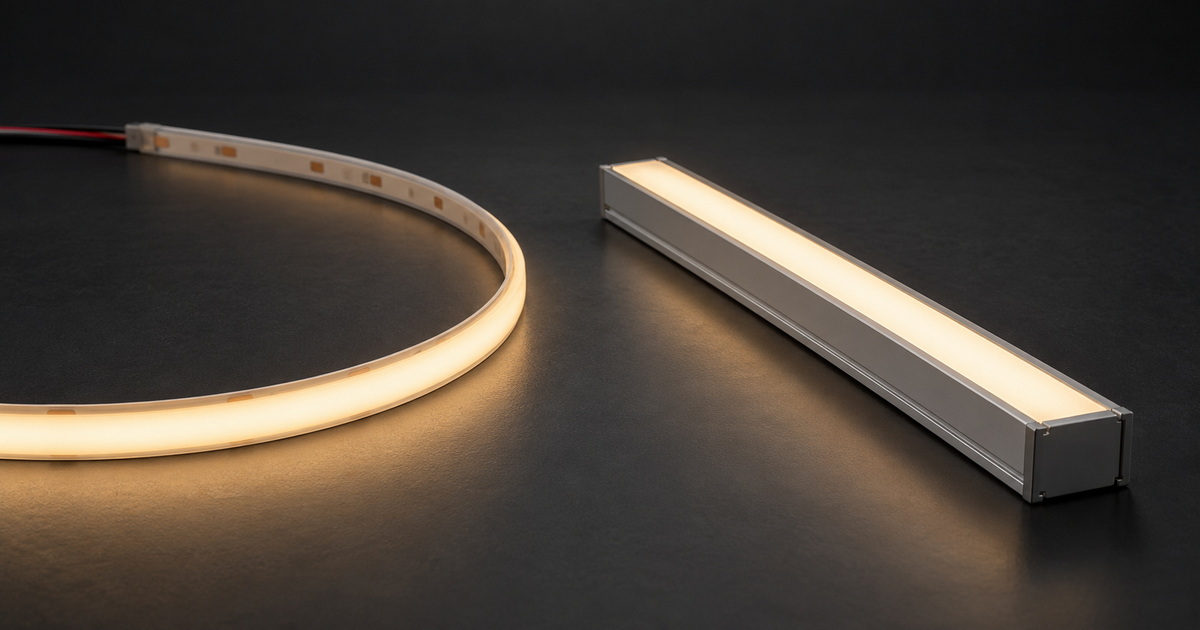
A COB flexible LED strip combines closely arranged LED chips with a flexible circuit board and a continuous phosphor layer. This construction helps create a smooth-looking line of light rather than visibly separated points.
A rigid LED light bar uses a non-flexible structure. Depending on the product, it may be a bare lighting board or a finished fixture with a housing, cover, connectors, and mounting hardware. That distinction matters when comparing installation effort and purchasing costs.
There is also an important category difference: COB describes an LED construction approach, while rigid describes physical structure. These are not opposite technologies. A rigid lighting assembly can also incorporate COB technology.
The practical comparison is therefore between a flexible COB lighting format and a specified rigid lighting assembly—not between two universally standardized products.
| Decision factor | COB flexible LED strip | Rigid LED light bar |
|---|---|---|
| Furniture geometry | Adaptable to permitted bends and custom routes | Suited to straight installation paths |
| Visual appearance | Naturally continuous-looking emission | Depends on LED arrangement and optical cover |
| Installation approach | Usually requires surface preparation and integration | Finished assemblies may simplify mounting |
| Mechanical support | Depends on the mounting arrangement | A finished housing provides structural support |
| Customization | Useful for adapting lighting to furniture details | Useful for repeatable modular assemblies |
| Maintenance | Depends on accessibility and attachment method | Removable assemblies can simplify replacement |
| Purchasing comparison | Include profiles, connections, and assembly | Check what the supplied assembly includes |
COB flexible LED strips are especially attractive when the light source is visible or reflected in a nearby surface. Their closely arranged emitters and phosphor covering help reduce the dotted appearance associated with separated LED packages.
This makes them useful for furniture details where visual continuity matters, including open shelving, recessed wardrobe lighting, and concealed bedroom accents. However, the final appearance still depends on positioning, surrounding materials, and any optical cover.
A rigid LED light bar should not automatically be dismissed as visibly dotted. A well-designed optical cover and appropriate LED arrangement can also produce an even-looking luminous surface.
Similarly, COB construction does not automatically mean better illumination of the furniture interior. A smooth source can still be poorly positioned, produce distracting reflections, or leave important areas in shadow.
Evaluate the illuminated surface as well as the light itself. Light distribution, color appearance, color rendition, and glare all affect the result.
For furniture applications, color quality affects how finishes and objects appear. Wood, fabric, painted panels, and countertop materials should therefore be assessed under the proposed lighting rather than judged from product photographs alone.
Color appearance and color rendition are separate considerations. One describes the apparent tone of the light; the other concerns how illuminated objects appear. Neither is determined simply by choosing flexible or rigid construction.
Flexible strips are useful when the lighting must follow furniture details that do not suit a fixed straight assembly. They can also support customized layouts where the lighting is integrated into a separate profile.
However, flexibility is not permission to fold, twist, or bend the product arbitrarily. Cutting and bending must follow the selected product's instructions. Connections, mounting surfaces, and mechanical support belong in the installation plan—not as decisions left until final assembly.
A separate channel can also provide a more finished installation and accommodate an optical cover.
A finished rigid LED light bar may arrive with its cover, housing, and mounting arrangement already integrated. This can reduce the number of separate installation decisions for repeated cabinet or wardrobe designs.
The limitation is geometric. A straight bar must fit the available furniture opening, including space for connectors, cable exits, mounting hardware, and removal.
Also confirm whether the quotation covers a complete fixture or only a rigid lighting board. Comparing a bare board with a finished flexible-strip assembly creates a misleading cost comparison.
One common comparison claims that rigid bars always last longer because they dissipate heat better. That is too broad.
A metal-backed rigid assembly may provide an effective thermal path. A flexible strip installed correctly in a suitable metal profile can also benefit from heat spreading. Conversely, an enclosed or poorly mounted lighting assembly can struggle regardless of its shape.
The important issue is the complete thermal path: how heat moves away from the LEDs and into the surroundings.
Thermal management strongly affects LED performance and useful life. Excessive operating temperature can accelerate light-output degradation. Consequently, evaluate the intended mounting arrangement and enclosure rather than treating "rigid" as proof of durability.
Neither format is inherently smarter. Door sensors, touch controls, motion detection, and dimming depend on the complete electrical system.
For procurement, the lighting, power supply, controls, connectors, and wiring should be treated as one coordinated assembly.
Flicker also cannot be judged from the lighting format. Driver and dimmer behavior can influence temporal changes in light output, particularly during dimming. Test the proposed combination in its intended operating modes rather than accepting a general "dimmable" description.
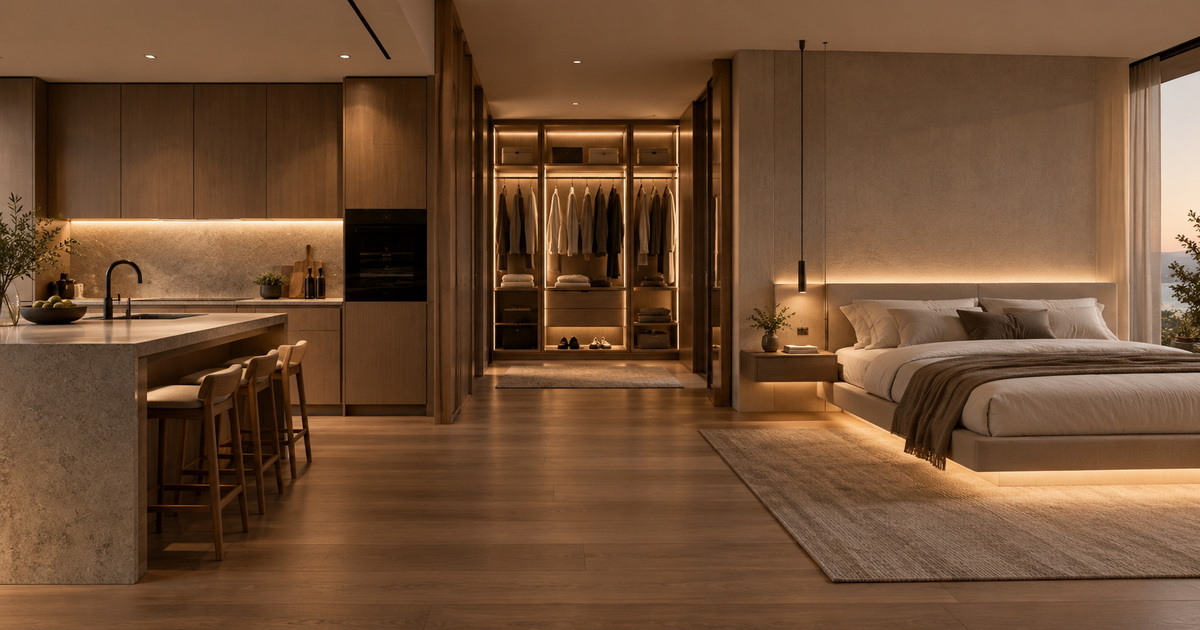
For under-cabinet lighting, either option can work. A flexible COB strip suits a customized concealed channel. A finished rigid bar can suit a straight, repeatable installation.
The decisive question is not just how the installation looks on completion. Consider whether someone can reach the connections and replace the lighting without damaging the cabinetry.
Wardrobe lighting must illuminate stored items rather than merely brighten an empty compartment.
Compare mounting positions with shelves, hanging garments, drawers, and doors in place. Evaluate sensor operation and cable clearance as part of the same mock-up.
Neither a flexible strip nor a rigid housing automatically establishes suitability for a bathroom location.
Request documentation for the intended environment and installation. Check the complete assembly, including connections and power components, rather than relying on the appearance of a protective cover.
Certification scope also matters: a recognized component is not equivalent to a complete product evaluated for field installation.
For bed surrounds and floating-furniture details, flexible COB lighting can support a continuous-looking accent. A recessed rigid assembly may suit straight sections where a protected, removable module is preferred.
In either case, inspect the light from normal seated and lying positions. A concealed installation should remain visually comfortable during actual use.
The purchase price of a strip or bar is only part of the project cost.
Build the comparison around the same scope:
- Lighting assembly.
- Profiles, covers, and mounting hardware.
- Connectors and cable preparation.
- Power supply and controls.
- Installation labor.
- Packaging and transport protection.
- Replacement access and servicing.
A lower component price does not necessarily produce a lower installed cost. A finished assembly may save labor, while a customized strip installation may integrate more effectively into the furniture.
Serviceability is easiest to address before the furniture enters production.
Ask how the lighting will be removed, whether connectors remain accessible, and whether replacement requires dismantling finished panels.
This approach avoids assuming that flexibility means easy repair or that rigidity guarantees modular replacement. Attachment methods and access determine the practical result.

Request documentation that identifies the actual product or assembly being supplied.
Confirm its scope and relevance to the destination market. Do not assume that documentation for one component covers the complete furniture-lighting system.
This distinction is especially important when the buyer combines lighting, controls, wiring, and power components from different sources.
Before placing a production order, use a structured evaluation:
1. Define the application. Identify whether the lighting serves task, display, interior-cabinet, or decorative purposes.
2. Build a representative mock-up. Use the intended furniture finish, mounting arrangement, cover, and controls.
3. Inspect the visual result. Check shadows, reflections, source visibility, and color appearance.
4. Test everyday operation. Include switching, dimming, door movement, and sensor behavior.
5. Review thermal suitability. Ask the supplier to assess the actual installation conditions.
6. Demonstrate servicing. Remove and reconnect the lighting using the intended access route.
7. Record the approved assembly. Keep drawings, component references, and installation instructions together.
This process creates a clearer purchasing specification than selecting solely from photographs or general product descriptions.
Farwise Technology Co., Ltd. brings 16 years of LED-lighting manufacturing experience to commercial and residential furniture applications. Its product offering includes COB LED strips and lighting solutions for cabinets, wardrobes, bathroom vanities, and bedroom furniture.
Through OEM/ODM cooperation, projects can be developed around customized dimensions, functions, appearance, and system requirements.
For buyers, the most useful starting point is a furniture drawing and an application brief—not simply a request for the lowest-priced strip or bar. The goal should be a lighting assembly that fits the furniture, supports practical installation, and remains serviceable.
Send Farwise your cabinet, wardrobe, vanity, or bedroom-furniture drawings, together with your lighting goals and customization requirements. Request a project-specific comparison of flexible COB and rigid-bar solutions, supported by samples and a clearly defined assembly scope.
Make integration the deciding factor: choose the lighting that works best within the complete furniture system.
Neither is universally better. Flexible COB strips favor adaptable layouts and continuous-looking illumination. Finished rigid bars favor straight, structured assemblies. The furniture design and supplied construction determine which is more suitable.
Yes. Their appearance depends on the LED arrangement, optical cover, and installation. COB is not the only route to an even-looking light source. Evaluate the finished sample rather than judging by the format name.
No. Useful life depends on construction, operating conditions, and thermal management. Rigidity alone does not establish a service-life advantage.
That depends on the product instructions and application. A channel may contribute mounting support, thermal management, and a finished appearance. Do not assume that adhesive backing alone resolves every installation requirement.
They can be, but compatibility must be established for the complete system. Confirm the proposed driver, controller, and lighting combination, and test dimming behavior before approving production.
Provide furniture drawings, installation locations, finish preferences, intended controls, destination market, and service-access requirements. Ask the manufacturer to identify exactly what is included in the proposed lighting assembly.
1. - Super Bright LEDs — [The Difference Between LED Strip Lights and Linear Light Bars]. Industry explanation of flexible strips, COB construction, rigid fixtures, channels, and installation differences.
2. - ENERGY STAR — [Learn About LED Lighting]. Technical background on heat management and LED light-output maintenance.
3. - U.S. Department of Energy — [LED Basics]. Background on LED operation and light quality.
4. - U.S. Department of Energy — [Lighting Specification Guidance for Schools]. General lighting-quality principles, including distribution, color, glare, and flicker; not a furniture-specific standard.
5. - U.S. Department of Energy — [Flicker Research]. Explanation of temporal light modulation and driver/dimmer considerations.
6. - UL Solutions — [Lighting Standards and Certification]. Explanation of lighting evaluation and the distinction between complete products and recognized components.
7. - Farwise Technology Co., Ltd. — Company background supplied for this article. Source of the company-history, product-scope, application, and OEM/ODM statements; not independently verified.


