
Views: 222 Author: Farwise Lighting Publish Time: 2026-09-21 Origin: Site


Content Menu
● What "Radiation" Means in LED Lighting
● Do White LED Lights Emit UV Rays?
>> Standard LED Lights vs. UV LEDs
● Why Some People Think LEDs Produce UV
● What About Blue Light From LEDs?
● LED Lighting Safety in Cabinets and Wardrobes
● How to Choose Low-UV LED Furniture Lighting
>> A Practical Buyer Checklist
● Common Myths About LED UV and Radiation
>> Myth 1: All LEDs emit dangerous UV radiation
>> Myth 2: White LED light is the same as sunlight
>> Myth 3: Any "radiation" from an LED is dangerous
>> Myth 4: Blue light and UV light are identical
>> Myth 5: A brighter LED is always unsafe
● Professional Advice for Safer LED Use
● Build Better Furniture Lighting Systems
● FAQ
>> 1.Do LED lights give off UV rays?
>> 2.Can LED cabinet lights damage skin?
>> 3.Are LED lights safer than fluorescent lights for UV exposure?
>> 4.Is blue light from LED wardrobe lighting harmful?
>> 5.Do LED lights emit harmful electromagnetic radiation?
>> 6.Can LED silicone strip lights be used in furniture safely?
>> 7.Should I worry about UV from bathroom cabinet lights?
Most everyday LED lights used in homes, cabinets, wardrobes, bathrooms, and commercial interiors do not emit a meaningful amount of ultraviolet radiation under normal operating conditions. Their visible light is non-ionizing, meaning it does not have the same cell-damaging mechanism as X-rays or gamma rays.
That said, "LED light" is a broad category. A standard white LED cabinet light is very different from a UV curing lamp, a germicidal UVC device, a tanning lamp, or a high-intensity specialty fixture. The safest purchasing approach is to choose a professionally designed lighting system, use it as intended, and avoid staring directly into bright exposed LED points at close range.

For ordinary household and furniture lighting, LED lamps are widely considered a low-UV lighting choice. Most white LEDs produce light through a blue LED chip combined with phosphor materials that convert part of that energy into broader visible white light. This is different from fluorescent lamps, which generate ultraviolet energy inside the tube and then use a phosphor coating to convert it into visible light.
The U.S. Department of Energy describes LEDs used in general illumination as having no ultraviolet or infrared emissions in their typical applications. In practical terms, a properly made LED strip light, under-cabinet light, wardrobe light, or bathroom cabinet light is not designed to function as a UV source.
However, the word "radiation" often causes unnecessary concern because it includes many different forms of energy. Visible light, radio waves, infrared heat, UV, X-rays, and gamma rays are all forms of electromagnetic radiation—but they do not carry the same risks.
For normal LED furniture lighting, the more relevant questions are:
- Is the light source designed for indoor general illumination?
- Is the fixture properly assembled and electrically safe?
- Is the LED point source shielded or diffused?
- Is the installation positioned to avoid direct glare?
- Is the driver or power supply matched correctly to the lighting system?
For cabinet manufacturers, designers, contractors, and furniture brands, the answer is not simply "LED is safe." The better answer is: a professionally specified LED lighting system is safe when the source, optical structure, driver, wiring, installation environment, and intended user behavior are considered together.
Radiation is energy that travels through space as waves or particles. In lighting discussions, the term usually refers to electromagnetic radiation.
The electromagnetic spectrum includes:
| Type of Energy | Common Example | Main Concern in Normal Lighting Use |
|---|---|---|
| Radio waves | Wi-Fi, broadcasting | Not part of the visible-light output discussion |
| Infrared | Heat lamps, remote controls | Heat exposure in high-output sources |
| Visible light | LED lamps, sunlight | Brightness, glare, visual comfort |
| Ultraviolet | Sunlight, tanning lamps, germicidal lamps | Skin and eye exposure |
| X-rays and gamma rays | Medical imaging, nuclear processes | Ionizing-radiation exposure |
Visible light from a standard LED fixture is non-ionizing radiation. Unlike X-rays and gamma rays, visible LED light does not have enough energy to ionize atoms or directly damage DNA through ionization.
This distinction matters because online discussions frequently group all "radiation" into one alarming category. That creates confusion between normal visible-light exposure and genuinely hazardous sources such as UVC disinfection devices, tanning lamps, or ionizing medical equipment.
A standard furniture light can still be uncomfortable if it is excessively bright, poorly positioned, flickers, or produces glare. But discomfort is not the same as ionizing-radiation exposure.
Most conventional white LEDs for residential and commercial lighting emit little to no UV radiation of concern during normal use. White LED light is commonly created by combining a blue LED with a phosphor layer, or by mixing multiple visible-color LEDs to create white light.
This is why LED technology is frequently selected for applications where lower UV exposure is desirable, including:
- Cabinet interiors
- Wardrobe lighting
- Bathroom cabinet lighting
- Retail display lighting
- Artwork illumination
- Hotel furniture lighting
- Residential kitchens
- Decorative wall and ceiling systems
Compared with some older lighting technologies, LED systems can reduce concerns related to ultraviolet-related fading of sensitive materials. This can be useful when illuminating wood veneers, textiles, printed surfaces, decorative panels, soft furnishings, and color-sensitive finishes.
Still, product design matters. Specialty LEDs can intentionally emit ultraviolet light for specific industrial, medical, cosmetic, curing, inspection, or sterilization purposes. These products should never be treated as ordinary interior lighting.
| Lighting Type | Typical Purpose | UV Exposure Consideration |
|---|---|---|
| White LED strip light | Cabinets, shelves, furniture, general interiors | Generally low UV concern in normal use |
| LED cabinet light | Task lighting and furniture illumination | Generally low UV concern in normal use |
| LED wardrobe light | Closet visibility and convenience | Generally low UV concern in normal use |
| UV nail lamp | Nail-product curing | Purpose-built UV exposure source |
| UVC germicidal lamp | Disinfection | Requires strict safety controls |
| Tanning lamp | Cosmetic tanning | Delivers intentional UV exposure |
| Fluorescent lamp | General lighting | Produces UV internally, usually managed by lamp construction |
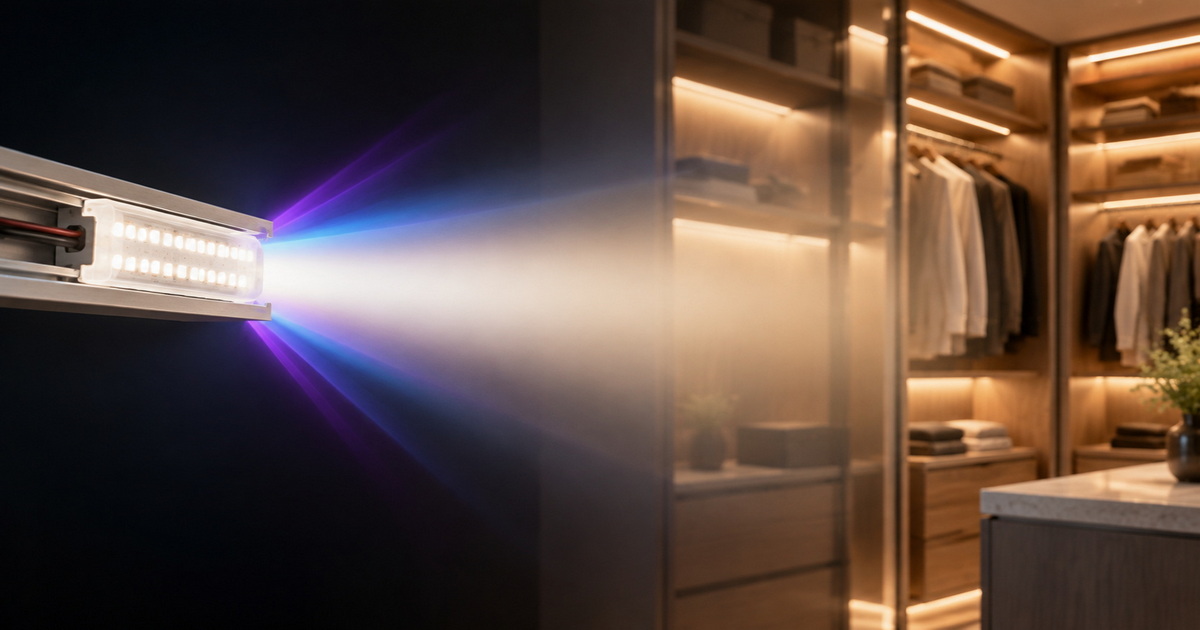
The concern often comes from three understandable sources.
First, sunlight contains UV radiation, and sunlight is also visible light. People may incorrectly assume that all visible white light contains a similar UV profile.
Second, fluorescent lamps use a process involving UV energy inside the lamp. In a fluorescent lamp, electricity excites gas in the tube, producing UV energy that activates the phosphor coating and creates visible light.
Third, some LEDs are specifically engineered to emit UV wavelengths. UV LEDs exist for curing, inspection, scientific instruments, disinfection equipment, printing, beauty devices, and other specialized uses.
But this does not mean a regular LED cabinet light is a UV lamp.
An everyday white LED fixture should be evaluated as an interior lighting product. A UVC sterilization device should be evaluated as a specialized optical-radiation device with very different exposure controls.
Blue light is visible light, not ultraviolet radiation. It occupies a different part of the spectrum and should not be confused with UVA, UVB, or UVC.
Blue light discussions are most relevant when a person looks directly at a bright, concentrated source for extended periods. In normal indoor settings, visual comfort depends on many factors:
- Source brightness
- Viewing distance
- Beam direction
- Diffuser quality
- Installation height
- Surface reflectivity
- Color temperature
- Duration of direct viewing
- Individual eye sensitivity
The European Commission's scientific review notes that the possible impact of LED optical radiation depends on spectrum, intensity, exposure duration, viewing angle, and individual eye health. It also states that exposure from LEDs is likely insignificant compared with natural outdoor light exposure.
Research reviews likewise report no evidence that LED lamps used at typical household intensity levels are retinotoxic under normal use. However, it remains sensible to avoid staring directly into an intense, exposed LED source—especially at close distance.
For furniture lighting, this leads to a practical design principle: use diffused, indirect, concealed, or properly shielded lighting whenever possible.
For example:
- Install LED silicone strip lights behind a diffuser or inside a recessed channel.
- Position wardrobe lighting so the source is not directly in the user's line of sight.
- Use cabinet lights with controlled beam direction rather than exposed high-brightness LED points.
- Place bathroom cabinet lighting to reduce harsh reflections in mirrors.
- Select a suitable driver and dimming method for consistent, comfortable operation.
Good optical design protects comfort while also improving the perceived quality of the furniture or interior.
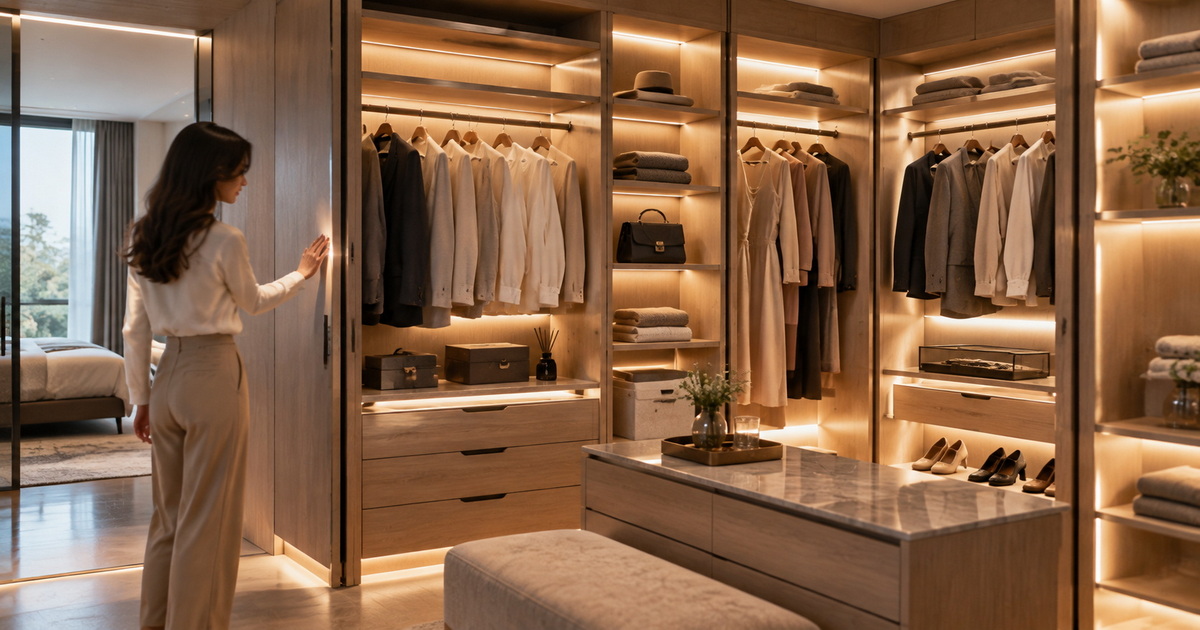
Furniture lighting presents unique design conditions. The light source is often installed in a small, enclosed, reflective, or user-facing area. A wardrobe light may activate at close range. A cabinet light may shine onto glossy worktops. A bathroom cabinet fixture may be reflected directly by a mirror.
For these reasons, the lighting supplier should consider more than brightness alone.
Use the right light distribution. A directional source should illuminate the intended work surface, shelf, drawer, hanging rail, or interior compartment without causing direct glare.
Use diffusion where appropriate. LED silicone strip lights and diffused linear fixtures can create a softer continuous light line, helping avoid visible LED dots and harsh shadows.
Match the power supply correctly. LED power supplies should be selected for the lighting load, operating environment, dimming requirements, and installation method. An incorrectly matched driver can cause instability, reduced service life, poor dimming behavior, or excess heat.
Protect electrical connections. Cabinet and wardrobe lighting often includes concealed wiring, sensors, switches, connectors, and drivers. Reliable assembly and secure connections are essential for long-term use.
Consider moisture exposure. Bathroom cabinet lighting requires particular attention to the fixture location, installation zone, sealing approach, and exposure to water vapor or splashes.
Plan for maintenance. A lighting design should allow installers and end users to access key components when servicing is needed. A beautifully concealed system that cannot be maintained can become an expensive problem.
At Farwise Technology Co., Ltd., our approach to furniture lighting is based on system compatibility rather than isolated components. LED silicone strip lights, cabinet lights, wardrobe lights, bathroom cabinet lights, and LED power supplies should work together as one practical lighting solution.
When sourcing LED lighting for furniture projects, do not rely only on a supplier's product photos or general safety claims. Ask structured questions before you specify the solution.
1. Confirm the intended application
Identify whether the product is for cabinets, wardrobes, bathroom cabinets, bedrooms, display furniture, retail fixtures, or another interior environment.
2. Clarify the light source type
Confirm that the product is a standard visible-light LED product rather than a UV, UVC, curing, tanning, or specialty optical source.
3. Ask about optical design
Determine whether the LED is diffused, recessed, shielded, directional, or exposed. This helps predict glare and visual comfort.
4. Review the system components
Check compatibility among the light, sensor, dimmer, connector, cable, control method, and LED power supply.
5. Evaluate customization needs
For OEM and ODM projects, confirm whether dimensions, cable length, installation method, switching function, housing appearance, and packaging can be adapted.
6. Check the installation environment
Consider heat, moisture, dust, surface material, enclosure space, and whether the project requires concealed wiring or quick-connect installation.
7. Request product documentation
A serious supplier should be able to provide relevant product information, quality-control processes, and application guidance for the selected solution.
This process is especially important for furniture brands, cabinet factories, interior contractors, and importers managing repeat orders across multiple markets.
False. Standard indoor white LED lighting is generally not designed as a UV source. General-illumination LEDs are commonly used because they offer low UV and infrared output compared with many traditional light technologies.
False. Both are visible light sources, but their spectra, intensity, directionality, and exposure conditions are very different. Outdoor sunlight remains the primary everyday source of UV exposure. The CDC identifies the sun, tanning beds, germicidal lamps, and certain other artificial sources as UV sources.
False. Visible light is electromagnetic radiation, but standard LED visible light is non-ionizing. The risk profile is not comparable to X-rays or gamma rays.
False. Blue light is visible. UV lies beyond the violet end of visible light. Both can be relevant in specific high-intensity or prolonged-exposure conditions, but they are not interchangeable terms.
Not necessarily. Brightness alone does not determine safety. Fixture design, shielding, mounting position, viewing angle, exposure duration, and intended use all matter.
For everyday residential or commercial interiors, follow these practical habits:
- Choose LED fixtures from experienced manufacturers with stable quality-control processes.
- Use LED lights only for their intended purpose.
- Avoid looking directly into exposed high-brightness LED chips.
- Prefer diffused or concealed light sources in furniture and mirror applications.
- Use compatible LED drivers and controls.
- Keep electrical components away from unsuitable moisture exposure.
- Do not use UVC or UV disinfection equipment in occupied spaces unless the system is specifically designed, installed, and controlled for that purpose.
- Replace damaged fixtures, loose cables, cracked housings, or malfunctioning power supplies promptly.
Ultraviolet radiation from sunlight and tanning devices is a recognized health concern. The American Cancer Society notes that UV radiation from the sun and artificial sources can damage skin cells and increase skin-cancer risk, while tanning devices are classified as carcinogenic to humans.
That is precisely why buyers should distinguish between a normal LED wardrobe light and an intentional UV-emitting device. They are not interchangeable products and should not be evaluated by the same assumptions.
The best LED lighting projects combine visual comfort, functional illumination, dependable components, and flexible installation. For cabinet, wardrobe, bathroom cabinet, bedroom, and full-home furnishing applications, a complete system is often more reliable than sourcing individual parts without compatibility planning.
Farwise Technology Co., Ltd. has focused on LED lighting manufacturing for 16 years, providing integrated furniture-lighting solutions that include LED silicone strip lights, LED cabinet lights, LED wardrobe lights, LED bathroom cabinet lights, and LED power supplies.
We support OEM and ODM projects with customization for dimensions, functions, installation concepts, appearance, and complete lighting configurations. Whether you are developing a new furniture collection, upgrading an existing cabinet-lighting range, or sourcing a complete lighting solution for an interior project, choosing the right supplier early can reduce installation issues and improve the final user experience.
Contact Farwise Technology Co., Ltd. to discuss a customized LED furniture-lighting solution for your cabinet, wardrobe, bathroom cabinet, or whole-house lighting project.
Most normal white LED lights used for homes, cabinets, wardrobes, and commercial interiors emit little to no UV radiation of concern in ordinary use. Specialty UV LEDs are different products designed for specific functions such as curing, inspection, or disinfection.
Standard LED cabinet lights are not intended to expose users to hazardous UV output. For normal indoor lighting use, the larger practical concerns are glare, installation quality, electrical compatibility, and choosing an appropriate fixture for the application.
LEDs are generally considered a lower-UV option for ordinary lighting applications. Fluorescent technology generates ultraviolet energy inside the lamp as part of its operating process, while common white LEDs use visible-light semiconductor and phosphor-conversion approaches.
Blue light is visible light, not UV. Normal use of domestic LED lighting has not been shown to cause retinal damage, but users should avoid staring directly at intense, exposed LED sources for long periods. Diffused and well-positioned wardrobe lighting improves comfort.
LED fixtures involve electrical and electromagnetic fields like other powered devices, but their visible-light output is non-ionizing. Standard indoor LED lighting should not be confused with ionizing sources such as X-rays or gamma rays.
Yes, when the strip light, diffuser, wiring, connectors, controls, and LED power supply are correctly matched and installed for the intended furniture environment. For enclosed cabinets, wardrobes, and moisture-prone bathroom areas, system design and installation quality are particularly important.
A standard visible-light LED bathroom cabinet light is not a UV tanning or germicidal device. Focus instead on selecting an appropriate fixture design, glare control, safe electrical installation, and protection suitable for the moisture conditions of the location.
1. U.S. Department of Energy, "[LED Basics]" — Overview of LED operation and general lighting characteristics. [energy]
2. ENERGY STAR, "[Learn About LED Lighting]" — Explanation of white LED phosphor conversion and fluorescent-light UV production. [energystar]
3. Centers for Disease Control and Prevention, "[Ultraviolet Radiation]" — UV sources, benefits, and health risks. [cdc]
4. U.S. Food and Drug Administration, "[IEC 62471: Photobiological Safety of Lamps and Lamp Systems]" — Standard scope for evaluating optical-radiation hazards from lamps and LEDs. [accessdata.fda]
5. European Commission Scientific Committee on Health, Environmental and Emerging Risks, "[Are LED Lights Safe for Human Health?]" — Summary of factors affecting LED optical-radiation exposure and health considerations. [health.ec.europa]
6. American Cancer Society, "[Does UV Radiation Cause Cancer?]" — UV exposure, tanning devices, and cancer-risk information. [cancer]
7. Cougnard-Gregoire et al., "[Blue Light Exposure: Ocular Hazards and Prevention]" — Review of evidence on blue-light exposure and domestic LED use. [pmc.ncbi.nlm.nih]


