
Views: 222 Author: Farwise Lighting Publish Time: 2026-09-18 Origin: Site


Content Menu
● Why Architectural Facade Lighting Uses More Energy Than Expected
● Architectural Facade Lighting and Energy Saving: A Practical Comparison
● Start With a Facade Lighting Audit
>> Review the Architecture Before Selecting Fixtures
>> Define Lighting Layers Instead of Lighting Everything
● Use Targeted Light Instead of Excessive Brightness
>> Improve Beam Direction and Fixture Position
>> Design With Contrast, Not Uniformity
● Choose LED Systems for Control and Integration
>> Consider System Compatibility From the Beginning
● Use Smart Controls to Reduce Operating Hours
>> Build a Multi-Stage Lighting Schedule
>> Combine Different Control Types
● Match Lighting to Building Use
>> Hotels and Hospitality Buildings
>> Retail and Commercial Buildings
>> Cultural and Landmark Buildings
● Avoid These Common Energy-Wasting Mistakes
● Commissioning Turns a Design Into a Working System
● Plan for Long-Term Maintenance and Upgrades
● Build a Better Facade Lighting Brief
● Create a More Efficient Lighting Project
● FAQ
>> 1.What is the most effective energy-saving strategy for facade lighting?
>> 2.Can architectural facade lighting remain visually impressive at lower output?
>> 3.Why are lighting controls important for facade projects?
>> 4.How can glare be reduced in architectural facade lighting?
>> 5.What should be included in an architectural facade lighting specification?
>> 6.Can LED silicone strip lights be used in architectural lighting details?
>> 7.How does an OEM or ODM lighting manufacturer support a facade project?
>> 8.When should facade lighting be dimmed or switched off?
Architectural facade lighting can turn a building into a recognizable nighttime landmark, reinforce a brand image, and improve the experience of an entrance, plaza, hotel frontage, retail destination, or mixed-use development. Yet a visually impressive facade does not need to operate at maximum output throughout every hour of darkness. The most effective energy saving strategies for architectural facade lighting projects combine purposeful lighting design, efficient LED systems, intelligent controls, precise installation, and long-term operational planning.
From a lighting-manufacturing perspective, the central challenge is not simply choosing an LED fixture. It is balancing two connected priorities: architectural facade lighting quality and energy-saving performance. A project succeeds when it reveals the building's materials, geometry, and identity while avoiding unnecessary light, glare, wasted operating hours, and difficult maintenance.
For project designers, contractors, developers, and lighting brands, this article explains how to reduce energy consumption without weakening visual impact. It also outlines practical methods for specifying scalable, controllable, and application-ready lighting systems for modern facades.

Facade lighting is often treated as a decorative finishing element. In reality, it is an operational lighting system with daily scheduling, seasonal changes, environmental exposure, driver compatibility, maintenance requirements, and local light-pollution considerations.
The largest energy losses rarely come from one single mistake. They usually result from several small decisions made early in the project:
- Lighting more wall area than the design actually requires
- Selecting fixtures based on appearance rather than optical control
- Leaving facade lighting at full output all night
- Using one lighting mode for weekdays, weekends, holidays, and late-night periods
- Failing to separate lighting zones
- Overlooking reflected light from glossy stone, glass, metal, or light-colored finishes
- Installing systems without a commissioning and re-aiming plan
- Selecting incompatible drivers, controls, or dimming methods
In our experience with customized LED lighting solutions, a facade project becomes more energy-efficient when the lighting plan starts with a clear question: What should the viewer notice first?
A historic entrance may need warm, focused accents. A hotel facade may need a calm vertical rhythm. A retail building may require stronger emphasis during business hours but reduced output after closing. A large commercial exterior may benefit from multiple controlled zones rather than a single all-on circuit.
The goal is not to make every surface equally bright. The goal is to make the architecture readable, attractive, and useful after dark.
Architectural facade lighting focuses on visual storytelling. Energy-saving planning focuses on delivering that story with the least unnecessary electricity, maintenance burden, and light spill. These priorities should work together rather than compete.
| Project Focus | Traditional Approach | Energy-Conscious Approach |
|---|---|---|
| Design intent | Illuminate as much of the facade as possible | Illuminate the most meaningful architectural features |
| Fixture placement | Use broad coverage with limited aiming review | Use targeted placement and deliberate beam direction |
| Operating schedule | Keep lighting on from dusk until morning | Use sunset activation, timed scenes, dimming, and curfews |
| Brightness strategy | Apply one output level across the building | Use layered output levels based on time and activity |
| Visual effect | Depend on quantity of fixtures | Depend on contrast, shadow, texture, and controlled highlights |
| Controls | Manual switching or simple on/off operation | Integrate photocells, timers, dimming, sensors, and centralized control |
| Maintenance planning | Repair fixtures after failure | Build accessible zones, service plans, and replaceable components into the design |
| Environmental impact | Accept glare and upward spill as unavoidable | Aim, shield, dim, and schedule lighting to minimize wasted light |
The difference is significant. A building can look brighter with fewer fixtures when the light is properly aimed and when surface reflectance, viewing distance, facade depth, and visual hierarchy are considered.
For example, a textured stone elevation may need grazing light to reveal depth. A flat glass curtain wall may need a restrained edge-lighting concept rather than direct floodlighting. Applying the same lighting technique to both surfaces can create poor visual results and waste energy at the same time.
Before selecting LED facade lights, conduct a site and design audit. This step helps prevent overspecification and reduces expensive changes during installation.
Study the building during the day and at night. Pay attention to what will affect light distribution and visual perception.
Key review points include:
- Facade materials, colors, and reflectivity
- Building height and viewing distance
- Recesses, columns, fins, canopies, louvers, and signage
- Main pedestrian and vehicle viewing angles
- Neighboring residences, roads, green spaces, and public areas
- Existing exterior lighting and ambient light levels
- Electrical access and cable-routing conditions
- Cleaning access and future maintenance limitations
A dark brick facade absorbs light differently from pale stone. Brushed metal creates different reflections than matte aluminum. Glass can mirror surrounding light sources and create visual clutter. These conditions influence where fixtures should be installed and how much light is genuinely needed.
A well-designed architectural facade lighting project often uses several layers:
- Primary lighting identifies the building's main silhouette, entrance, or signature feature.
- Secondary lighting supports vertical lines, facade textures, canopies, columns, or landscape transitions.
- Accent lighting draws attention to selected details, signs, artwork, or special materials.
- Functional lighting improves wayfinding, accessibility, safety, and entry visibility.
- Late-night lighting preserves a limited identity after business hours at a lower level.
This layered approach is more flexible than operating all facade fixtures in the same way. It also makes dimming and scheduling easier because each zone has a specific purpose.
One of the strongest energy-saving strategies for architectural facade lighting projects is better optical control. Light should reach the intended facade feature rather than surrounding windows, sky, landscaping, neighboring properties, or traffic areas.
Responsible outdoor-lighting guidance emphasizes five principles: lighting should be useful, targeted, no brighter than necessary, controlled by time or activity, and warmer in color where appropriate. These principles support lower energy use while reducing glare, unnecessary spill, and disturbance to nearby environments.
Fixture position has a direct effect on both appearance and energy use. Moving a luminaire closer to the design target, adjusting its aiming angle, or using a more suitable beam pattern can improve visible results without simply increasing output.
Consider these practical actions:
1. Aim fixtures at architectural features, not at general wall areas.
2. Use shielding where light could spill above rooflines or toward windows.
3. Avoid placing fixtures where trees, signage, or future construction may block light.
4. Create test scenes before final installation across the full facade.
5. Check the facade from the same viewpoints used by pedestrians, drivers, guests, and nearby residents.
6. Re-aim fixtures after installation rather than assuming initial alignment is final.
A common oversight is that fixtures are installed and energized but never properly commissioned after dark. Small aiming adjustments can substantially change the visual result, making a building look more refined while reducing the need for additional fixtures.
Uniform brightness can make architectural lighting look flat. Controlled contrast gives the facade depth. Shadow can be as valuable as illumination.
For instance, a hotel entrance may use a brighter focal zone at the porte-cochère, softer vertical lighting along the main facade, and minimal lighting on less important side elevations. This creates a clear visual sequence for arriving guests and reduces unnecessary overnight operation.
The best energy-saving facade lighting is often not the dimmest system. It is the system that makes intentional use of contrast.
LED technology is now the foundation for most modern architectural facade lighting because it offers efficient operation, compact design possibilities, directional output, color consistency options, and compatibility with advanced controls. The U.S. Department of Energy notes that LED exterior luminaires can increase energy and operating-cost savings when paired with networked controls that adapt lighting to environmental conditions and real-time activity.
For projects requiring custom integration, OEM and ODM capabilities can be especially valuable. Rather than forcing a standard fixture into a complex facade, a manufacturer can help align the product solution with installation constraints, housing details, cable routing, mounting methods, control requirements, and visual objectives.
Energy performance depends on the complete lighting system, not only the light source. A well-integrated system includes:
- LED lighting fixtures or flexible linear lighting
- Compatible LED power supplies
- Dimming and control interfaces
- Electrical protection and cable-management planning
- Mounting accessories
- Zoning logic
- Maintenance access
- Clear commissioning instructions
For facade details that need continuous lines of light, flexible LED silicone strip lights can be considered where the design calls for curved profiles, narrow architectural recesses, or indirect lighting effects. For interior-to-exterior design continuity, cabinet lights, wardrobe lights, and customized linear lighting can support coordinated lighting language in entrances, display areas, hospitality interiors, and residential amenity spaces.
Farwise Technology Co., Ltd. supports OEM and ODM customization for varying project and market requirements, making it possible to develop more integrated lighting solutions around size, appearance, function, and application needs.
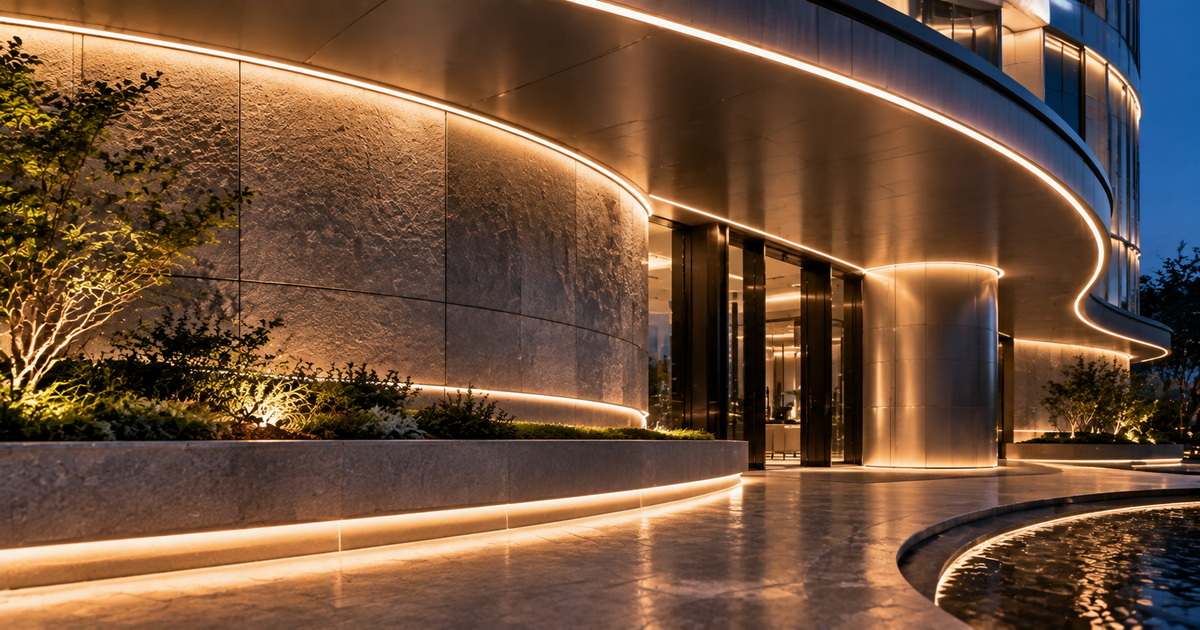
Efficient fixtures matter, but operating time often determines the real energy outcome. A well-designed control strategy ensures facade lighting operates only when it supports safety, commerce, guest experience, architectural identity, or scheduled events.
U.S. Department of Energy exterior-lighting guidance states that automatic controls can reduce energy costs in exterior and parking lighting applications by up to 30% to 75%, depending on the strategy and application. It specifically recommends automatic scheduling for landscape and building-facade lighting after hours.
Instead of one fixed nightly program, divide the operation into useful phases.
| Time Period | Recommended Lighting Strategy | Main Objective |
|---|---|---|
| Daylight hours | Lighting off | Avoid daytime energy waste |
| Sunset to evening peak | Full architectural scene | Support visual identity and active public use |
| Evening business hours | Moderate scene with key highlights | Maintain presence while reducing consumption |
| Late night | Reduced-output scene or selected feature lighting | Preserve identity with lower operating demand |
| Closed or low-activity hours | Lighting off except for necessary functional zones | Eliminate nonessential operation |
| Special events | Temporary programmed scene | Deliver impact only when required |
This approach supports better energy management without making a property appear closed, unsafe, or visually neglected.
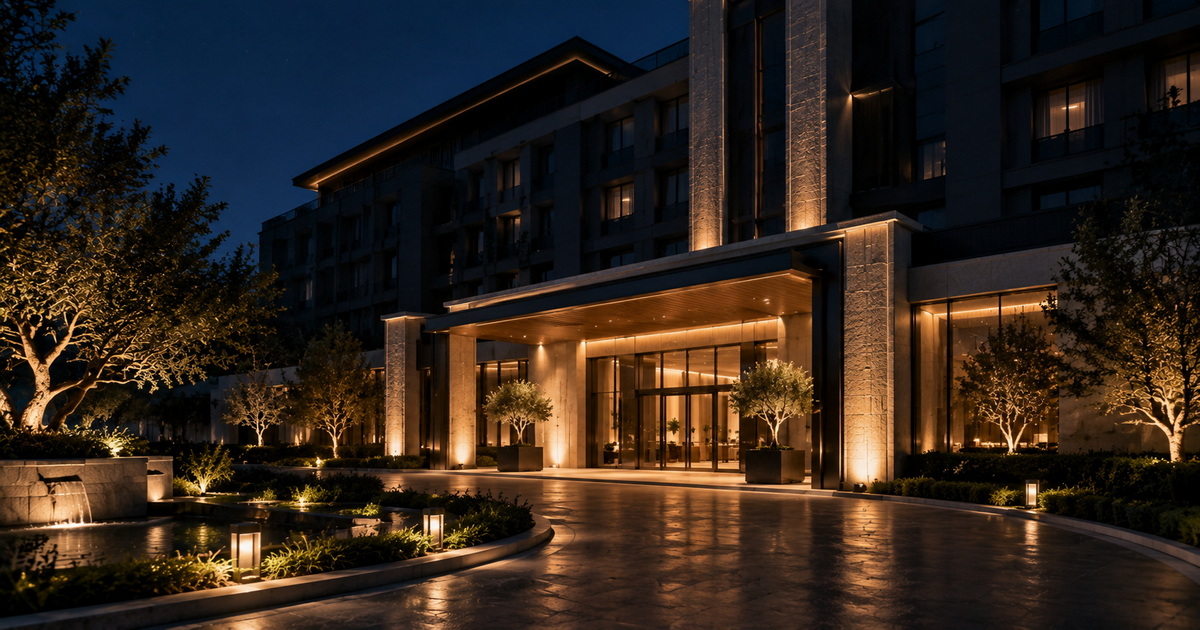
The most useful control methods often work together:
- Photocells prevent operation during daylight.
- Astronomical timers adjust schedules according to changing sunrise and sunset times.
- Time clocks establish business-hour and late-night programs.
- Dimmers lower output during low-traffic periods.
- Motion or occupancy sensors can activate limited functional lighting near service entries, paths, or access points.
- Centralized controls allow facilities teams to monitor, update, and override schedules when needed.
- Scene controllers enable visual changes for holidays, campaigns, and events without permanently increasing energy use.
A basic control system can already deliver substantial improvements. A more advanced connected system adds the ability to monitor performance, identify faults, coordinate multiple zones, and refine schedules using actual building activity.
Facade lighting should reflect how the property is used. The same strategy will not suit every project.
Hotels often need a welcoming arrival experience and a recognizable nighttime image. The entrance, drop-off area, landscape transitions, and key architectural elements deserve the strongest visual attention.
An energy-conscious plan can reduce output on upper floors, side elevations, and low-visibility zones later at night while keeping the entry sequence clear and elegant.
Retail projects benefit from stronger lighting while stores are open and customers are arriving or leaving. After closing, the facade can transition to a simpler identity scene that preserves brand presence without using the same level of lighting.
Lighting zones around window displays, entrances, signage, and pedestrian circulation should be independently controlled.
Residential facade lighting requires more restraint. Occupants need comfort, privacy, safe circulation, and low glare. Excessive light near bedrooms or balconies can create complaints and may undermine the premium feel of the development.
Warm, shielded, low-level lighting with reliable late-night dimming is generally more appropriate than dramatic high-output floodlighting.
Museums, civic buildings, heritage sites, and landmark properties may require detailed lighting scenes that reveal historic materials and architectural features. However, these projects also benefit from scheduled operating windows and careful aiming to protect the surrounding nighttime environment.
Many facade lighting projects underperform because the specification focuses on a dramatic rendering rather than how the system will be used for years.
Avoid the following mistakes:
- Treating decorative lighting as a permanent full-output requirement
- Designing without night-time mockups or on-site aiming checks
- Ignoring building material reflectance
- Failing to separate functional and decorative lighting circuits
- Installing unshielded fixtures near windows or property boundaries
- Selecting a control system that facilities staff cannot easily operate
- Using incompatible LED power supplies and dimming components
- Forgetting access requirements for cleaning, adjustment, and replacement
- Designing only for opening night rather than normal daily operations
- Allowing exterior lighting to remain on after the building no longer needs it
A visually successful project should be easy to manage. If the control system is overly complicated, the building team may bypass it and return to all-night operation. Simplicity, clear zones, and documented scene settings are essential.
Commissioning is one of the most overlooked steps in architectural facade lighting. It is the process of verifying that fixtures, drivers, controls, timers, dimming scenes, and aiming positions all perform as intended.
A professional commissioning process should include:
1. Confirming that each lighting zone corresponds to the approved design intent.
2. Checking photocell and timer settings.
3. Verifying dimming levels for evening and late-night scenes.
4. Reviewing fixture aiming from key public viewpoints.
5. Checking for glare, unwanted spill, and reflected light.
6. Testing control overrides for maintenance and special events.
7. Labeling circuits, drivers, control zones, and service points.
8. Providing the facility team with an operating schedule and maintenance guide.
The Department of Energy notes that exterior lighting controls can offer high savings potential, but proper commissioning is essential to achieving those results.
Commissioning also protects the project's visual quality. It enables designers and owners to see how the building behaves at different times, rather than evaluating the installation only at initial full output.
Energy-saving facade lighting is not a one-time purchasing decision. It is a long-term operational strategy.
A maintainable system reduces the likelihood that failed components will be replaced with mismatched alternatives or that controls will be disabled because troubleshooting is too difficult. During project planning, consider service access, component identification, spare-part planning, cable protection, driver locations, and control documentation.
For customized projects, a manufacturer should be involved early enough to address real installation conditions. This is especially important for linear lighting details, concealed channels, curved facade edges, waterproof connections, and projects that require coordinated indoor and outdoor lighting elements.
Farwise Technology Co., Ltd. develops and supplies LED lighting solutions for cabinet, wardrobe, bathroom cabinet, bedroom, commercial, and customized lighting applications, with OEM and ODM support for design, function, dimensions, and appearance. This experience in system-oriented lighting development can help project teams align lighting components with installation needs rather than treating each product as an isolated item.
Before contacting a lighting supplier or manufacturer, prepare a concise project brief. It will improve quotation accuracy, reduce revisions, and help the technical team recommend a more effective solution.
Include the following information:
- Building type and project location
- Facade drawings, elevations, photographs, or renderings
- Key architectural features to highlight
- Preferred visual mood and color appearance
- Required operating schedule
- Installation locations and mounting conditions
- Desired control method
- Power and cable-routing limitations
- Environmental exposure conditions
- Target completion date
- Customization needs for dimensions, finish, function, packaging, or accessories
A strong brief allows the lighting supplier to recommend a system that is visually appropriate, energy-conscious, practical to install, and easier to maintain.
The most successful architectural facade lighting projects do not rely on maximum brightness. They use carefully selected LED solutions, purposeful zoning, directional optics, compatible power supplies, automated controls, and disciplined commissioning to create better nighttime architecture with lower long-term operating demand.
For developers, lighting brands, contractors, and designers, the priority should be clear: create a facade lighting system that looks intentional at peak hours, reduces output when activity declines, and remains easy to operate throughout its service life.
Farwise Technology Co., Ltd. provides customized LED lighting solutions for commercial and residential applications, including LED silicone strip lights, LED cabinet lights, LED wardrobe lights, LED bathroom cabinet lights, and LED power supplies. Contact Farwise with your drawings, installation requirements, and lighting concept to discuss an OEM or ODM solution tailored to your architectural lighting project.
The most effective strategy is to combine targeted fixture placement with automatic controls. Use light only on meaningful architectural features, then reduce output or switch off decorative zones when the building no longer needs full nighttime illumination.
Yes. A lower-output design can look more sophisticated when it uses contrast, texture, shadow, accurate aiming, and layered lighting zones. A focused entrance or vertical feature can have more impact than uniformly bright walls.
Controls prevent lights from operating unnecessarily. Photocells stop daytime operation, schedules manage evening and late-night scenes, and dimming reduces energy use while maintaining a suitable building presence.
Reduce glare by selecting appropriate beam distribution, aiming fixtures away from direct lines of sight, using shielding where needed, avoiding excessive brightness, and testing the installation from pedestrian, vehicle, and neighboring-property viewpoints.
A complete specification should include design objectives, lighting zones, fixture locations, mounting details, control requirements, power-supply compatibility, wiring considerations, environmental conditions, commissioning expectations, and maintenance access requirements.
Yes. Flexible LED silicone strip lights can be suitable for continuous lines, curved edges, recessed details, indirect lighting, and customized architectural features when the system is properly designed for the location and installation conditions.
An OEM or ODM manufacturer can help customize product dimensions, appearance, mounting methods, functionality, control compatibility, packaging, and supporting accessories. This can reduce installation compromises and improve consistency across the finished project.
Decorative facade lighting should generally be reduced after peak public or business activity and switched off when it no longer serves a clear purpose. Functional lighting for entrances, paths, access points, and safety areas can remain active as required.
1. U.S. Department of Energy, Better Buildings Solution Center. "[Exterior Lighting Control Guidance]."
2. U.S. Department of Energy, Better Buildings Solution Center. "[Exterior Lighting for Energy Savings, Security, and Safety]."
3. U.S. Department of Energy, Federal Energy Management Program. "[Purchasing Energy-Efficient Exterior Lighting]."
4. DarkSky International. "[Five Principles for Responsible Outdoor Lighting]."
5. Illuminating Engineering Society. "[IES Standards]."
6. Farwise Lighting. "[Company Profile]."
7. U.S. Department of Energy. "[SSL Forecast Report]."


