
Views: 222 Author: Farwise Lighting Publish Time: 2026-09-17 Origin: Site


Content Menu
● What Are Modulated Glass Shelf Cabinets?
● Spring-Clip Recessed Profiles: A Built-In Lighting Approach
>> Why Spring-Clip Recessed Profiles Suit Fixed Cabinet Designs
>> Installation Considerations for Recessed Profiles
● Magnetic Track Mini-Bars: A Flexible Lighting Approach
>> Why Magnetic Track Mini-Bars Work Well in Modular Cabinets
>> Installation Considerations for Magnetic Track Mini-Bars
● Spring-Clip Recessed Profiles vs. Magnetic Track Mini-Bars
● When to Choose Spring-Clip Recessed Profiles
>> Recessed Does Not Mean Automatic
● When to Choose Magnetic Track Mini-Bars
>> Flexibility Needs a Clear Lighting Plan
● Light Quality and Glass Reflection Management
>> Practical Ways to Reduce Glare in Glass Shelf Cabinets
● A Decision Framework for Cabinet Manufacturers
● Customization Matters for Furniture Lighting Projects
● FAQ
>> 1.What is the main difference between spring-clip recessed profiles and magnetic track mini-bars?
>> 2.Are magnetic track mini-bars suitable for glass display cabinets?
>> 3.Which option looks more premium in a residential cabinet?
>> 4.Can recessed profiles be used in adjustable glass shelf cabinets?
>> 5.How can I reduce reflections in a glass shelf cabinet?
>> 6.Do cabinet lighting systems need dedicated power planning?
>> 7.Can Farwise support customized cabinet lighting designs?
For modulated glass shelf cabinets, the choice between spring-clip recessed profiles and magnetic track mini-bars affects far more than the appearance of the light. It influences installation workflow, service access, cabinet flexibility, visual consistency, and the long-term user experience of the finished furniture.
At Farwise Technology Co., Ltd., we have spent years working with furniture-lighting applications for cabinets, wardrobes, bathroom cabinets, bedside systems, retail displays, and customized interior projects. In practical projects, the best lighting solution is rarely the one with the most features. It is the one that matches the cabinet structure, glass layout, production process, and future maintenance expectations.

A modulated glass shelf cabinet is built around repeatable cabinet sections, adjustable glass shelves, or shelf modules that can be repositioned, added, removed, or reconfigured. These cabinets are common in:
- Premium kitchen display cabinets
- Glass-front wardrobes
- Living-room showcase furniture
- Jewelry and retail display systems
- Wine cabinets and bar cabinets
- Bathroom mirror cabinets
- Hotel and apartment furniture packages
- Smart-home storage systems
In these applications, lighting has two main jobs. First, it must illuminate shelves and displayed objects evenly. Second, it must preserve the clean, transparent, lightweight visual quality of glass.
Poorly selected lighting can create visible glare, dark shelf corners, exposed wires, inconsistent alignment, or unnecessary installation complexity. A well-selected lighting system becomes part of the furniture architecture.
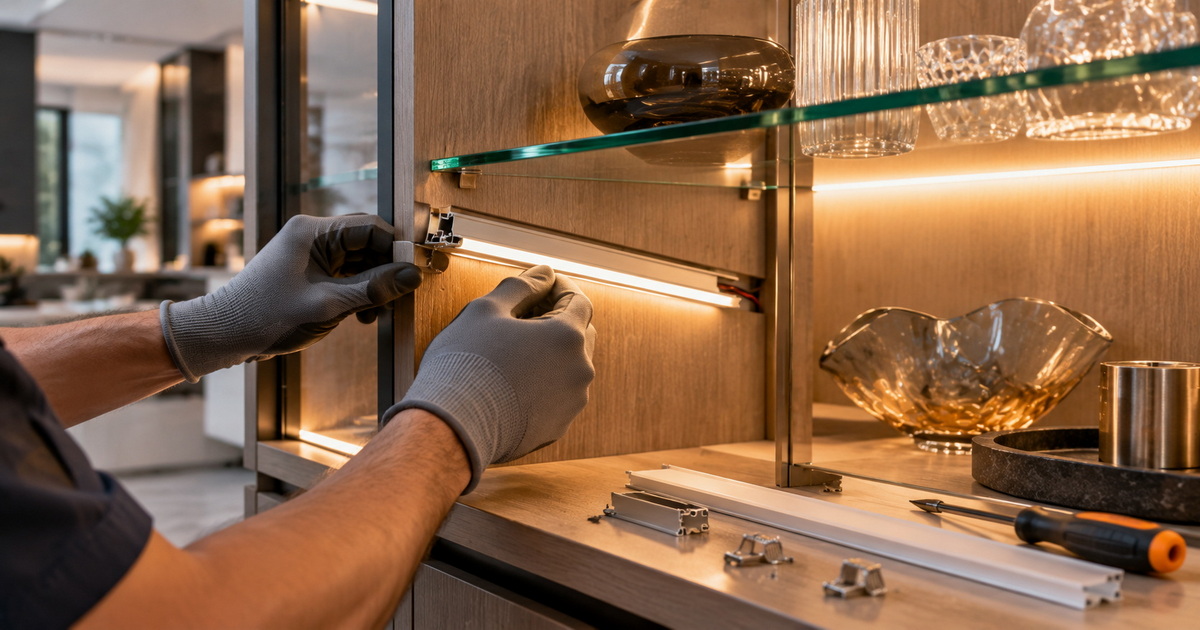
A spring-clip recessed profile is generally installed into a prepared groove or opening in a cabinet panel, frame, shelf support, or structural element. The spring clips hold the profile securely in place after it is pressed into the cutout.
For glass shelf cabinets, spring-clip recessed profiles are often used in fixed cabinet structures where the lighting position is known before manufacturing begins. The recessed installation helps create a flush and refined appearance.
The major advantage of a recessed profile is visual integration. Once installed correctly, the lighting channel becomes less noticeable because it sits within the furniture rather than being mounted on its surface.
This approach is especially effective when the cabinet design requires:
- A minimal and architectural appearance
- Continuous illumination along a fixed shelf line
- Hidden wiring routes within cabinet panels
- A clean exterior without visible mounting accessories
- Repeatable installation in standardized furniture production
- Better protection for the lighting element inside the cabinet structure
For many high-end furniture collections, the recessed look supports a more premium result. The light appears to come from the cabinet itself rather than from an attached fixture.
The elegant appearance of spring-clip recessed profiles depends on accurate cabinet preparation. The groove must be properly positioned, consistently machined, and compatible with the selected profile body.
This means the cabinet manufacturer should confirm the lighting system early in the design stage. If the lighting choice is delayed until after panel cutting begins, revisions can become expensive and disruptive.
A practical installation sequence usually includes:
1. Confirm the lighting layout during cabinet design.
2. Identify the preferred light direction for each glass shelf level.
3. Prepare consistent recesses in the cabinet panels or shelf-support components.
4. Plan concealed cable routes before final cabinet assembly.
5. Install the LED profile after surface finishing and cleaning.
6. Test light distribution before the glass shelves are installed.
7. Complete final inspection for alignment, glare control, and cable concealment.
This process works best when the cabinet design is stable. If the shelf positions are unlikely to change after installation, a spring-clip recessed profile can provide a highly polished result.
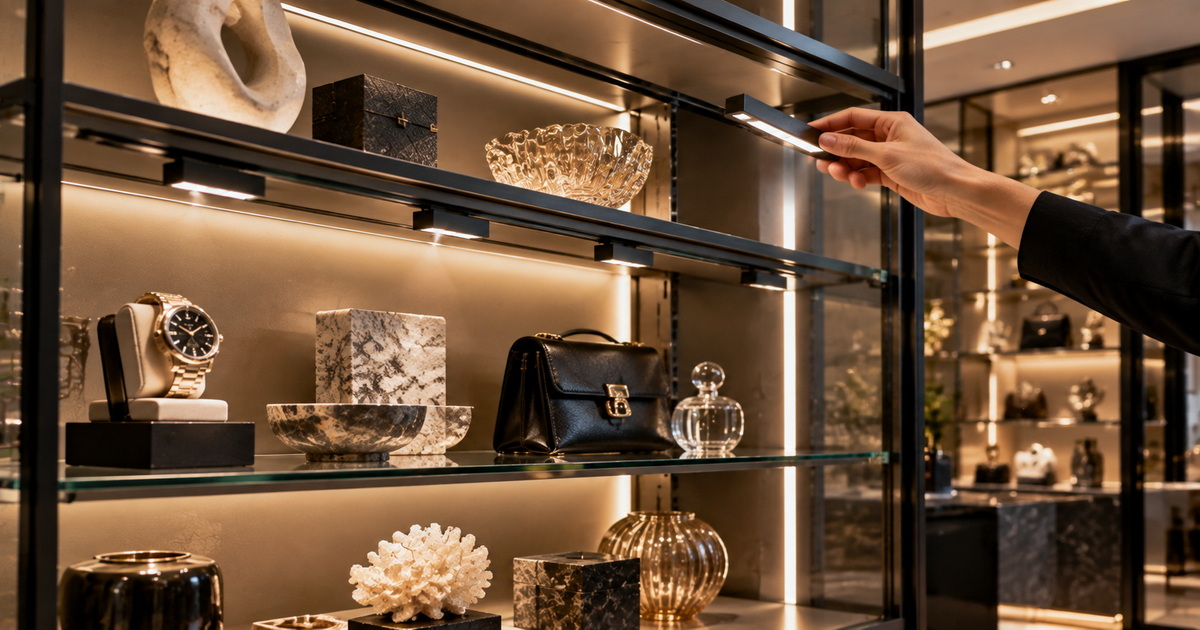
A magnetic track mini-bar is designed to connect with a compatible magnetic rail or track system. Rather than permanently fixing a lighting bar into a cabinet groove, the mini-bar can usually be positioned, removed, or replaced more easily within the track layout.
For modulated glass shelf cabinets, this flexibility can be valuable. Glass shelves are often adjustable, display layouts may change, and retail or residential users may want to update the lighting configuration over time.
The central advantage of magnetic track mini-bars is adaptability. The light source can be repositioned when the cabinet layout changes, helping designers and installers respond to real-world variations without rebuilding the cabinet.
This can be useful when:
- Glass shelves are height-adjustable
- Display products change frequently
- Cabinets are manufactured in modular sections
- Lighting maintenance needs to be fast
- A project requires future upgrades or replacement options
- The cabinet is used in retail, hospitality, or display environments
- The customer wants a flexible smart-home furniture lighting layout
Instead of treating lighting as a fixed component, the magnetic approach treats it as a configurable system. This is particularly attractive for display cabinets where merchandise, decorative objects, and shelf positions may evolve over time.
Magnetic track mini-bars simplify fixture access, but they still require careful system planning. The rail needs to be positioned where it can illuminate the shelf face, the back panel, or displayed items without creating distracting reflections on glass.
The track should also be integrated into the cabinet in a way that feels intentional. If a rail is added without attention to finish, location, or cable management, it may look like an afterthought.
For best results, consider the following:
- Position the magnetic track where the mini-bars can light shelf contents rather than shining directly into the viewer's eyes.
- Keep the rail aligned with cabinet divisions or shelf modules.
- Coordinate the track finish with the cabinet frame, glass hardware, and handle color.
- Use a consistent lighting direction across adjacent cabinet modules.
- Plan accessible power connections for service and future adjustments.
- Confirm that shelf movement will not block the light path or interfere with track access.
A magnetic solution can make a cabinet more adaptable, but the visual discipline of the original furniture design still matters.
The following comparison highlights the practical differences between these two furniture lighting approaches for modulated glass shelf cabinets.
| Comparison Area | Spring-Clip Recessed Profiles | Magnetic Track Mini-Bars |
|---|---|---|
| Visual appearance | Flush, concealed, and built into the cabinet structure | More visible, but can look highly intentional in a modern modular design |
| Installation timing | Best selected before cabinet machining and production | Can offer more flexibility during installation and later adjustments |
| Cabinet modification | Requires prepared recesses or installation grooves | Requires track integration but may reduce the need for multiple fixed light positions |
| Shelf-layout flexibility | Best for fixed shelf arrangements | Better for adjustable or evolving shelf layouts |
| Service access | May require more effort if the profile is deeply integrated | Usually easier to remove, reposition, or replace |
| Design style | Suitable for premium minimalism and seamless furniture integration | Suitable for contemporary, technical, and configurable furniture systems |
| Wiring management | Can provide highly concealed wiring | Requires thoughtful rail and power-feed planning |
| Production consistency | Excellent for repeatable cabinet models | Excellent for modular cabinet programs and configurable projects |
| Ideal buyer | Cabinet factories, fixed interior projects, premium residential furniture brands | Display-system suppliers, retail projects, modular furniture makers, smart-home integrators |
Neither option is universally better. The correct choice depends on whether the project values permanent integration or adjustable functionality.
Choose spring-clip recessed profiles when the cabinet layout is fixed and the brand wants lighting to feel almost invisible.
They are often the stronger option for:
- Luxury kitchen cabinets with stable shelf positions
- Built-in wardrobes with fixed display zones
- Bathroom cabinets with clean, minimal detailing
- High-end residential joinery
- Hotel cabinetry produced in repeatable room packages
- Furniture collections where the lighting must blend into the structure
A recessed profile is particularly effective when the cabinet designer wants the glass shelves and displayed objects to remain the visual focus. The lighting supports the presentation without competing for attention.
A common mistake is assuming that a recessed profile will automatically produce a premium result. In reality, the quality depends on alignment, light direction, diffuser selection, cabinet finish, and installation accuracy.
If the profile is poorly aligned, the cabinet can look less refined than a well-executed surface or magnetic solution. The recessed approach requires coordination between the lighting supplier, cabinet designer, machining team, and installer.
For this reason, customized lighting projects should begin with drawings, cabinet cross-sections, and installation samples rather than relying only on product images.
Choose magnetic track mini-bars when the cabinet is designed for change. This may include changing glass shelf heights, changing product displays, evolving room functions, or future lighting upgrades.
They are especially suitable for:
- Adjustable glass display cabinets
- Retail showcase systems
- Jewelry and collectible display furniture
- Smart-home cabinet systems
- Modular wardrobes and storage walls
- Hospitality display areas
- Custom furniture programs with multiple cabinet configurations
Magnetic mini-bars can also improve after-sales service. If a light module needs adjustment or replacement, service personnel may not need to dismantle cabinet panels or disturb finished surfaces.
The main risk with a magnetic system is over-flexibility. If every mini-bar can be moved freely without a defined layout, lighting consistency can suffer.
A successful magnetic track project should still include a lighting plan that defines:
- Recommended mini-bar positions
- Preferred spacing between illuminated areas
- Direction of light output
- Standard mounting locations for each cabinet module
- Maintenance access points
- Power and control routing
In other words, magnetic track mini-bars should provide controlled flexibility, not visual randomness.
Glass is beautiful, but it is unforgiving. It can reflect the light source, amplify glare, and reveal uneven illumination. Whether you choose spring-clip recessed profiles or magnetic track mini-bars, reflection management should be part of the cabinet design process.
- Direct light toward the displayed items rather than toward the viewer.
- Avoid placing the light source where it reflects directly in the glass door.
- Use a diffuser or shielding method that softens the visual appearance of the light.
- Keep lighting positions consistent across adjacent cabinet modules.
- Test the cabinet from normal viewing angles before final project approval.
- Consider the reflection created by glossy back panels, mirrors, metal trims, and glass shelf edges.
- Coordinate lighting with cabinet-door opening direction and hardware placement.
A lighting sample cabinet is often more valuable than a technical drawing alone. It reveals how the light behaves on real glass, real finishes, and real objects.
When comparing spring-clip recessed profiles vs. magnetic track mini-bars for modulated glass shelf cabinets, ask these questions before selecting a system.
1. Will the glass shelf positions remain fixed after installation?
2. Does the cabinet need a flush, concealed lighting appearance?
3. Will end users frequently change what the cabinet displays?
4. Is quick maintenance or module replacement a priority?
5. Can the cabinet factory prepare precise recesses during production?
6. Is the furniture program based on standard modules or one-off custom cabinetry?
7. Are smart controls, sensor functions, or future system expansion planned?
8. Does the project require OEM or ODM customization for size, appearance, connection method, or lighting function?
If most answers favor fixed architecture and refined concealment, a spring-clip recessed profile is likely the better direction. If most answers favor adaptability, service access, and changing display layouts, magnetic track mini-bars are likely more suitable.
Standard lighting products can work for standard cabinets. However, furniture lighting becomes more complex when projects involve glass shelves, custom dimensions, multiple cabinet modules, smart controls, special finishes, or branded design requirements.
A capable OEM/ODM lighting partner should be able to support customization across areas such as:
- Profile length and installation method
- Housing color and surface appearance
- Cable exit direction and connector layout
- Light distribution requirements
- Sensor and control compatibility
- Track configuration for modular cabinet systems
- Packaging for furniture manufacturers and project delivery
- Integrated LED power supply planning
Farwise Technology Co., Ltd. provides LED silicone strip lights, LED cabinet lights, LED wardrobe lights, LED bathroom cabinet lights, LED power supplies, and related furniture-lighting solutions for commercial and residential projects. For cabinet manufacturers and project buyers, the most effective approach is to evaluate the lighting system together with the cabinet structure rather than selecting components independently. Farwise supports OEM and ODM customization for different project and market requirements.
Spring-clip recessed profiles are the stronger choice when you need seamless integration, fixed shelf lighting, and a high-end built-in appearance. Magnetic track mini-bars are the stronger choice when you need adjustability, efficient servicing, and a modular lighting system for changing glass shelf layouts.
For modulated glass shelf cabinets, the best solution often begins with a simple principle: design the lighting around how the cabinet will actually be used, assembled, maintained, and updated.
Before committing to either solution, prepare a cabinet cross-section, confirm the shelf module arrangement, identify the viewing angles, and test the lighting in a sample unit. This process helps prevent glare, uneven illumination, visible hardware, and later installation changes.
Contact Farwise Technology Co., Ltd. with your cabinet drawings, shelf layout, project concept, or prototype requirements to develop a customized furniture lighting solution for your glass shelf cabinet program.
Spring-clip recessed profiles are installed into prepared cabinet recesses for a flush and permanent appearance. Magnetic track mini-bars connect to a compatible track system and are better suited to adjustable, modular, or service-friendly cabinet lighting designs.
Yes. Magnetic track mini-bars can be a practical choice for glass display cabinets, especially when shelf heights or product displays change regularly. The rail and light direction should be planned carefully to avoid glare and distracting reflections.
Spring-clip recessed profiles often create a more concealed and architectural appearance because they are integrated into the cabinet structure. However, a well-designed magnetic track system can also look premium in modern, modular, and technology-focused interiors.
They can be used, but they are usually better for fixed lighting positions. If the shelf layout changes often, a magnetic track mini-bar system may provide greater flexibility and easier adaptation.
Position the light to illuminate objects rather than the viewer, avoid direct reflections in glass doors, use appropriate shielding or diffusing elements, and test the cabinet from normal viewing angles before final installation.
Yes. Cabinet lighting should be planned with compatible LED power supplies, concealed cable routes, accessible connection points, and appropriate control options. Early planning improves safety, appearance, maintenance access, and installation efficiency.
Yes. Farwise supports OEM and ODM development for furniture-lighting projects, including customized installation approaches, functional requirements, dimensions, appearance, lighting solutions, and related power-supply planning.
1. Farwise Lighting. "[Company Profile]." Information on OEM/ODM support and company contact details.
2. Farwise Technology Co., Ltd. "[Company Profile on LinkedIn]." Background information on LED lighting manufacturing and product categories.
3. Global Lighting Forum. "[Farwise Technology Co., Ltd.]." Company profile and magnetic track lighting system overview.
4. U.S. Department of Energy, Office of Energy Efficiency and Renewable Energy. "[Solid-State Lighting]." Background information on LED and solid-state lighting technology.
5. Illuminating Engineering Society. "[Lighting Library]." Professional lighting design resources, visual comfort considerations, and recommended lighting practice information.
6. U.S. General Services Administration. "[Interior Lighting]." Guidance on interior lighting considerations and project planning.


