
Views: 222 Author: Farwise Lighting Publish Time: 2026-11-10 Origin: Site


Content Menu
● What Is the Difference Between SMD and COB LED Strips?
>> What Are SMD LED Strip Lights?
>> What Are COB LED Strip Lights?
● SMD vs COB LED Strips: A Practical Comparison
● Which LED Strip Is Better for Different Furniture Applications?
>> COB vs SMD for Under-Cabinet Lighting
>> LED Strips for Wardrobes and Display Cabinets
>> LED Strips for Bathroom Vanities
>> LED Strips for Beds and Bedroom Furniture
● Four Claims About SMD and COB That Buyers Should Question
>> "COB Is Always Brighter and More Efficient"
>> "One Technology Always Lasts Longer"
● How to Test LED Strip Samples Before Bulk Ordering
>> Step 1: Build a Representative Furniture Section
>> Step 2: Inspect Direct and Reflected Light
>> Step 3: Check Materials Under the Light
>> Step 4: Test the Complete Control System
>> Step 5: Review Operation and Service Access
● OEM/ODM LED Strip Selection: What Should Buyers Specify?
● Compare Installed Value, Not Just Strip Price
● Plan Your Furniture Lighting with Farwise
>> 1.Is COB better than SMD for furniture lighting?
>> 2.Do COB LED strips need a diffuser?
>> 3.Can SMD LED strips produce dot-free lighting?
>> 4.Are COB LED strips automatically suitable for bathrooms?
>> 5.Can both technologies work with smart controls?
>> 6.Which option is easier to maintain?
>> 7.What should I send Farwise for an OEM/ODM inquiry?
Choosing between SMD and COB LED strip lights is not simply a question of which technology is newer. For cabinets, wardrobes, bathroom vanities, and bedroom furniture, the better choice depends on how the light appears after installation, how the system is controlled, and how easily it can be maintained.
COB LED strips are often preferable when you want a visually continuous line of light, especially in shallow furniture channels. SMD LED strips remain a practical option when individual light points are concealed or blended by a suitable diffuser.
At Farwise Technology Co., Ltd., our approach is to start with the furniture and the intended lighting effect—not the technology label. With 16 years of focus on LED lighting, we support commercial and residential projects through furniture-lighting solutions and OEM/ODM customization.
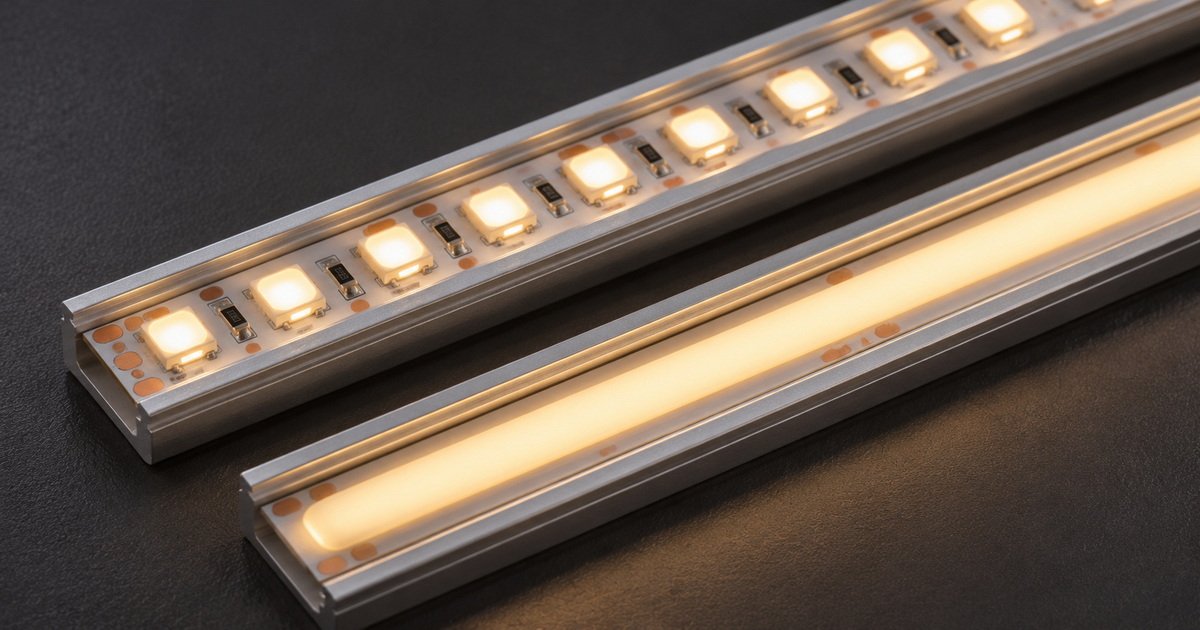
Both technologies use light-emitting diodes mounted on a circuit board. Their principal difference is how those light sources are packaged and arranged.
SMD stands for surface-mounted device. An SMD LED strip uses individually packaged LED components mounted along a flexible circuit board.
These separate packages create individual points of light. Whether those points remain visible depends on the spacing between them, the installation depth, the diffuser, and the surrounding surfaces.
SMD strips can work effectively in furniture lighting when the installation allows the light to blend before it reaches the viewer.
Typical applications include:
- Concealed cabinet lighting.
- Recessed shelving with suitable diffusers.
- Indirect bedroom lighting.
- Decorative installations with compatible color-control systems.
SMD does not automatically mean uneven illumination. The complete installation determines the result.
COB stands for chip on board. In typical white COB LED strips, closely arranged LED chips are mounted directly onto the circuit board beneath a continuous phosphor-containing layer.
This construction helps blend the individual light sources into a visually continuous emitting surface.
For furniture designers, the practical benefit is a smoother-looking light line where installation depth is limited or the source may be reflected in nearby finishes.
However, a continuous appearance does not automatically mean higher efficiency, better color quality, or longer service life.
Those qualities require separate evaluation.
| Selection factor | SMD LED strips | COB LED strips |
|---|---|---|
| Visible appearance | Individual light points may remain visible | Usually produces a more continuous-looking light line |
| Shallow furniture channels | May require careful diffuser selection | Often helpful where blending space is limited |
| Reflective surfaces | Reflected dots may need additional control | Can reduce the appearance of reflected individual points |
| Concealed installations | Practical when the light blends before becoming visible | Useful, although the visual advantage may be less noticeable |
| Color and control | Depends on the selected strip and controller | Depends on the selected strip and controller |
| Maintenance | Plan access to replaceable sections and connections | Plan access to replaceable sections and connections |
| Purchasing decision | Evaluate the complete installed system | Evaluate the complete installed system |

Under-cabinet lighting must illuminate the work surface without becoming visually distracting.
A polished countertop can reveal the lighting source through reflection, even when the strip itself is hidden. With SMD strips, this may appear as a row of bright points.
COB strips are worth considering when a continuous reflected line is preferred.
However, placement still matters. Moving the light source within the cabinet recess can change reflections, shadows, and visibility.
For task lighting, also check whether the installed arrangement illuminates the working area rather than simply brightening the backsplash.
Wardrobe lighting should help users distinguish clothing and locate items easily.
A smooth light line can make a narrow vertical channel look more integrated, making COB an attractive option for some wardrobe designs.
Nevertheless, light continuity and color fidelity are different qualities. A strip can look perfectly smooth while making fabrics appear unnatural.
Assess clothing, wood veneers, and display objects under the proposed lighting. Include the door sensor or occupancy control in the sample installation.
The practical question is whether the system works naturally when someone opens the furniture.
For bathroom furniture, environmental suitability comes before the choice between SMD and COB.
Consider moisture exposure, cleaning practices, connection protection, and power-supply placement. Check that the selected products and installation method are appropriate for the actual location and local requirements.
Do not assume that a protective coating makes the entire assembly suitable for every bathroom position.
A COB strip can provide a clean decorative line beneath a vanity, but it does not replace properly planned lighting for grooming tasks.
For bed frames and bedside furniture, visual comfort is particularly important.
Check the lighting from a seated position and while lying down. A source that looks concealed when standing may become directly visible from the bed.
COB can help create a continuous accent line, while concealed SMD strips may also work well.
In either case, shielding and dependable dimming matter more than the technology name alone.
Brightness and efficiency are not interchangeable.
A system can produce more light simply because it uses more electricity. Its efficiency also depends on the LED design, operating conditions, driver, and optical losses.
Compare complete lighting systems under comparable conditions rather than assuming the packaging method determines performance.
Both technologies generate heat.
Operating temperature depends on the electrical design, mounting surface, surrounding enclosure, and the path available for heat to escape.
A dense emitting surface does not eliminate the need for thermal management. Follow the installation requirements for the selected product and assess it inside the actual furniture assembly.
A continuous light line may reduce visible dotting, but it can still cause discomfort if it is bright and directly exposed.
Glare depends on placement, shielding, surrounding brightness, and viewing position.
A diffuser can improve appearance, but it cannot correct every poorly positioned installation.
Lighting reliability is a system issue.
LEDs, drivers, connectors, optical materials, and installation conditions all affect useful service life. Changes in color or light output can also become unacceptable before the system stops operating.
Ask about the complete assembly rather than relying on an unsupported lifespan claim.
Sample validation is one of the most useful steps a furniture manufacturer or project buyer can take.
A loose strip on a desk cannot reproduce the conditions inside a finished cabinet.

Use the intended channel, cover, mounting surface, and nearby finish.
Include joints and corners where possible. A sample that ignores these details may conceal problems that appear during installation.
View the sample from normal standing and seated positions.
Look for:
- Visible individual light points.
- Reflections in glossy surfaces.
- Unwanted shadows.
- Exposed wiring or bright strip ends.
- Uncomfortable direct views of the source.
For bedroom applications, include the reclining viewing position.
Place representative fabrics, cabinet finishes, and decorative objects beside the sample.
Assess whether their appearance suits the design. Also compare adjacent illuminated sections for visible differences.
This is more useful than judging the strip only against a plain wall.
Use the proposed driver, dimmer, sensor, and controller together.
Check startup, shutdown, dimming, and sensor operation. Look for visible flicker, uneven transitions, unexpected behavior, or unwanted noise.
Compatibility should be demonstrated with the intended combination of components.
Evaluate the assembly under representative operating conditions.
Confirm that the mounting arrangement follows the product instructions and that power supplies and connections remain accessible.
Record the approved configuration so production follows the same arrangement.
A clear project brief reduces the risk of receiving a good strip that does not fit the furniture.
Start with the application and intended experience:
- Where will the lighting be installed?
- Will the source be visible or reflected?
- Is the purpose task lighting, display lighting, or decoration?
- How should users switch or dim it?
- What environmental conditions will it face?
- How will replacement and maintenance work?
Then define the customization scope.
Farwise Technology Co., Ltd. supports OEM/ODM requirements covering dimensions, functions, lighting solutions, and appearance. Our furniture-lighting range includes COB LED strips and solutions for cabinets, wardrobes, bathroom cabinets, and beds.
Depending on the project, the brief should address furniture integration, wiring routes, connection positions, controls, and the desired external finish.
For repeat orders, agree on an approved sample and document any permitted substitutions. A component change should not silently alter the installation experience.
The least expensive strip is not necessarily the least expensive solution.
A purchasing decision should consider:
- Channels and diffuser requirements.
- Assembly and installation work.
- Driver and controller compatibility.
- Inspection and rework.
- Access for servicing.
- Replacement availability.
For example, COB may be worthwhile where it achieves the intended continuous appearance in a shallow channel. In a concealed installation where SMD already produces an acceptable result, the same visual benefit may be less important.
The objective is not to purchase the most fashionable technology. It is to achieve the required lighting effect reliably and economically.
The right starting point is your furniture drawing, installation environment, and intended lighting effect.
Share these requirements with Farwise Technology Co., Ltd. to discuss a suitable LED strip solution and OEM/ODM customization. Include your preferred controls, visible finishes, and maintenance expectations.
Our focus is to help you develop a coordinated furniture-lighting solution rather than select a strip in isolation.
Request a project-specific proposal and sample configuration before confirming bulk production.
COB is often preferable when a continuous-looking light line matters, particularly in shallow channels. SMD can be equally suitable when individual light points are concealed or effectively blended.
Not always for visual continuity. However, a suitable cover may improve the finished appearance and provide protection. Decide according to the installation environment and product guidance.
Yes, an SMD installation can appear continuous when LED spacing, diffuser design, channel depth, and viewing distance work together. Test the actual assembly rather than relying on photographs.
No. Suitability depends on the selected product, connections, power supply, exposure conditions, and installation requirements. The COB construction itself does not establish moisture protection or electrical safety.
Yes, when the selected strip, driver, and controller are compatible. Confirm the required functions and test the complete arrangement, including dimming and any sensors.
Access and system design usually matter more than the packaging method. Plan for replaceable sections, accessible drivers, identifiable connections, and suitable replacement products.
Provide furniture drawings, intended applications, desired lighting appearance, control requirements, environmental conditions, and customization priorities. These details help establish a useful proposal and representative sample.
1. [SignliteLED — "Difference Between SMD LED and COB LED: Which Is Better?"]
Original comparison reviewed for subject coverage, technical claims, and reader feedback. Its visible comment expresses appreciation for the explanation, not a verified product experience. [signliteled]
2. [U.S. Department of Energy — "LED Basics"]
Background on color appearance, color fidelity, dimmability, and the distinction between LED degradation and electronics failure. [energy]
3. [U.S. Department of Energy — "Lifetime and Reliability"]
Technical foundation for treating reliability as a system-level issue involving LEDs, drivers, thermal management, and optical materials. [www1.eere.energy]
4. [U.S. Department of Energy — "Energy Efficiency of LEDs"]
Supports the distinction between brightness and efficiency, including the influence of operating conditions, driver losses, and optical losses. Historical performance figures from this document are not reproduced. [www1.eere.energy]
Supports discussion of thermal design, driver reliability, color change, and complete-system maintenance. [energy]
6. [Flexfire LEDs — "COB LED Strip vs. SOB LED Strip: What's the Difference?"]
Used for its explanation of discrete SMD packages, continuous COB construction, and visible light-point blending—not as independent proof of comparative reliability. [flexfireleds]
7. [WAC Lighting — "Tape Lighting"]
Supports the distinction between general tape-lighting applications and products specifically identified for wet-location use. [waclighting]


