
Views: 222 Author: Farwise Lighting Publish Time: 2026-11-08 Origin: Site


Content Menu
● What Is the Difference Between DALI Dimming and Ordinary Dimming?
● How DALI Dimming Works with LED Strip Lights
>> The LED Strip Is Only One Part of the System
>> Commands, Groups, and Scenes Work Together
>> Brightness Control Is Different from Color Control
● Why DALI vs PWM Is Not a Direct Comparison
● Does DALI Automatically Deliver Better Dimming?
● DALI-2 Certification: What Buyers Should Verify
● Choosing Dimming for Cabinets, Wardrobes, and Bedrooms
>> Kitchen and Display Cabinets
>> Wardrobes and Dressing Areas
● An Illustrative Furniture-Lighting Scenario
● A Practical Specification and Commissioning Checklist
>> Step 1: Write a User-Behavior Brief
>> Step 2: Define Lighting Zones
>> Step 3: Allocate System Responsibilities
>> Step 4: Approve a Representative Sample
>> Step 5: Commission and Document
● What Should an OEM/ODM Lighting Supplier Contribute?
>> 1.Can an Existing LED Strip Be Used with DALI?
>> 2.Is DALI Better Than Conventional Dimming for Every Project?
>> 3.Can DALI Control Brightness and Color Temperature?
>> 4.Does DALI Eliminate the Need for PWM?
>> 5.Does Every DALI-2 Product Provide Detailed Energy Reports?
>> 6.Can Lighting Groups Be Changed After Installation?
DALI dimming vs ordinary dimming is primarily a choice about how your LED strip lights are controlled—not simply which strip produces better light. DALI supports addressable lighting control, grouping, scene recall, and two-way communication. Conventional dimming can provide a simpler solution when a cabinet, wardrobe, or bedside installation only needs straightforward brightness adjustment.
At Farwise Technology Co., Ltd., our perspective starts with the furniture and the people using it. Drawing on the 16 years of LED manufacturing experience described in our company profile, we help customers develop lighting solutions for cabinets, wardrobes, bathroom furniture, and bedroom applications.

DALI stands for Digital Addressable Lighting Interface. It is a standardized communication protocol that allows compatible lighting devices to receive commands and answer queries. Individual devices can be addressed separately or organized into groups.
"Ordinary dimming" is a convenient description rather than a single technical standard. It may refer to phase-cut dimming, analog control, or a local controller that regulates the strip's output.
The central distinction is addressability. DALI can tell a particular lighting zone what to do through its associated control gear. A conventional arrangement generally controls the lights connected to a particular dimming channel or circuit.
| Decision factor | DALI lighting control | Conventional dimming |
|---|---|---|
| Control organization | Individually addressed devices and configurable groups | Usually organized around physical circuits or controller channels |
| Everyday operation | Scenes, coordinated zones, and compatible automated controls | Straightforward local brightness adjustment |
| Communication | Commands and supported status queries | Depends on the chosen control technology |
| Reconfiguration | Some changes can be made through software | Changes may require controller or wiring modifications |
| Project responsibility | Requires control-system planning and commissioning | Requires careful dimmer, driver, and strip matching |
These differences make DALI attractive for coordinated installations, but they do not make conventional dimming unsuitable for professional furniture lighting.
A common purchasing mistake is treating "DALI LED strip" as though the strip itself necessarily contains the communication interface.
In many installations, the DALI functionality sits in the driver or a compatible control module. That device receives lighting commands and regulates the connected strip. The system therefore needs to be evaluated as a complete assembly, not as tape lighting alone. DALI terminology explicitly distinguishes control gear, which operates the light source, from controllers and input devices.
For buyers, this changes the sourcing question:
- Which component receives the DALI commands?
- Who supplies the controller and bus power?
- How will the strip connect to the control gear?
- Who will configure and test the completed installation?
A quotation that only names the strip leaves these responsibilities unresolved.
DALI supports commands for individual devices, groups, or the entire connected system. Scenes recall predefined lighting states, allowing different zones to respond together.
Consider a bedroom with wardrobe illumination, bedside lighting, and concealed furniture lighting. A reading scene could emphasize the bedside area, while an evening scene could soften the overall atmosphere.
This flexibility comes from the control design and commissioning. It does not happen automatically because a driver carries a DALI label.
Not every DALI installation supports adjustable color temperature.
DT6 identifies control gear for LED light sources. DT8 addresses color-control functions, including supported tunable-white arrangements. A project requiring coordinated brightness and white-tone adjustment must confirm the relevant driver and controller capabilities.
Specify the desired behavior first. Then select compatible components rather than assuming every DALI product offers the same functions.
One important technical correction concerns pulse-width modulation, or PWM.
DALI describes communication between lighting-control devices. PWM describes a method that can regulate LED output. They operate at different layers and can exist in the same system. The DALI Alliance database includes certified control products explicitly identified as PWM dimmers.
Consequently, "DALI or PWM?" is often the wrong purchasing question.
A better comparison asks:
1. How will the user or building controller communicate with the lighting?
2. How will the selected driver or control module regulate the strip?
3. Does the complete combination deliver acceptable visual performance?
This distinction prevents buyers from rejecting a suitable control method based on an inaccurate either-or comparison.
DALI provides a standardized approach to lighting commands. Certified DALI-2 control gear follows a standardized dimming curve designed around perceived brightness, supporting repeatable control behavior.
However, a protocol label is not a complete assessment of the finished luminaire.
For procurement, evaluate the assembled system in its actual furniture application. Request a demonstration of:
- Gradual changes from bright to dim.
- Switching on from a previously dimmed setting.
- Consistency between adjacent illuminated sections.
- Audible behavior during adjustment.
- Operation through the intended switch, sensor, or control interface.
Treat these as acceptance checks, not assumptions.
A well-selected conventional solution may satisfy a straightforward installation. DALI becomes more compelling when the project also requires coordinated control, configurable groups, or supported feedback.
DALI-2 is a certification program based on the DALI protocol. It adds more comprehensive testing than the original DALI version, with a strong emphasis on interoperability. Certification results are verified by the DALI Alliance.
For a commercial project, ask suppliers to identify the exact certified devices and check them against the official product database. Do not treat a general statement such as "DALI compatible" as equivalent to verified certification.
Also separate basic communication from advanced reporting. DALI can support status queries, but extended energy and diagnostic data are not mandatory for every DALI-2 device. Those capabilities must be checked individually.
This matters when a client expects a maintenance dashboard or detailed operational reporting. Put those expectations into the project brief before selecting components.
Begin with the relationship between task lighting and decorative lighting.
If the user only needs a local adjustment for one cabinet area, conventional dimming may be the more proportionate design choice. If display cabinets and surrounding architectural lighting must respond to shared scenes, an addressable system deserves consideration.
DALI's value here is coordinated control—not an automatic improvement in the strip's appearance. Its group and scene functions provide the mechanism for that coordination.
Describe the intended interaction before specifying the control technology.
Should the lighting respond only to a door opening? Should the user adjust brightness locally? Must it participate in a wider dressing-room scene?
These are different requirements. The first task is to document the behavior; the second is to choose the controls capable of delivering it.
A simple wardrobe should not become unnecessarily complicated merely because the wider project includes sophisticated lighting.
Keep control selection separate from installation suitability.
A DALI control interface does not establish whether the finished lighting assembly is appropriate for its installation location. Request the relevant installation documentation and have the responsible electrical professional confirm suitability.
For the user experience, define whether mirror lighting, cabinet lighting, and ambient lighting should operate independently or together.
Bedroom lighting often involves several activities: reading, dressing, relaxing, and moving around without fully illuminating the room.
DALI scenes can coordinate multiple lighting zones when supported by the chosen system. A standalone bedside or under-bed installation may instead need only an accessible local control.
Choose around the routine, not around the terminology.

Imagine a hospitality bedroom containing a wardrobe, illuminated headboard, bedside reading area, and bathroom vanity.
If each furniture item only requires independent local operation, separate conventional controls may meet the brief.
If the operator wants coordinated arrival and evening scenes, configurable grouping becomes more useful. DALI allows lighting groups and scenes to be configured through the control system, with some later changes possible through software rather than rewiring.
This is an illustrative design scenario, not a reported Farwise installation.
Its lesson is practical: count the required interactions before deciding how sophisticated the lighting system should become. More illuminated furniture does not automatically mean more complicated controls.
Describe what happens when someone enters the room, opens furniture, touches a switch, or selects a scene.
Include manual override expectations. Avoid vague instructions such as "make it smart."
Identify which areas must operate together and which require independent adjustment.
For an addressable system, remember that control follows the addressed gear and connected arrangement. It does not automatically provide independent control over every section of strip.
Confirm who supplies the strips, drivers, controls, sensors, and supporting infrastructure.
A DALI bus requires an application controller and bus power supply. These functions may be provided through the selected system architecture, but responsibility for them must be clear.
Test the intended combination inside a representative furniture assembly.
Review appearance, control response, access for servicing, and the practicality of assembly before approving wider production.
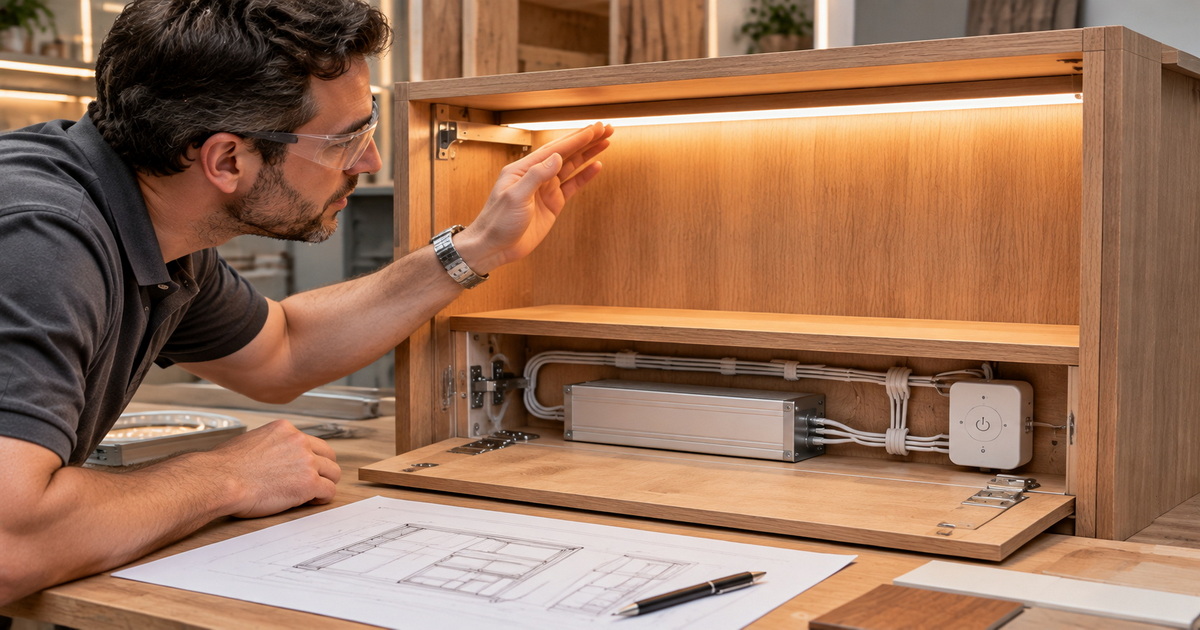
DALI commissioning includes assigning addresses, creating groups, and configuring scenes. Record the final configuration and retain the handover information for future servicing.
For either control approach, approve the complete lighting behavior rather than isolated components.
A useful manufacturing partner should help translate an application brief into a buildable lighting assembly.
Based on the company information provided for this article, Farwise Technology Co., Ltd. offers furniture-lighting products and OEM/ODM customization covering dimensions, functions, appearance, and solution development.
For a dimmable furniture-lighting project, start discussions with:
- The furniture category and installation layout.
- The desired user interactions.
- The preferred control approach.
- The appearance and integration requirements.
- The expected division of installation and commissioning work.
Do not assume certification, complete-system integration, or specialist reporting capabilities unless they are confirmed for the proposed components.
Contact Farwise with your furniture drawings and lighting-control brief to discuss a customized LED strip lighting solution. Ask for the proposed system boundary and sample-validation plan before approving production.
Possibly. Compatibility depends on the strip and the selected driver or control module. DALI functionality commonly resides in the control gear rather than the strip itself, so the complete combination needs assessment.
No. DALI offers useful addressing, grouping, scenes, and communication features. A project that only needs simple local adjustment may not need those additional capabilities.
Yes, with compatible equipment. Specify supported tunable-white control and confirm the relevant DT8 functionality rather than assuming all DALI drivers provide it.
No. DALI communication and PWM output regulation can coexist. Certified DALI PWM control products demonstrate that these are not mutually exclusive technologies.
No. Extended energy and diagnostic reporting are optional for DALI-2 certification. Verify the required reporting functions against the specific device documentation.
DALI supports software-based reconfiguration of groups. What can be changed depends on the installed arrangement and controller capabilities; software cannot create independent control where the physical system does not provide it.


