
Views: 222 Author: Farwise Lighting Publish Time: 2026-10-04 Origin: Site


Content Menu
● COB LED Strip vs LED Linear Light: What Are You Comparing?
>> A Practical Side-by-Side View
● Which Option Costs Less to Install?
>> Consider the Cost of a Future Replacement
● How Do Their Lighting Results Differ?
>> Uniformity Is Not the Same as Usefulness
>> Color, Glare, and Dimming Need Separate Checks
● Heat, Reliability, and Energy Use
>> Kitchen Cabinets and Work Surfaces
>> Wardrobes and Display Shelves
>> Bathroom Vanities and Bed Frames
● Three Checks Many Comparisons Miss
>> Check the Actual Cutting Rules
>> Check the Installed Sample, Not Just a Photograph
>> Check Who Owns the System Design
● A Manufacturer's Perspective
>> 1.Is a COB LED strip always cheaper than an LED linear light?
>> 2.Can an LED linear light contain a COB strip?
>> 3.Which provides a more continuous line of light?
>> 4.Which is better for under-cabinet task lighting?
>> 5.Can I cut either product to fit my furniture?
>> 6.Is a linear light easier to replace?
>> 7.Do I need to test the driver and dimmer together?
Choosing between a COB LED strip and an LED linear light is not simply a choice between flexible and rigid lighting. The right option depends on where the light will sit, how it should look, who will install it, and what happens if it needs repair. A COB strip often suits custom furniture details and uninterrupted light lines. A linear light often suits repeatable cabinet installations where a finished housing and straightforward mounting matter more. Neither is automatically cheaper or better performing once the complete system is considered.
For cabinet makers, contractors, and lighting buyers, the most useful question is: Which solution delivers the required result with the least installation effort and long-term risk? This guide compares cost, visual quality, thermal management, controls, maintenance, and procurement decisions without treating either product category as a universal winner.

A COB LED strip is a flexible circuit board carrying closely spaced LED chips beneath a phosphor coating. It is designed to create a visually continuous line of light. Buyers may install it in a concealed recess, attach it to a suitable mounting surface, or pair it with an aluminum profile and diffuser.
An LED linear light, as used in this comparison, is a more complete, generally rigid lighting assembly. It typically combines the light source with a housing and may include a diffuser, mounting features, and ready-to-connect wiring. Some linear lights contain COB strips, so the two labels do not describe mutually exclusive LED technologies.
That distinction prevents a common purchasing mistake. A bare COB strip and a finished linear light are not equivalent items. A fair comparison places a complete COB-strip installation beside a complete linear-light installation, including drivers, profiles, connectors, controls, labor, and access for service.
| Decision factor | COB LED strip | LED linear light |
|---|---|---|
| Physical form | Flexible, subject to its specified bending direction | Generally rigid and shaped by its housing |
| Visible light line | Often smooth without an added diffuser | Depends on its LED source and diffuser design |
| Length customization | Cut only as permitted by the product instructions | May be fixed-length, made to order, or cuttable by design |
| Mounting | May need a profile, clips, or prepared surface | Often incorporates mounting features |
| Finished appearance | Depends heavily on installation details | More of the finish is defined before installation |
| Best purchasing fit | Irregular layouts and tailored furniture details | Repeated layouts and installation-ready assemblies |
These are typical design differences, not promises about every product. A rigid light can use COB technology, while a strip installed in a profile can look much like a manufactured linear fixture. Compare actual samples and drawings before approving either approach.
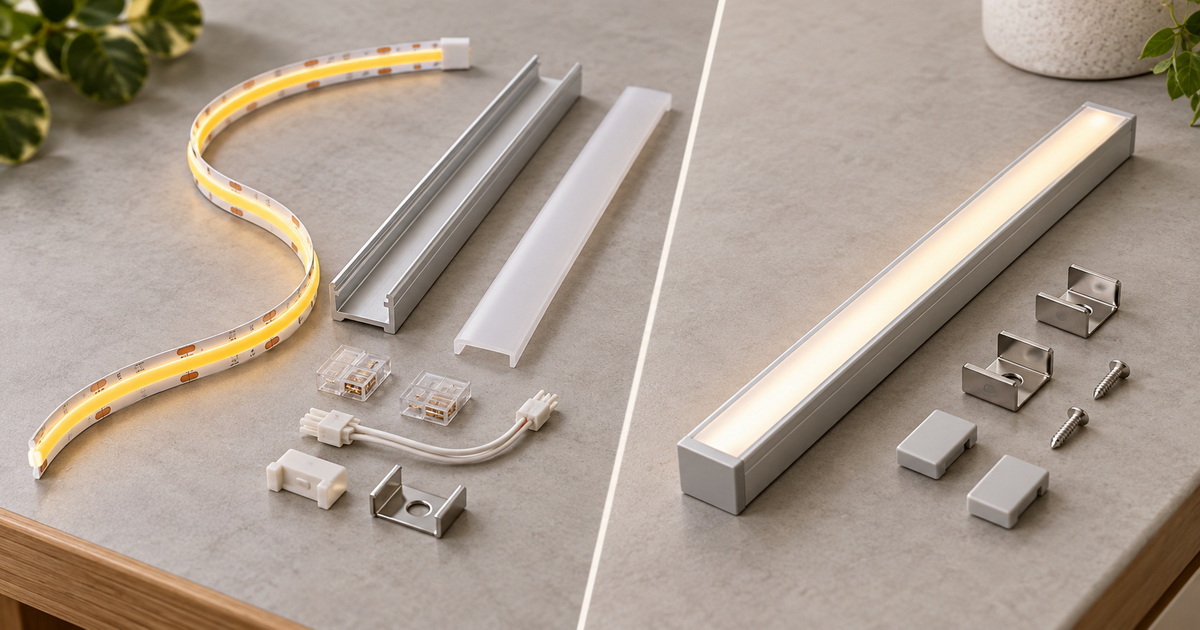
At first glance, a COB LED strip may appear to be the economical choice because the strip itself is only one component. That impression can change when the project requires an aluminum channel, diffuser, end caps, connectors, extra cutting, and careful placement.
A linear light may cost more as an individual assembly, yet reduce on-site preparation if its mounting and wiring are already resolved. The opposite can also happen: a made-to-order linear light may require extra tooling, coordination, or replacement planning that a readily available strip would avoid.
Build each quotation around the same finished lighting requirement. Include:
- Light source and optics: Strip or fixture, plus any necessary profile, cover, or diffuser.
- Power and controls: Compatible driver, dimmer, sensor, controller, and wiring accessories.
- Installation work: Cutting, cabinet preparation, mounting, connection, testing, and finishing.
- Material waste: Offcuts, unusable lengths, and components left over from the layout.
- Service costs: Access panels, replacement parts, electrician visits, and disruption to finished furniture.
This approach matters especially for large furniture programs. A small saving on each light source may disappear if installers must repeatedly cut profiles, hide cable exits, or correct inconsistent finishes. Conversely, custom-length strip assemblies can be economical when a manufacturer prepares them for a well-defined cabinet design.
Ask what a technician would actually remove if a light fails. Can the strip be changed without damaging the cabinet? Can a linear light be unclipped and replaced with an equivalent unit? Will the same connectors and driver still be available?
The least expensive purchase is not necessarily the least expensive installation to own. Service access is part of the design, particularly in hotels, apartment developments, and commercial interiors where one failed light can trigger a site visit.
COB strips are often chosen for a smooth, close-view light line. That makes them attractive under shelves, inside wardrobes, and along visible furniture edges. But a smooth-looking source does not guarantee comfortable illumination on the surface below it.
A linear light gives the designer more control through its housing and diffuser. Its optical design can help conceal the source, soften the apparent brightness, or direct light toward a work area. Results vary by fixture; a poor housing can still create glare, shadows, or visible bright spots.
When reviewing samples, separate appearance at the light source from illumination where people need it. A strip may look beautifully continuous yet leave a kitchen counter unevenly lit because it sits too far back under the cabinet. A linear light may look slightly less continuous up close but direct light more effectively onto the work surface.
Test both options from normal viewing positions. Open the wardrobe doors. Stand at the bathroom vanity. Look at the countertop while preparing a task, not just at the fixture from a showroom angle. The position and direction of the installed light can matter more than its product label.
Neither category has an inherent advantage in color quality. The actual LED source, material selection, and production consistency determine how reliably whites and surface colors appear. When matching lights across a room or a furniture range, request samples from the proposed production configuration rather than relying only on a nominal color description.
Dimming performance also depends on the complete electrical combination. A well-made light source can still flicker or dim unevenly when paired with an unsuitable driver or controller. Test the specified components together at full output and at the dimmed settings people will use.
Finally, assess glare. If the source is visible from a seated position or reflected in a glossy door, repositioning it or changing the diffuser may improve comfort more than changing from COB to a linear fixture.
Both options generate heat and need an installation that manages it. An aluminum profile can provide a useful mounting and heat-transfer path for a compatible strip. A linear light's housing may serve a similar role. Neither approach guarantees good thermal performance simply because it contains aluminum.
For either design, consider whether the light will operate inside an enclosed cabinet, against an insulating surface, or near another heat source. Follow the manufacturer's mounting guidance. Do not assume that a strip intended for one installation method will perform identically when enclosed behind a different cover.
Energy use cannot be ranked by format alone. It depends on the light delivered for the complete system's power input, including losses associated with the driver and optics. A bright bare strip and a diffused linear light should not be judged solely by how they look on a workbench. Compare the proposed finished assemblies under the same application conditions.
Reliability is also broader than the LED chips. Connectors, wiring, drivers, adhesives, covers, and serviceable joints all affect whether an installation remains consistent over time. Request evidence appropriate to the finished product and its intended use, rather than accepting a component-level claim as proof of whole-system performance.
The strongest choice changes with the furniture, viewing angle, and installation workflow.
For a kitchen counter, start with the working area. Determine where the light must land and whether the cabinet edge hides the source from view. A COB strip in a suitable profile can provide a neat custom-length solution where cabinet sizes vary. An LED linear light may simplify repeated installations and offer a consistent finished edge.
If the counter reflects the light source, examine glare before approving either option. A polished surface can reveal flaws that are barely noticeable on a matte sample board.
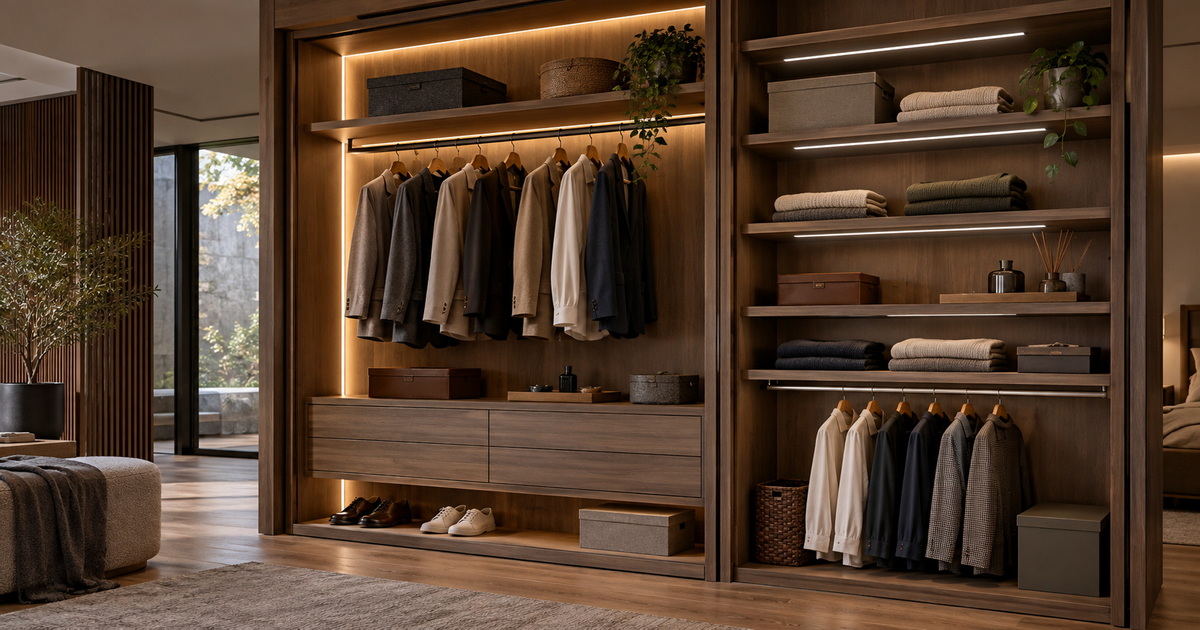
COB strips suit slim recesses and furniture contours where designers want a continuous visual detail. Linear lights suit repeatable shelf or wardrobe modules, particularly when an installer needs a defined mounting and connection method.
For either option, plan cable exits and sensor positions before machining the furniture. A beautiful light line loses its intended effect when wiring or a poorly placed switch remains visible.
In a bathroom vanity, moisture exposure and cleaning practices must inform the complete installed assembly, including joints and connections. Do not infer that cutting or altering a protected product preserves its original protection. Confirm the installation method and any required local electrical provisions before ordering.
Around a bed frame, the priority is often a soft, concealed glow rather than maximum brightness. A strip can follow a planned furniture outline if its permitted bend direction allows it. A linear light can be effective along straight, repeatable sections. In either case, check that the source does not shine directly into someone's eyes while resting.
"Flexible" does not mean "cut anywhere," and "rigid" does not always mean "fixed length." COB strips have product-specific cutting locations or instructions. Some purpose-designed linear lights also support length customization. Require the supplier to identify the allowed cut points, connection method, and treatment of exposed ends for the exact model quoted.
Ask for a sample built with the proposed driver, diffuser, cable exit, and mounting method. Review it inside a representative cabinet or furniture mock-up. Photographs can help communicate an aesthetic, but they cannot establish how a light behaves against the project's actual finishes and viewing angles.
When components come from different suppliers, clarify who confirms their compatibility. A buyer may receive a strip, driver, dimmer, and sensor that each appear suitable on their own but do not work smoothly together. Assign responsibility for the complete assembly, testing, and replacement specification before production begins.
Use a short, repeatable approval process rather than selecting by catalogue image.
1. Define the visual goal. Decide whether the light is primarily for a task, an accent, or a visible design line.
2. Map the furniture. Mark lengths, corners, recesses, cable paths, mounting surfaces, and access points.
3. Compare complete assemblies. Quote both options with their required profiles, drivers, controls, and installation accessories.
4. Request installed mock-ups. Evaluate appearance, glare, color consistency, dimming, and ease of fitting.
5. Plan service. Confirm how parts can be identified and replaced without unnecessary damage to finished furniture.
6. Approve the production version. Record the agreed construction and accessories so later orders match the sample.
For buyers managing several furniture types, a mixed specification may be the most practical result. Use a tailored COB strip where a curve or uninterrupted detail matters, and a linear assembly where repeated straight runs make installation speed and finish consistency more important.
Farwise Technology Co., Ltd. describes its work as spanning silicone LED strips, cabinet lighting, and OEM/ODM furniture-lighting solutions. Its published range includes both flexible lighting products and slim linear cabinet lights, including designs with a COB light source. That makes the distinction especially relevant: a buyer is often choosing how to package and install the light, not choosing whether COB technology can exist inside a linear product.
For an OEM or project brief, begin with the cabinet drawing and the desired lighting effect. Then specify the visible finish, installation method, controls, cable routing, and maintenance approach. These decisions give a manufacturer a much clearer basis for proposing a strip assembly, a rigid light, or a combination.
No. A bare strip may have a lower initial component cost, but a finished installation can also require a profile, diffuser, connectors, preparation, and additional labor. Compare complete installed quotations, not strip and fixture prices in isolation.
Yes. "COB" describes a way of constructing the light source, while "linear light" describes the form of the lighting assembly. A linear cabinet light can therefore use COB as its light source.
COB strips are commonly selected for a continuous-looking source. A well-designed linear light can also appear continuous, especially when it uses COB or an effective diffuser. Judge the actual sample at its intended viewing distance.
Neither wins automatically. Compare how evenly each assembly lights the work surface, whether it causes reflections or glare, and how easily it fits the cabinet. Mounting position and optical design are critical.
Only when the specific product instructions permit it. Follow marked cutting locations and approved connection methods. Some linear lights are customizable, while others must not be cut after manufacture.
It can be, particularly if it uses accessible clips and connectors. A COB strip can also be serviceable when the profile and wiring were designed for replacement. Confirm the removal process before installing either product into finished furniture.
Yes. The light source alone does not establish dimming quality. Test the proposed light, driver, controller, and sensor as one system, including the settings people will use most often.
The practical answer to COB LED strip vs LED linear light is not a blanket recommendation. Choose COB strip lighting when its flexibility and smooth visual line solve a real furniture-design need. Choose a linear light when its finished construction and repeatable installation better suit the project. Where both are plausible, compare installed mock-ups and total system cost.
Send Farwise Technology Co., Ltd. your furniture drawings, application photos, preferred finish, and control requirements. Request a matched COB-strip and linear-light proposal so your team can evaluate the complete assemblies before committing to a production design.
1. - U.S. Department of Energy, [*Reporting LED Luminaire Product Performance*]. Guidance on evaluating complete luminaire output, system power, and optical and thermal effects. [www1.eere.energy]
2. - U.S. Department of Energy, [*LED Color Characteristics*]. Background on color appearance, consistency, stability, and rendition. [energy]
3. - U.S. Department of Energy, [*Flicker Research*]. Research and guidance on temporal light modulation and the effect of driver and dimmer combinations. [energy]
4. - ENERGY STAR, [*Learn About LED Lighting*]. Explanation of LED heat management and its relationship to long-term light output. [energystar]
5. - Illuminating Engineering Society, [*Lighting Library Standards Collection*]. Overview of lighting measurement, testing, and practice standards. [ies]
6. - Super Bright LEDs, [*The Difference Between LED Strip Lights and Linear Light Bars*]. Product-category discussion covering flexibility, housings, mounting, and installation. [superbrightleds]
7. - Flexfire LEDs, [*LED Strip Light Installation Guide*]. Product-specific examples of cutting, mounting, power matching, and installation precautions; other products require their own instructions. [flexfireleds]
8. - Farwise Technology Co., Ltd., [*Company Profile*] and [*Slim Aluminum LED Linear Light for Wardrobe Cabinet*]. Sources for Farwise's stated manufacturing background, customization services, and an example of a linear light offered with a COB source. [farwiselighting]


