
Views: 222 Author: Farwise Lighting Publish Time: 2026-10-03 Origin: Site


Content Menu
● How the Suppliers Were Selected
>> What to Request Before Quoting
● Manufacturer and Supplier Profiles
>> 1. Farwise Technology Co., Ltd. — China-Based OEM/ODM Alternative
>> 2. LED Linear GmbH — Architectural Project Engineering
>> 3. PROLED / MBN GmbH — Flex Tubes and Controls
>> 4. Barthelme LED Solutions — Tailored Linear Assemblies
>> 5. rutec Licht GmbH & Co. KG — German Distribution and Neon-Style Range
>> 6. ARDITI GmbH — Components, Neon Lines, and Connections
>> 7. LED-Konzept / Abrams & Mantler GmbH & Co. KG — Configured German Supply
● Buyer's Guide: From Sample to Shipment
>> A Practical Sample-Approval Sequence
>> Logistics and Contract Details
>> 1.How do we verify that a supplier's ISO certificate has not expired or been suspended?
>> 2.Does a CE mark or RoHS report prove that our customized neon strip is ready for sale in the EU?
>> 3.How can we tell whether a supplier is the factory or a distributor?
>> 4.Why does a finished sample pass inspection when a field-cut installation later fails?
>> 5.How do we prevent a replacement batch from looking different beside the original installation?
Germany is a credible starting point for buyers who need architectural lighting expertise, project consultation, and access to European distribution. A 2025 analysis by lighting-industry research firm CSIL identified Germany as Europe's largest lighting-fixture exporter, accounting for 19% of European exports in the underlying trade data. That figure covers lighting fixtures broadly; it is not a market-share estimate for LED neon strips. The same analysis noted the growing importance of connected lighting and the recovery of professional lighting relative to residential lighting—useful context when sourcing systems rather than isolated strips.
This guide profiles six Germany-based companies with publicly identifiable LED neon-style products or closely related flexible linear lighting. It also places Farwise Technology Co., Ltd. first as a clearly labelled China-based alternative for buyers comparing German suppliers with a factory-direct OEM/ODM route. Farwise is not presented as a German manufacturer, and the order of the profiles is not a quality ranking.
The distinction matters. Some companies design and manufacture lighting systems in Germany; others supply a product range and provide local stock, technical support, or assembly services. None of those models is inherently better. The right choice depends on where your project needs value added—and whether the supplier can document exactly where each step takes place.

The shortlist favours companies with identifiable business operations, a relevant product range, and enough public information for a buyer to begin due diligence. It is a research shortlist, not a factory-audit result. Published product pages and company descriptions support the profiles below; they do not independently verify monthly capacity, current certificate status, minimum order quantities, or on-time delivery performance.
We applied these screening questions:
- Product relevance: Does the company offer a neon-style flexible light line, or a closely related protected, homogeneous linear-lighting system?
- Engineering fit: Can it help with the actual installation—bending direction, mounting, cable exits, controls, or project-specific assembly?
- Manufacturing clarity: Does it explain whether it manufactures, assembles, designs, or distributes the product?
- Quality evidence: Can a buyer request traceable materials, inspection records, sample approvals, and documents tied to the exact ordered configuration?
- Commercial fit: Is its apparent strength project engineering, distribution speed, small-brand customization, or integrated lighting components?
A useful supplier comparison separates business age from product capability. A long-established lighting company may have substantial application knowledge without making every listed strip itself. Conversely, a specialist factory may offer deep customization but require the importer to manage European-market documentation and distribution. Treat "manufacturer," "supplier," and "Germany-based" as different claims.
Send each candidate the same application brief. Describe the installation location, expected exposure to moisture or cleaning agents, viewing distance, preferred light appearance, bending direction, mounting surface, control method, and whether the light line will be cut and sealed at the factory or on site. Ask the supplier to identify the legal entity that will invoice you, the site responsible for the proposed assembly, and any subcontracted steps.
For the product itself, request a cross-section or construction drawing, material declaration for the jacket and diffuser, connector and end-seal method, installation instructions, sample inspection plan, and a list of documents available for the exact configuration being offered. That common brief makes quotations more comparable than a generic request for "LED neon flex."
Founded: Farwise states that it was founded in 2009. Main markets: Its company profile describes global customers but does not publish a verifiable regional sales breakdown. Business model: Manufacturer based in Dongguan, China—not Germany.
Farwise specialises in silicone LED strips and furniture lighting. Its stated portfolio also includes under-cabinet, wardrobe, bathroom-vanity, kitchen-cabinet, and motion-sensor lights. The company describes an in-house team spanning research, production, and quality control, with standardized production lines and support for OEM/ODM customization. These are company-published claims, so buyers should still audit the proposed production site and sample process.
For a small or mid-sized lighting brand, the practical appeal is the ability to discuss a coordinated furniture-lighting range, rather than procure a neon-style strip in isolation. Farwise could be a candidate where a buyer needs custom fit, appearance, function, or a lighting scheme aligned with cabinets, wardrobes, vanities, and bedroom furniture. Its factory-direct model may also be worth comparing on landed cost. That is a sourcing hypothesis, not a verified price advantage: request a written quotation and test the supplier's response time and engineering communication during sampling.
Ask Farwise to show which customizations use established tooling, which require new development, and who approves drawings and materials before production. Its public company profile does not establish a neon-strip-specific capacity, MOQ, or current product-level EU compliance status. Those points belong in the RFQ and subsequent audit, not in a marketing claim.
Founded: 2006. Main markets: International architectural and professional lighting projects. Customization: Project-specific flexible light engines, luminaire designs, lengths, finishes, cables, and OEM solutions.
LED Linear says it designs and manufactures its systems at its Duisburg facility. Its flexible-lighting portfolio includes the VENUS family and protected flexible light engines. More importantly for complex procurement, the company describes a modular, made-to-order service and expressly offers complete custom or OEM solutions based on its core technologies.
This makes LED Linear a strong candidate when lighting must integrate into an architectural detail and a catalogue strip alone will not resolve the installation. A façade curve, continuous interior feature, or difficult cable exit can justify early engineering discussion. Ask for a drawing that shows the proposed light line, mounting method, feed positions, and service access. Confirm which elements of the quoted system are made in Duisburg and which components are sourced elsewhere; "designed and manufactured in Germany" should still be tied to the particular item on your purchase order.
Founded: MBN GmbH says it was founded in 1988; the PROLED brand dates from 2005. Main markets: PROLED's published material describes applications across retail, hospitality, wellness, public buildings, and offices worldwide. Customization: Profiles, covers, individual cable inputs, flexible strips, and ready-to-install units.
Based in Friedberg, PROLED offers FLEX TUBE products designed to create neon-like lines. Its product information gives particular attention to installation and control compatibility. One FLEX TUBE page describes premoulded silicone-sealed ends and cable-feed details, including a water stop intended to limit capillary moisture movement. The company also says research and development, manufacturing, warehousing, testing, and support are located at its headquarters.
PROLED is worth shortlisting when a buyer needs the strip, its finishing method, and a compatible control approach considered together. However, do not assume a catalogue description of one FLEX TUBE applies to every family or to a modified cable exit. Request the assembly-specific drawing and documentation after all custom changes have been agreed.
Founded: 1931. Main markets: Barthelme describes indoor and outdoor project work and an international customer reach; it does not publish a neon-strip-specific regional sales split. Customization: Flexible LED-strip assembly, soldering, profiles, custom luminaires, and control integration.
Barthelme evolved from a distributor into a maker of customer-specific lighting solutions. It says that luminaires in its "Made in Germany" collection are developed and manufactured at its Nuremberg headquarters. Its published service information also covers pre-assembling flexible LED strips to customer requirements and adapting profiles.
For buyers, its strength is system integration: strip, profile, luminaire, and control can be discussed as one installation rather than separate purchases. Still, Barthelme's broad flexible-strip portfolio should not be mistaken for a claim that every product is a silicone LED neon strip. Identify the specific line under consideration and ask whether Barthelme manufactures it, finishes it, or incorporates a sourced strip into a German-made luminaire.
Founded: The family business began in 1990; rutec lists 2003 as the founding year of the current GmbH & Co. KG legal entity. Main market: Its company profile emphasises German customers, local representatives, warehousing, and daily dispatch. Customization: Its VARDAflex Neon documentation refers to alternative colours and lengths on request; broader private-label work needs separate confirmation.
rutec identifies LED strips, profiles, control equipment, and downlights as core offerings. Its published VARDAflex Neon materials provide evidence of a neon-style product family, while its Syke warehousing and distribution model may suit installers and resellers who value local availability and technical contact.
The key audit question is where the work is done. A German warehouse and a Germany-based supplier do not, by themselves, establish that a given flexible strip was extruded or assembled domestically. Ask rutec for the manufacturer-of-record, country of origin, available finishing options, and the procedure for ordering consistent repeat batches.
Founded: A published company report states that ARDITI GmbH was established in Ebersdorf in 2009; that date refers to the German company, not necessarily the founding of the wider ARDITI group. Main markets: Its public German materials establish a German supply presence but do not substantiate a regional sales breakdown. Customization: The published neon-line range includes different viewing orientations and accessories; private-label or tooling scope should be confirmed directly.
ARDITI lists LED-Line Neon products alongside lighting components. Its product materials cover finishing accessories and explain that some neon lines can be separated at designated points, with mounting and sealing kits available separately. Its installation guidance also warns against exceeding the permitted bend or twisting the line.
Consider ARDITI when the project depends as much on connections and finishing components as on the illuminated line. Before approving a quote, ask for a complete bill of materials: strip, feed, connector, sealing kit, mounting parts, and replacement components. A strip-only price is misleading if the installed system requires separately supplied accessories.
Founded: Not verified from the reviewed public sources; request the company-register record if legal-entity age matters to your qualification process. Main market: Its German-language storefront and contact information indicate a Germany-focused supply channel; no verified regional revenue split was found. Customization: Published product information shows selectable lengths and matching installation accessories; factory-level OEM/ODM services are not established by those pages.
LED-Konzept sells NEON SIDE and NEON UP products. Its NEON SIDE page is unusually useful to an installer because it discusses bending direction, mounting clips, resealing after cutting, and allowing the jacket to move with temperature changes. The page identifies Abrams & Mantler GmbH & Co. KG as the selling business.
This is a practical option for buyers who need a locally supplied, specified product and matching accessories, rather than a newly developed private-label construction. Treat it as a supplier profile, not proof of German manufacture. Ask who makes the line, whether custom assemblies are sealed by the supplier or by the installer, and which documents accompany the finished item.
Capacity, MOQ, and certificates often change by product family, finish, and purchase commitment. No comparable, independently verified figures were found for this shortlist, so the table records what a buyer must confirm rather than inventing a ranking.
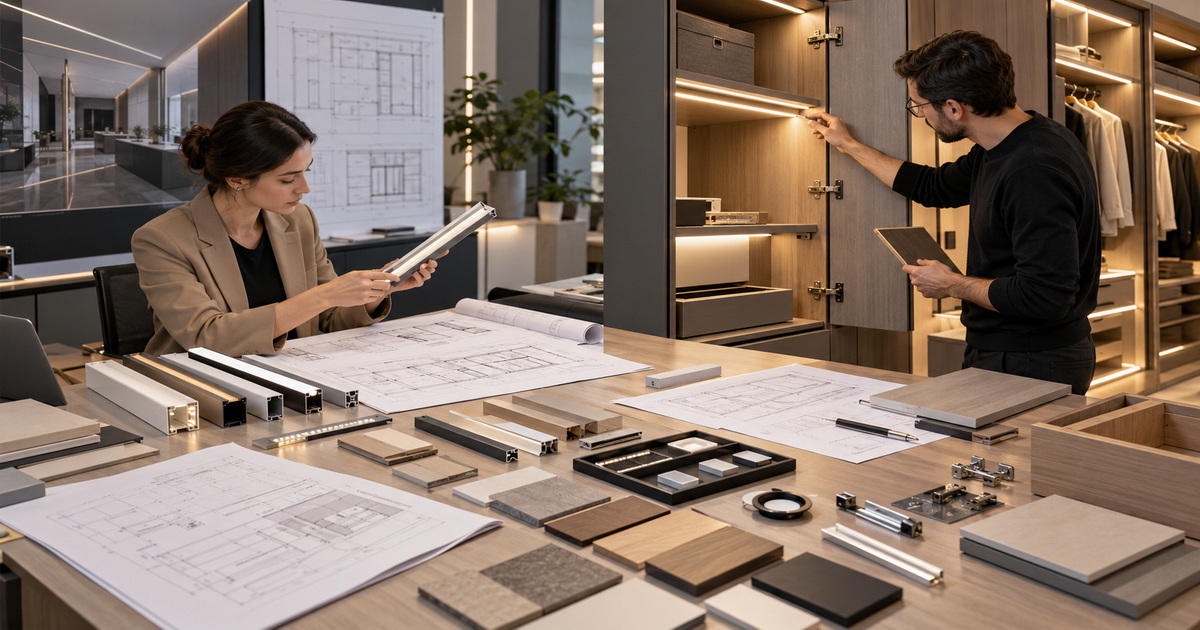
| Supplier | Primary sourcing fit | Capacity evidence to request | MOQ position | Certification and conformity evidence |
|---|---|---|---|---|
| Farwise | China-based factory-direct furniture-lighting OEM/ODM | Production and QC records for the proposed line; available slots for repeat orders | Quote by standard design versus new tooling | Current product-specific EU documents and any claimed management-system certificates |
| LED Linear | Made-to-order architectural systems | Project schedule and production plan for the exact assembly | Quote by configured project | Applicable declarations, test evidence, and any certificate claimed for the quoted product |
| PROLED / MBN | Flex-tube systems and controls | Assembly schedule and component availability | Quote by family and finishing method | Documents matching tube, feed, controller, and any custom changes |
| Barthelme | Tailored strip-and-profile assemblies | Assembly capacity and sourcing plan for the selected components | Quote by finished assembly | Documents for the specific strip, luminaire, and control combination |
| rutec | Germany-based range and distribution | Stock position, replenishment source, and repeat-order plan | Confirm by stock item versus requested variant | Product documents and evidence identifying the manufacturer-of-record |
| ARDITI | Neon lines with system accessories | Availability of both light line and finishing components | Confirm by complete kit | Documents covering the assembled line and supplied connections |
| LED-Konzept | Configured local supply | Current stock and availability of matching accessories | Confirm by selected length and finishing service | Product-level documents; clarify who is responsible for any cut-and-resealed item |
An LED neon strip can look uniform during a brief desk test yet fail after installation. The usual procurement mistake is to approve the visible light effect while leaving the jacket compound, cut-end method, cable entry, and mounting conditions undefined.
Materials first. Ask whether the proposed jacket and diffuser are silicone, PVC, or another material, and specify the approved construction on the purchase order. Do not accept "silicone-style" or "neon flex" as a material declaration. For exposed installations, require evidence appropriate to the actual environment—for example, resistance to expected sunlight, cleaning agents, or moisture. For furniture projects, check how the product sits against finished surfaces and whether its appearance remains acceptable in the final recess.
Process next. Review the permitted bending direction, how the line is supported, and whether cutting is allowed outside the factory. LED-Konzept's installation notes, for example, call for resealing after cutting and leave room for the jacket to expand and contract; ARDITI's guidance cautions against twisting and incorrect bending. Those details are easy to overlook when a purchasing specification describes only the light effect.
Compliance is configuration-specific. CE marking is not evidence that an EU authority has approved a product, nor does it identify the product's country of origin. The European Commission says the manufacturer is responsible for assessing conformity, preparing the technical file, and issuing the EU Declaration of Conformity where applicable. RoHS restricts specified hazardous substances in electrical and electronic equipment. Request a declaration and supporting evidence that identify the exact product and applicable rules; a generic logo or unrelated test report is insufficient.
1. Issue one written brief. Give every shortlisted supplier the same installation description, drawings, finish expectations, destination market, forecast, and packaging needs. Mark unresolved requirements explicitly rather than letting a supplier assume them.
2. Request a documented sample. Require the sample to reflect the proposed production material, light appearance, cable exit, seal, mounting method, and labelling. A demonstration offcut is not a reliable substitute for the ordered assembly.
3. Test in the intended setting. Check visual uniformity from the real viewing position. Fit the sample into the actual channel or furniture detail, exercise its permitted bends, and inspect the finish after installation and normal cleaning.
4. Approve a controlled reference. Sign a sample approval record with photographs, drawing revision, material identification, component list, and any accepted deviations. Keep a physical reference where practical.
5. Inspect the first production shipment. Compare incoming goods with the approved reference, especially at cable exits, sealed ends, colour appearance, labels, and accessories. Record any discrepancy before releasing repeat orders.
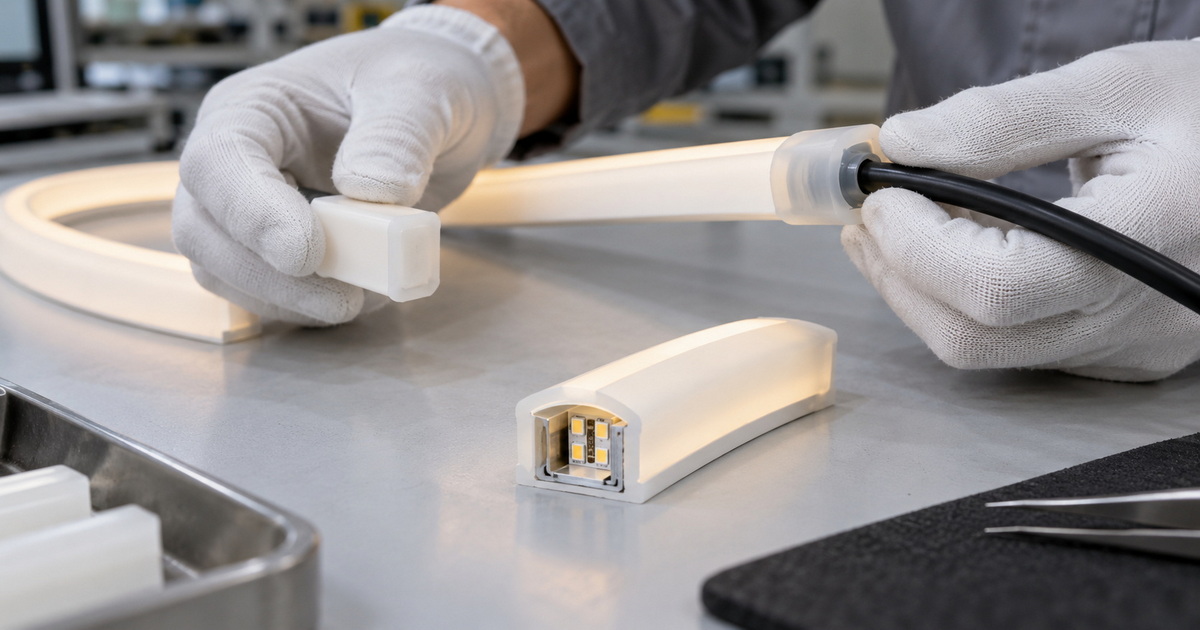
The most useful inside-the-workshop check is a cut-and-reseal trial using the *actual production team and method*, not a specially prepared sales sample. Ask the supplier to prepare a finished end as it would for an ordinary order, then document who performed the work, which sealing materials were used, and how the result was inspected. If site cutting is planned, repeat the exercise with the installer. This directly tests a handoff where responsibility often becomes unclear; it is a recommended verification method, not a claim that any listed company has a defective process. Published product guidance from PROLED and LED-Konzept shows why end feeds, water stops, and resealing deserve separate attention.
| Trap | Why it matters | How to avoid it |
|---|---|---|
| Material substitution after sampling | A visually similar jacket may behave differently in the intended environment | Name the approved compound or material specification in the order and retain a reference sample |
| Testing the strip but not the finished end | The connection and seal may be the installation's weakest point | Approve and inspect a production-method end assembly |
| Treating "Germany-based" as "made in Germany" | Design, stocking, assembly, and extrusion may happen in different countries | Request the manufacturing-site breakdown for the exact item |
| Comparing strip-only quotations | Feeds, caps, controls, profiles, and mounting parts affect installed cost | Compare complete bills of materials |
| Accepting a generic compliance file | Documents for another model may not cover a changed assembly | Match model, legal entity, revision, and accessories to the order |
| Leaving repeat-batch appearance open | A replacement section may look different beside installed lighting | Define an approved visual reference and a repeat-order change-control process |
For a German supplier, confirm whether the quote covers local delivery, export packing, or collection from its premises. For Farwise or any other overseas factory, request a written trade term, named handover location, packing method, shipment insurance responsibility, customs-document list, and importer-of-record decision. Compare landed, installable cost, not only the unit price.
Also clarify how flexible lines will be coiled and protected in transit, how custom-cut sections are labelled, and how feeds and mounting accessories are paired with the correct assemblies. On arrival, inspect packaging damage before installation. A replacement policy is more useful when it states what evidence the supplier needs, who pays for replacement freight, and whether a repeat item can be made to the approved reference.
Germany-based suppliers offer different strengths: LED Linear for engineered architectural systems, PROLED for flex tubes and controls, Barthelme for tailored assemblies, and rutec, ARDITI, and LED-Konzept for differing combinations of product range, components, and local supply. Farwise offers a separate China-based, factory-direct path to evaluate when furniture-lighting integration and OEM/ODM customization are priorities. Choose by documented fit, not by country label or list position.
Obtain the complete certificate and check the legal entity, site, covered activities, issuing body, status, and validity. ISO advises buyers to use IAF CertSearch for accredited certifications or contact the certification or accreditation body directly. An active certificate for a sales office does not automatically cover a different production site.
Not by itself. Ask the responsible economic operator for the applicable EU Declaration of Conformity and technical documentation for the *finished configuration*, then check whether customization changed the materials, electrical assembly, or other assessed characteristics. CE marking is a manufacturer's conformity declaration, while RoHS addresses restricted substances; neither is a blanket approval of every variant.
Ask the supplier to identify the legal manufacturer and map where the LED board is assembled, the jacket is made or applied, the ends are finished, and final inspection takes place. Request a site visit or live process review focused on the proposed product. A distributor may still be the right partner if it offers dependable stock and support; the issue is accurate accountability, not the label.
The sample and the installed assembly may have been sealed by different people using different methods or exposed to different conditions. Require separate approval for factory-finished and field-finished ends, written installation instructions, and a clear warranty boundary. PROLED's published attention to premoulded sealed feeds and LED-Konzept's resealing instructions illustrate why the finishing method must be specified, not assumed.
Keep an approved physical sample and record the product revision, material, light-appearance requirements, and acceptable inspection method. Put change notification and repeat-order matching in the supply agreement. When replacements will sit next to existing sections, test them together before release; a product name alone is not a sufficient visual acceptance standard.
1. - [ZVEI: German Electro and Digital Industry—Facts & Figures] — broader German electrical-industry context; not a neon-strip market estimate. [zvei]
2. - [German Federal Statistical Office: Foreign Trade] — official starting point for German trade data; product-specific claims require checking the relevant classification. [destatis]
3. - [CSIL: Long-Term Trends in the European Lighting Fixtures Market] — 2025 lighting-fixture industry analysis used for the market context above. [csilmilano]
4. - [European Commission: CE Marking] and [RoHS Directive] — official EU explanations of product responsibilities and restricted substances. [single-market-economy.ec.europa]
5. - [ISO: Certification Verification] and [IAF CertSearch] — starting points for checking claimed accredited management-system certificates. [iso]


