
Views: 222 Author: Farwise Lighting Publish Time: 2026-11-04 Origin: Site


Content Menu
● What Are Custom Bendable Linear Light Fixtures?
>> Flexible Lighting Versus Factory-Curved Fixtures
● Where Bendable Linear Lighting Adds Real Value
>> Curved Cabinets and Kitchen Islands
>> Wardrobes and Dressing Areas
>> Bathroom Vanities and Bedroom Furniture
>> Retail and Hospitality Interiors
● How to Choose the Right Bendable Linear Lighting System
>> Confirm the Bending Direction
>> Evaluate the Complete Light Line
● Lighting Quality: Look Beyond the Shape
>> Check Materials Under the Proposed Lighting
>> Review Glare from Everyday Positions
>> Test Dimming and Sensors Together
● A Practical OEM/ODM Customization Workflow
>> 1. Share the Installation Context
>> 3. Review Manufacturability
>> 4. Approve a Representative Mock-Up
>> 5. Freeze the Approved Configuration
>> 6. Plan Delivery and Installation
● A Mock-Up Review That Prevents Avoidable Rework
● Illustrative Design Scenario: A Curved Wardrobe Display
● What to Request from a Custom Lighting Manufacturer
● How Farwise Supports Custom Furniture Lighting Projects
● Turn Your Curved Lighting Concept into a Practical Solution
>> 1.Can bendable linear lights follow any curve?
>> 2.Are flexible LED strips and curved light fixtures the same?
>> 3.Can these fixtures be integrated into smart furniture?
>> 4.Is bendable linear lighting suitable for bathroom cabinets?
>> 5.What should we provide for an OEM/ODM inquiry?
>> 6.How can buyers reduce visible joints and dark areas?
Custom bendable linear light fixtures help designers bring continuous illumination to curved furniture, rounded cabinetry, and architectural details that straight lighting cannot follow naturally. However, a successful installation requires more than a flexible light source. The lighting system must also suit the furniture construction, installation environment, control method, and maintenance needs.
At Farwise Technology Co., Ltd., we bring 16 years of LED lighting manufacturing experience to commercial and residential projects. Our furniture lighting portfolio supports cabinets, wardrobes, bathroom vanities, and bedroom furniture, alongside broader interior applications. Through OEM/ODM services, we help customers develop customized lighting solutions around their dimensions, functions, appearance, and project requirements.

Custom bendable linear light fixtures are lighting assemblies designed to follow curved or irregular layouts. Depending on their construction, they may use flexible LED circuits, silicone diffusers, compatible mounting channels, or factory-shaped housings.
The important distinction is that a flexible strip, a diffuser, and a complete fixture are not interchangeable products. Each performs a different role.
A complete solution coordinates:
- The light source and its supporting structure.
- Diffusion and shielding.
- Mounting accessories and connection points.
- Power supplies and controls.
- Installation access and replacement arrangements.
The goal is not simply to bend the light. It is to create an integrated system that looks intentional and remains practical after installation.
Flexible silicone lighting can follow contours when installed within its approved bending direction and handling limits.
Factory-curved fixtures use a shaped supporting structure to create a defined architectural form. They are useful when the housing itself must remain visually precise.
Some designs combine flexible lighting with rigid supports. Selecting the right approach starts with the installation, not the product name.
Curved lighting works best when its shape supports a functional or visual purpose. Following every available edge can create visual clutter; carefully selected lines create hierarchy.
Custom curved cabinet lighting can follow rounded island bases, display edges, or open shelving. Concealed placement can emphasize the furniture outline without making the light source dominant.
Reflective stone, polished doors, and metal finishes deserve particular attention. A concealed fixture may still create an uncomfortable reflection from another viewing position.
Wardrobe lighting should help users identify garments and navigate storage.
Vertical placement can illuminate hanging clothes differently from a light positioned above a shelf. Curved layouts also require coordination with doors, partitions, hinges, and cable routes.
Automatic switching can improve convenience, provided the sensor arrangement matches how the wardrobe opens and how users approach it.
Bathroom cabinet lighting requires assessment of moisture exposure, cleaning practices, and applicable installation rules. A protected light source does not automatically make every connector or power supply suitable for the same location.
For beds and headboards, concealed lighting can provide ambient illumination. Reading tasks generally need separate consideration rather than relying entirely on decorative contour lighting.
Curved linear lighting can reinforce reception desks, display furniture, and circulation routes.
Here, consistency matters across repeated installations. A successful sample should become an approved reference for appearance, assembly, and installation—not merely a photograph used for inspiration.
| Project need | Suitable direction to explore | Main decision |
|---|---|---|
| Concealed furniture contour | Flexible lighting with compatible support | Visibility and installation access |
| Visible architectural curve | Factory-shaped fixture | Shape accuracy and finish continuity |
| Repeated cabinet production | Standardized custom assembly | Repeatability and connection consistency |
| Bathroom furniture integration | Environment-appropriate complete system | Protection of all exposed components |
| Smart furniture lighting | Coordinated lighting and controls | Reliable switching and dimming behavior |
"Bendable" does not mean unrestricted movement.
Some products bend in one plane. Others accommodate more complex forms. A layout that combines flat curves with elevation changes may therefore need a different construction from a simple horizontal arc.
Ask the manufacturer to review drawings showing the actual bending direction. Avoid relying on a perspective rendering alone.
A smooth illuminated line depends on the relationship between the source, diffuser, mounting position, and surrounding surfaces.
Curves can make joints and shadows more noticeable. End sections, cable entries, and transitions deserve the same attention as the middle of the fixture.
Evaluate the finished assembly rather than assuming that an individual component guarantees a seamless result.
A fixture can follow the furniture perfectly and still deliver disappointing light.
Color appearance, glare, distribution, and control behavior all affect the finished experience. These qualities should be evaluated together, not treated as separate purchasing decisions.
Wood grain, textiles, painted panels, and stone can look different under different light sources.
For furniture projects, review representative material samples under the proposed lighting. Where multiple illuminated sections appear together, check whether their light looks consistent.
This is especially useful for wardrobes, display cabinets, and projects combining several furniture finishes.
A light source hidden from a standing designer may remain visible to someone seated nearby.
Inspect the mock-up while standing, sitting, approaching the furniture, and using adjacent mirrors or screens. Pay attention to reflections as well as direct visibility.
The practical question is whether the installation supports comfortable use—not whether the fixture appears concealed in one photograph.
Controls should be tested as part of the assembled system.
Check switching, dimming, sensor response, and behavior after power interruption. Observe whether the light starts predictably and whether low-level operation remains comfortable.
Compatibility should be demonstrated with the intended components rather than assumed from separate product descriptions.
For custom bendable linear lighting, a structured approval process reduces uncertainty between design intent and production.
Provide drawings, furniture construction details, material references, and the intended lighting effect.
Include cable routes, service openings, mounting surfaces, and nearby moving parts. Explain whether the project is a one-off installation or a repeatable furniture range.
Clarify who supplies the fixture, power supply, controls, connectors, and installation accessories.
Also establish who approves electrical suitability and installation compliance. Unclear responsibility can leave important interfaces unresolved until the site stage.
The manufacturer should assess the proposed curve, assembly method, mounting approach, and access requirements.
Changes made here are generally easier to accommodate than changes discovered after furniture fabrication.
Use a sample that includes a meaningful curve, a connection, and the intended mounting arrangement.
Review it with the actual furniture finish wherever possible. A short straight sample cannot demonstrate every challenge in a curved installation.
Record the accepted appearance, component arrangement, connection method, and packaging requirements.
Any later substitution should receive review before production continues. This protects consistency between the approved sample and delivered assemblies.
Agree on identification labels, handling instructions, and installation sequencing.
For shaped assemblies, packaging should protect the approved form. Installers should not need to force a finished fixture into a position it was not designed to accommodate.
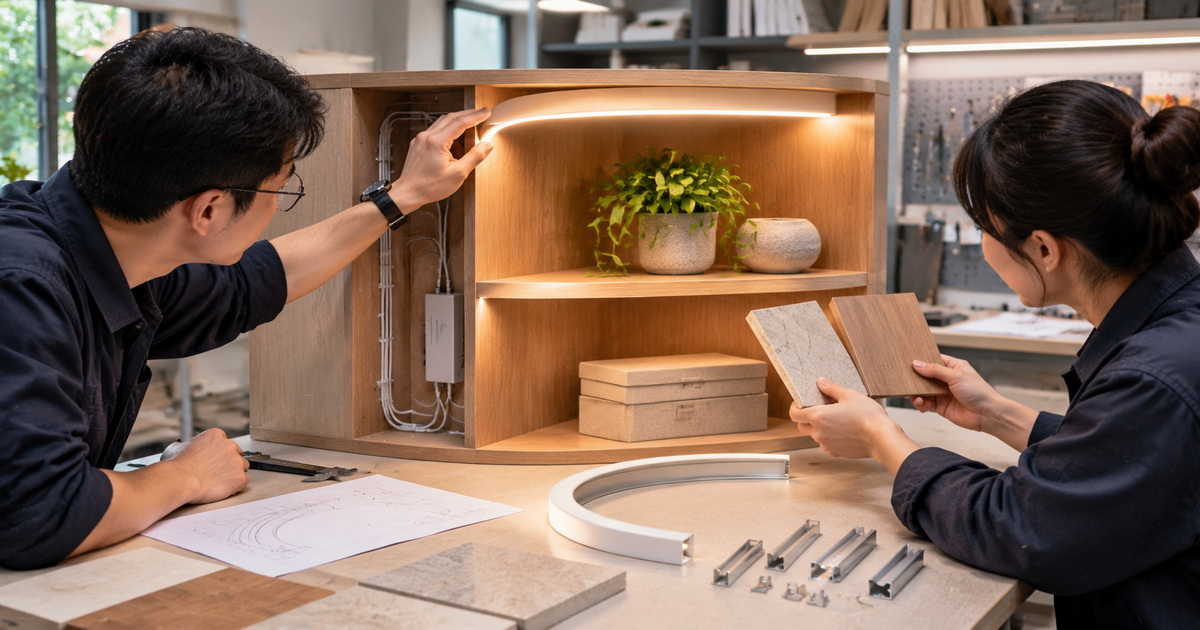
The highest-value review is often a practical inspection of the assembled lighting and furniture.
Use the following checklist before approving production:
1. Does the curve follow the intended furniture line?
2. Are joints, end sections, and cable entries visually acceptable?
3. Can installers secure the assembly without forcing it?
4. Are reflections comfortable from normal viewing positions?
5. Do doors and drawers move without interfering with wiring?
6. Do controls behave consistently during repeated use?
7. Can serviceable parts be reached after installation?
For serviceability, ask one additional question: if a component needs replacement, what must be removed to reach it?
A concealed installation is not automatically a maintainable installation. Access should be designed before furniture construction is finalized.
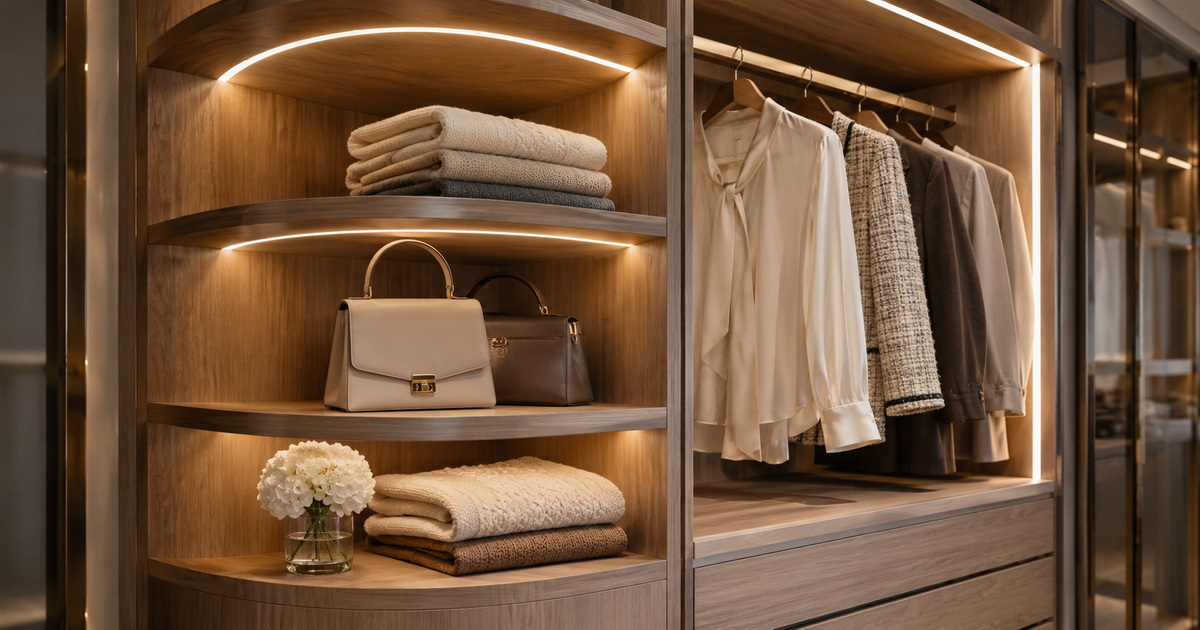
Consider a furniture brand developing a wardrobe with a rounded display section. This is an illustrative scenario, not a documented Farwise customer project.
The initial concept uses a continuous light line around the display perimeter. During review, the team identifies three issues: the source appears in a mirror, the cable route crosses a removable shelf, and the sensor is obstructed when the door opens.
The revised design conceals the source behind a furniture detail, reroutes the cable through an accessible section, and relocates the sensor.
The lesson is straightforward: the curve is only one part of the solution. Viewing positions, furniture movement, and maintenance access determine whether the design works in daily use.
A useful supplier discussion should produce more than a quotation.
Request information that helps your team make and document decisions:
- A clear distinction between components and complete assemblies.
- Confirmation of suitable bending and installation methods.
- A representative sample approval process.
- Documentation relevant to the destination market.
- Instructions covering connections, handling, and maintenance.
- A defined process for production changes and replacement parts.
Do not assume that a component approval automatically covers the completed installation. Ask which documentation applies to the exact configuration being supplied.
Likewise, avoid judging proposals on the fixture price alone. Assembly effort, installation complexity, replacement access, and consistency can materially affect project value.
Farwise Technology Co., Ltd. focuses on the development, production, and supply of commercial and residential LED lighting solutions.
Our OEM/ODM approach supports customization of dimensions, functionality, appearance, and system configuration. Applications include cabinets, wardrobes, bathroom furniture, beds, and coordinated interior lighting.
For buyers, the most productive starting point is a clear project brief. Share the furniture layout, intended lighting effect, control preferences, installation environment, and destination market. These details create a stronger basis for evaluating a workable solution.
The strongest custom bendable linear light fixtures unite design intent with installation practicality.
Send Farwise your furniture drawings, curved lighting concept, finish references, and control requirements. Our team can review your customization needs and help define an OEM/ODM solution for your next furniture collection or interior project.
No. Suitability depends on the product's construction, approved bending direction, and installation method. Submit the actual layout for review before selecting the lighting system.
No. A flexible strip is a light-source component. A complete curved fixture also addresses support, diffusion, mounting, connections, and integration with the surrounding installation.
Yes, when compatible controls are selected and tested with the lighting system. Confirm the intended switching, dimming, and sensor behavior before approving production.
It can be, but suitability depends on the installation location and complete system. Review moisture exposure, connections, power supply placement, and applicable local requirements.
Provide drawings, application details, finish references, control preferences, installation conditions, and destination-market requirements. Include service-access expectations and whether the design will be used across a furniture range.
Review the assembled design, including curves, connectors, ends, and mounting details. Approve a representative illuminated mock-up rather than relying only on component images.
1. - [SignliteLED — "Custom Bendable Linear Light Fixtures: The Perfect Lighting Solution for Complex Architectural Projects," Steven Quan, May 27, 2025.] Original article reviewed for its discussion of curved lighting construction, applications, and customization. This rewrite expands system selection, furniture integration, mock-up approval, controls, and maintenance planning. The original page displays no customer comments; no testimonials or competitor project claims have been presented as Farwise experience. [signliteled]
2. - [U.S. Department of Energy — "LED Color Characteristics."] Technical background for color consistency, color stability, material appearance, and the relationship between color quality and other lighting-quality considerations. [energy]
3. - [U.S. Department of Energy — "Lighting Specification Guidance for Schools," November 2024.] Supports the general discussion of light distribution, color quality, contextual glare, flicker, and evaluating lighting in place. Its school-specific recommendations are not presented here as furniture product requirements. [energy]
4. - [UL Solutions — "Opportunities and Impacts of Revisions to UL 2108, the Standard for Low Voltage Lighting Systems."] Background for the importance of configuration-specific safety documentation and requirements affecting field-cuttable low-voltage lighting. This reference does not establish certification of any Farwise product. [ul]
5. - [Farwise Lighting — Official Website.] Manufacturer-published background on furniture and cabinet lighting, flexible silicone lighting, and OEM/ODM services. The statement of 16 years' experience and company-specific customization scope follows the company brief supplied for this article. [farwiselighting]
6. - [Farwise Lighting — "360 Round LED Neon Flex: A Complete Guide to Design, Installation, and Custom Lighting Projects."] Manufacturer-published context on flexible-lighting handling and the distinction between flexibility and unrestricted bending. The illustrative wardrobe scenario and purchasing checklists are editorial guidance, not reported customer results. [farwiselighting]


