
Views: 222 Author: Farwise Lighting Publish Time: 2026-10-09 Origin: Site


Content Menu
● What Is an FPCB in LED Strip Lighting?
● How a Flexible Printed Circuit Board Is Built
>> Flexible Insulating Substrate
>> Coverlay and Protective Layers
>> Connection Areas and Local Support
● Common FPCB Types and Their Lighting Relevance
● FPCB vs. Rigid PCB: Which Is Better for Furniture Lighting?
● What Silicone Adds to LED Silicone Strip Lights
● Three Reliability Questions Buyers Often Overlook
>> Is the Circuit Bent During Installation or Repeatedly During Use?
>> Does the Finished Assembly Have a Suitable Thermal Path?
>> Are Connections Protected from Installation Stress?
● A Practical FPCB Selection Process for Furniture Projects
>> Step 1: Define the Installation Environment
>> Step 2: Map the Lighting Route
>> Step 3: Review the Complete Electrical System
>> Step 4: Evaluate a Representative Furniture Sample
>> Step 5: Establish Acceptance Criteria
● Application Planning: Cabinets, Wardrobes, Vanities, and Beds
>> Cabinet Lighting: Plan Corners Before Assembly
>> Wardrobe Lighting: Keep the Circuit Clear of Movement
>> Bathroom Vanity Lighting: Review the Complete Assembly
>> Bed Lighting: Design for Future Access
● What to Ask an OEM/ODM LED Lighting Manufacturer
● Build Your Lighting Solution Around the Application
● Frequently Asked Questions About FPCB and LED Strip Lights
>> 1.What Does FPCB Stand For?
>> 2.Is an FPCB the Same as an LED Strip?
>> 3.Can Flexible LED Strips Bend in Every Direction?
>> 4.Does Silicone Make an LED Strip Waterproof?
>> 5.Are Flexible PCBs Better at Managing LED Heat?
>> 6.What Should Buyers Provide for Custom Furniture Lighting?
An FPCB, or flexible printed circuit board, is the electrical foundation of many LED strip lights. It carries the conductive pathways and supports the components that turn a flexible strip into a working lighting system. For LED silicone strip lights, understanding the FPCB helps buyers evaluate more than appearance: it connects circuit design with installation reliability, serviceability, and furniture integration.
At Farwise Technology Co., Ltd., our focus is furniture lighting that fits real applications. With 16 years in LED lighting, we develop and manufacture solutions for cabinets, wardrobes, bathroom vanities, and bedroom furniture, supported by OEM/ODM customization.
A flexible printed circuit board connects electronic components through conductive tracks supported by a flexible insulating substrate. Unlike a rigid circuit board, it can accommodate a defined bend or shaped installation.
In an LED strip, the FPCB supports LEDs and associated components while distributing electrical power along the circuit. However, flexibility does not mean the board can stretch, twist freely, or survive unlimited bending.
The distinction is important: flexible describes a designed mechanical capability, not freedom from installation restrictions.
For furniture manufacturers, this technology allows lighting to follow suitable contours and fit narrow spaces. The complete lighting assembly still needs compatible connectors, mounting support, power delivery, and protection appropriate to its environment.
An FPCB is a coordinated material system. Its performance depends on how its layers, conductors, protective materials, and connections work together.
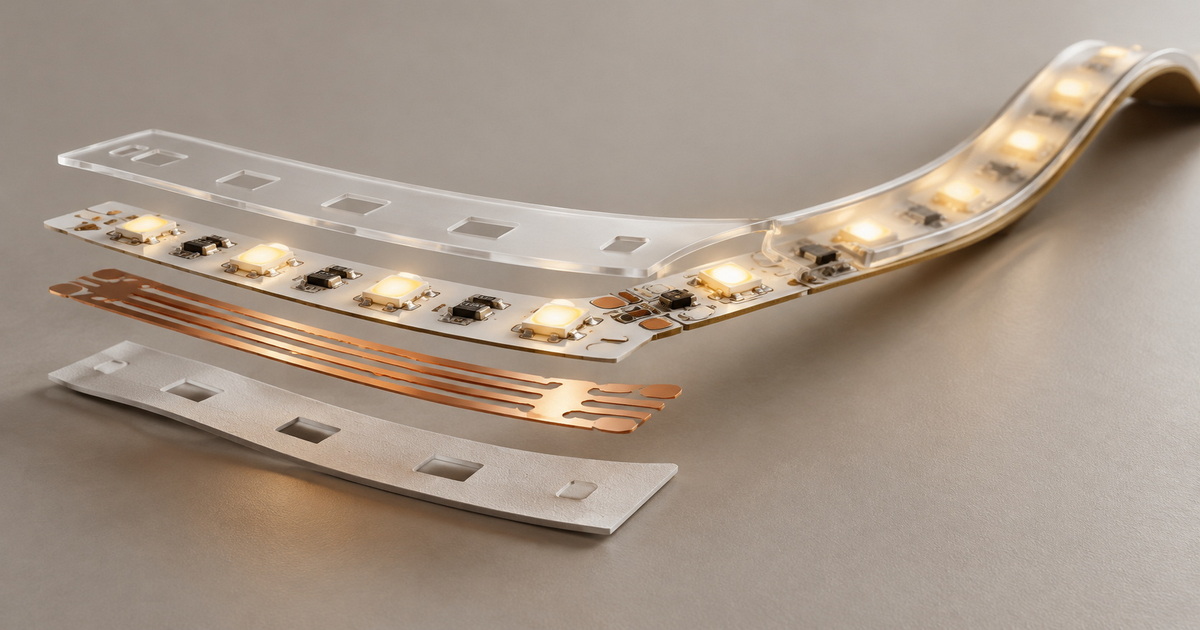
The substrate supports the conductive circuit while electrically separating it from surrounding structures.
Polyimide is widely used in flexible circuit materials. Its suitability depends on the complete construction and intended operating conditions, rather than the material name alone.
Copper pathways carry electricity between components.
Their design must match the electrical load and routing requirements. A strip that looks well finished can still perform poorly if its power distribution or connection layout is unsuitable for the installation.
Coverlay provides electrical insulation and environmental protection over circuit areas, while leaving necessary connection points accessible.
It should not be confused with an external silicone enclosure. These layers serve different purposes and must be evaluated separately.
Solder pads and connectors provide interfaces between the strip and the surrounding system.
Some flexible circuits use stiffeners where local support is needed. These reinforced areas help manage assembly and connection requirements, but they also influence where bending should occur.
Flexible circuits are available in several constructions. Greater complexity is not automatically an advantage.
| Circuit construction | General purpose | Buyer consideration |
|---|---|---|
| Single-sided flexible circuit | Provides a comparatively simple conductive layout | Assess whether it meets the application's electrical and mechanical needs |
| Double-sided flexible circuit | Enables additional routing possibilities | Review construction and connection requirements |
| Multilayer flexible circuit | Supports more complex interconnections | Confirm that complexity delivers a practical benefit |
| Rigid-flex circuit | Combines rigid component areas with flexible interconnections | Consider when the product needs both stable mounting and shaped connections |
The appropriate choice depends on the circuit design, installation geometry, and operating environment.
For furniture lighting, buyers should prioritize a suitable complete assembly instead of treating the number of circuit layers as a quality ranking.
Neither construction is universally better. They solve different integration problems.
A flexible PCB is useful when the circuit must accommodate a suitable contour or connect areas within a compact assembly. A rigid PCB provides a stable platform where bending is unnecessary.
| Selection factor | Flexible PCB | Rigid PCB |
|---|---|---|
| Installation geometry | Accommodates designed bends | Maintains a fixed shape |
| Component support | May need reinforcement in selected areas | Provides inherent structural support |
| Handling | Requires attention to bend zones and connections | Requires protection from other mechanical stresses |
| Application fit | Useful for flexible strips and shaped integration | Useful for fixed modules and assemblies |
Thermal performance is a separate question. A board is not automatically an effective cooling solution simply because it is rigid or flexible.
The complete heat-transfer path must be considered.
In LED silicone strip lights, the FPCB forms the electrical circuit, while the silicone enclosure serves a different role.
Depending on its design, silicone can contribute to physical protection and the finished appearance of the light. Its presence alone, however, does not establish that the assembly is suitable for every damp, enclosed, or demanding location.
Three interfaces deserve particular attention:
- The relationship between the circuit and enclosure.
- The cable entry and termination details.
- The relationship between the enclosed strip and mounting system.
For bathroom vanities, suitability must be assessed at the complete product level. Protective claims should cover the actual assembly, including its ends and connections.
For cabinets and wardrobes, enclosure selection should also account for cleaning practices, handling, and the intended installation method.
A useful FPCB guide should move beyond definitions and explain what happens after installation.
A circuit shaped once during assembly has different mechanical requirements from one that bends repeatedly in service.
A strip installed beneath a fixed shelf may only need installation flexibility. A circuit routed across a moving furniture joint presents a different challenge.
Do not assume ordinary flexible LED strip lighting is suitable for repeated movement. The intended movement must be communicated and evaluated before design approval.
LEDs generate heat. Their operating temperature influences light output, color behavior, and service life.
The relevant question is not simply whether the FPCB "dissipates heat." It is how heat travels through the complete assembly and into the surrounding environment.
An enclosed furniture cavity, a silicone enclosure, and the mounting surface can all affect that path.
Evaluate the strip in its intended installation rather than relying exclusively on an open-air demonstration.
A flexible circuit does not eliminate mechanical stress at its connections.
Pulling a cable, forcing a connector into a confined space, or bending close to a termination can concentrate stress in vulnerable areas.
Connection positioning, cable routing, and strain relief should therefore be addressed during furniture design—not left entirely to the installer.
A structured review helps turn a visually attractive sample into a repeatable lighting solution.
Describe where the lighting will operate and what surrounds it.
Include:
- Furniture materials and mounting surfaces.
- Enclosed or ventilated spaces.
- Possible moisture or cleaning exposure.
- Fixed or moving installation areas.
- Access for maintenance.
This context helps the manufacturer identify issues that a product photograph cannot reveal.
Show the proposed route, corners, cable exits, and connection locations.
Identify where the strip will bend and where it must remain supported. Avoid assuming that a flexible strip can follow every corner without a planned transition.
Discuss the strip, power supply, connectors, and controls together.
For smart furniture lighting, confirm the intended dimming and switching arrangement. A suitable FPCB cannot compensate for an incompatible control system or poorly planned power delivery.
Install the sample in a realistic assembly.
Check the visible lighting effect, cable organization, connection accessibility, and behavior during normal operation.
A sample mounted inside the intended furniture provides more useful evidence than a loose strip viewed on a workbench.

Agree on what constitutes an acceptable finished assembly.
Include workmanship, connection security, lighting consistency, installation fit, and any application-specific checks.
Where relevant, discuss flexible-board design guidance and qualification requirements separately. Design standards and finished-board acceptance requirements serve different functions.
The following are illustrative planning scenarios, not documented customer case studies.
Cabinet lighting often combines straight runs with transitions around shelves or partitions.
A better approach is to define the lighting route and connection method early. Forcing a strip around a tight corner during installation can introduce avoidable mechanical stress.
Wardrobe lighting may sit close to hinges, sliding mechanisms, and stored items.
Keep the strip and its wiring clear of moving hardware. If the circuit itself must move, treat that requirement as a separate engineering condition.
A protected strip is only part of the solution.
Cable entries, terminations, mounting details, and component placement must also suit the intended environment. Avoid extending a protection claim from the strip body to unverified connections.
Hidden lighting can improve the appearance of a bed frame, but concealment should not prevent servicing.
Plan access to connections and control components. A lighting system that can be maintained without damaging the furniture offers a practical ownership advantage.

A productive supplier discussion should connect customization with application requirements.
Ask:
1. What installation conditions informed the proposed construction?
2. Where may the strip bend, and which areas require support?
3. How will cable routing and connection stress be managed?
4. How will the lighting be evaluated inside the intended furniture?
5. Which inspections apply to the board and completed assembly?
6. How will changes between approved samples and production be controlled?
Request evidence appropriate to the project. Do not assume that a standard, certification, or inspection process applies unless the manufacturer confirms its scope.
At Farwise Technology Co., Ltd., we support OEM/ODM customization across dimensions, functions, appearance, and lighting configurations. Our development discussions should begin with the furniture application, so the proposed solution addresses integration rather than appearance alone.
The right FPCB supports the lighting system; it does not replace system-level planning.
For a customized furniture lighting project, send Farwise Technology Co., Ltd. your furniture drawings, application requirements, and preferred lighting appearance. Request an OEM/ODM review covering strip integration, connections, controls, and representative sample evaluation before approving production.
FPCB stands for flexible printed circuit board. It uses conductive pathways on a flexible insulating structure to connect electronic components.
No. The FPCB is the circuit foundation. A completed LED strip also includes LEDs, associated components, connections, and any additional protective or mounting features.
No. Permitted bending depends on the construction and product design. Follow the manufacturer's installation guidance, especially around components, connections, and reinforced areas.
Not automatically. Suitability depends on the verified protection of the complete assembly, including cable entries, ends, and connectors.
Not inherently. Thermal performance depends on the complete construction, mounting arrangement, enclosure, and operating environment. Flexibility alone does not establish cooling capability.
Provide the furniture layout, proposed lighting route, installation environment, control requirements, connection preferences, and service-access expectations. These details support a more useful design review.
1. - LEDYi Lighting, "Everything You Should Know About FPCB." Original article reviewed as the starting point for restructuring. Its broad benefit claims were not adopted as universal performance guarantees. [ledyilighting]
2. - Minco, "Flex Circuits Design Guide." Technical guidance supporting construction selection, mechanical planning, and application-specific design review. [minco]
3. - Minco, "Flex Circuit FAQ." Supports the distinction between installation bending and repeated flexing, and the importance of avoiding damaging creases. [minco]
4. - Qnity Electronics, "Pyralux® Flex Circuit Laminates and Adhesive Systems." Supports the explanation of flexible circuit material systems and coverlay functions. [qnityelectronics]
5. - DigiKey, "ABCs of LED Thermal Management." Supports the relationship between LED operating temperature, light output, color behavior, and lifetime. [digikey]
6. - IPC official standards listing, "IPC-2223 Standard Only." Identifies flexible-board design guidance and the separate qualification and performance standard. No Farwise compliance claim is implied. [shop.electronics]
7. - Farwise Technology Co., Ltd., company information supplied for this article. Source for the stated manufacturing experience, furniture-lighting applications, and OEM/ODM capabilities. No customer reviews, laboratory results, or independently verified case studies were supplied; none have been invented.


