
Views: 222 Author: Farwise Lighting Publish Time: 2026-10-07 Origin: Site


Content Menu
● LED Sheet Light vs. LED Strip Light: Key Differences
>> Light Distribution and Visible Finish
>> Shape, Cutting, and Service Access
>> Power, Controls, and Long Runs
● Which Works Best in Furniture Lighting?
>> Kitchen Cabinets and Display Shelves
>> Bathroom Vanities and Bed Frames
● How to Specify a Better System
● What Should OEM/ODM Buyers Ask?
● Common Selection Mistakes to Avoid
>> 1.Can LED strip lights replace LED sheets for backlighting?
>> 2.Are LED sheet lights always free of hotspots?
>> 3.Which is better for under-cabinet kitchen lighting?
>> 4.Can silicone LED strip lights be installed in a bathroom vanity?
>> 5.Which option is easier to dim or connect to smart controls?
>> 6.How do I compare costs fairly?
>> 7.Can sheet lights and strip lights be used in the same project?
Choosing between an LED sheet light and an LED strip light starts with a simple question: Are you lighting a surface or tracing a line? LED sheets are designed to illuminate broad translucent areas from behind. LED strips follow edges, recesses, and furniture details. Yet a good result depends on more than shape. The diffuser, mounting space, driver, controls, moisture exposure, and access for repairs all affect the finished installation.
For furniture manufacturers, interior designers, and project buyers, the wrong choice can create visible dots, dark seams, awkward wiring, or unnecessary rework. This guide compares LED sheet lights vs. LED strip lights in the places where decisions matter most: cabinetry, wardrobes, bathroom vanities, bed frames, display panels, and branded interiors. It also explains where silicone LED strip lights fit—and where they do not.

An LED sheet light is a relatively flat array of light sources arranged across a backing sheet. Depending on the design, that sheet may be flexible or comparatively rigid. It sits behind a translucent face, such as a diffuser or decorative panel, to create an illuminated area. The visible surface is a system result, not an automatic property of the sheet: LED layout, cavity depth, panel material, and seam placement all determine whether the viewer sees an even glow.
Sheets are useful when the illuminated object itself is broad. Think of a retail graphic, a decorative wall insert, or a translucent cabinet feature panel. They simplify the arrangement of many light sources across an area, although irregular cutouts, access openings, and wiring routes still need planning.
An LED sheet is not the same thing as a finished ceiling panel luminaire. Nor is every sheet safe to trim anywhere. The permitted cut lines and connection method depend on the actual product. Buyers should request drawings and instructions before designing a custom outline.
An LED strip light is a linear circuit carrying a sequence of LEDs. It can run beneath a cabinet, inside a wardrobe, along a bed-frame recess, or around a display perimeter. Many versions are flexible and cuttable at marked locations. A strip creates a line of light first; a channel, lens, silicone extrusion, or reflected mounting position determines how that line appears to the eye.
A silicone LED strip light typically adds a protective, light-diffusing silicone body around the lighting element. Depending on its construction, it can produce a softer visible line and suit shaped furniture details. However, "silicone" does not by itself prove that the full assembly is appropriate for splashes, steam, or outdoor use. End caps, joins, power connections, and the product's location rating matter too.
Some strips can illuminate an area when arranged in parallel behind a diffuser. That does not make them identical to sheets. It changes the installation work: the designer must account for spacing between runs, the path of every connection, and the appearance of gaps under the actual facing material.
| Decision factor | LED sheet light | LED strip light |
|---|---|---|
| Primary visual role | Backlights a broad surface | Defines an edge, recess, or continuous line |
| Best-fit geometry | Panels and relatively broad shapes | Narrow details, contours, and long furniture features |
| Uniformity challenge | Seams, cavity depth, and diffuser interaction | Visible dots, reflections, and gaps between parallel runs |
| Installation planning | Sheet layout, cut permissions, panel access | Routing, cut points, channels, and power-feed locations |
| Typical repair approach | Access and replace a sheet section or module, if the design allows | Access and replace an affected strip segment, if the design allows |
| Cost comparison | Judge against finished backlit area and installation labor | Judge against installed line, profile, wiring, and labor |
Neither format is inherently brighter, more efficient, longer lasting, or cheaper in every project. Those outcomes depend on the selected components and the way they are installed. Comparing only the material price gives an incomplete picture, especially when one proposal includes diffusion, drivers, and accessible wiring while another does not.
A sheet is a practical starting point for broad, even backlighting, but it can still reveal hotspots or dark bands. The diffuser may be too transparent; the cavity may be too shallow; or the sheets may meet along a visible seam. Always test the intended facing material with the intended light source before approving production.
A strip is better for a crisp line. If LEDs are individually visible in a polished stone, glass, or glossy laminate reflection, hiding the strip behind a lip or specifying a suitable diffuser may improve the appearance. A silicone-diffused strip can help achieve a smooth-looking line, but the result should be assessed from normal viewing angles and with the surrounding surfaces in place.
Both formats can be customizable, but neither offers unlimited freedom. A sheet may accommodate a panel cutout only within its approved cutting pattern. A strip bends along its intended axis and must not be forced around a corner that its construction cannot tolerate. Silicone-encased products may have additional rules for cutting and resealing.
Access is easy to overlook. A beautiful, permanently sealed furniture panel can make a simple lighting repair expensive. Design a removable cover, an accessible driver compartment, or another practical service route. Agree on how a replacement part will be identified and installed before the joinery is finalized.
Both systems need a compatible power supply and an appropriate control method. A sheet is not automatically harder to dim, and a strip is not automatically easier; the actual driver, controller, and lighting module must work together. For responsive wardrobe or cabinet lighting, confirm that door sensors, dimmers, and any smart-control interface have been tested as a complete system.
Long strip runs deserve particular attention. Voltage drop can leave the far end visibly dimmer. Splitting the design into planned sections or using suitable additional power feeds may help, but the wiring must follow the manufacturer's instructions and the project's electrical requirements. Sheets also require careful planning where multiple sections share a power supply or controller.
Low-energy lighting still produces heat. Mounting a product in a tight cavity without an approved heat path can undermine light quality and service life. Do not assume every strip needs the same channel, or that every sheet can be fixed to any backing board. Follow the specific installation instructions and test the proposed assembly.
In bathroom cabinetry, decide whether the light may encounter condensation or direct water contact. Those are different conditions. Check the location rating of the complete product and connections, not just a claim about a silicone cover. Keep power supplies accessible and placed as their instructions and local rules require. Have a qualified professional review installations where electrical or wet-location requirements are uncertain.
The correct choice is easier when the designer names the visible effect first. "Light the cabinet" is ambiguous. "Make the worktop usable without seeing LED dots" is a workable brief.
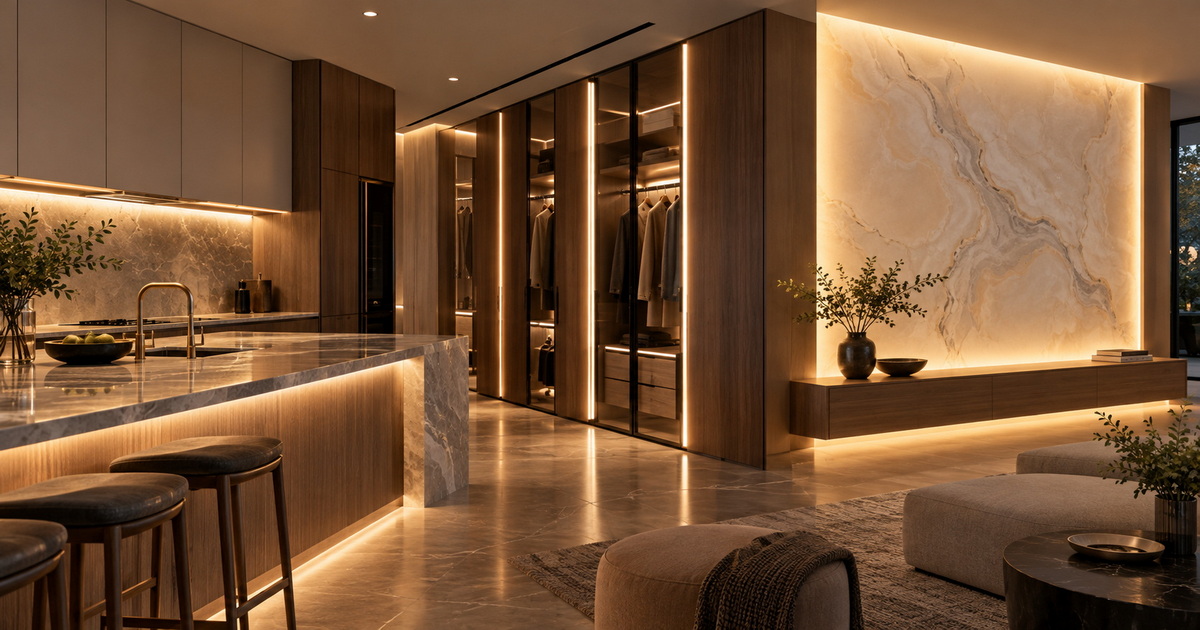
For under-cabinet task lighting, a strip in a suitable channel often follows the worktop neatly. Its position should help light the work surface without placing the source in the viewer's direct sightline or creating harsh reflections. A diffuser can soften the appearance, while the cabinet construction can conceal wiring.
For an illuminated cabinet door insert or a glowing display back panel, an LED sheet may be a more direct starting point. It spreads light behind the panel rather than outlining the panel's perimeter. If the illuminated insert is small or unusually shaped, however, a carefully laid-out strip arrangement may be more practical. A mockup, not a generic category claim, should settle the choice.
Wardrobe lighting benefits from clearly defined lines along rails, shelves, or vertical sides. Strips can follow those features and support door-activated lighting when paired with compatible controls. Position them so stored clothing does not block the beam or press against the lighting assembly.
A backlit wardrobe panel serves a different purpose: it creates a visual feature rather than simply lighting the contents. An LED sheet can suit that brief if the panel, diffuser, and service access have been designed together. The two formats may coexist without duplicating each other's job.
A bathroom vanity may use a strip beneath the cabinet for a floating effect, while a broad translucent detail calls for a sheet. In either case, assess moisture exposure at the exact installation position, including joints and connections. Do not substitute a decorative silicone sleeve for a verified location rating.
A bed-frame recess usually favors a linear product because the light needs to follow the furniture edge. A silicone LED strip can create a softer visible contour where the design calls for it. For a glowing headboard insert, a sheet may suit the larger illuminated face. In both settings, hide glare from the normal seated or lying position.
Many comparison articles stop at "sheets for surfaces, strips for lines." That distinction is helpful, but a procurement decision needs a repeatable process. The following sequence gives designers and buyers a way to compare finished results rather than isolated products.
1. Describe the outcome. State whether the viewer should see a luminous surface, a visible line, or light falling onto a task area. Identify the normal viewing position.
2. Map the construction. Share furniture drawings, panel materials, cavities, corners, hinges, access points, and expected moisture exposure with the lighting supplier.
3. Choose a candidate layout. Select a sheet for a broad backlit face or a strip for a linear detail, then test exceptions where geometry makes the obvious choice difficult.
4. Coordinate the system. Confirm the proposed light source, mounting method, diffuser, power supply, controls, connectors, and wiring route are compatible.
5. Build a representative mockup. Use the real facing material and examine the result when the room lights are on and off. Look for dots, seams, glare, color mismatch, and uneven edges.
6. Plan replacement before approval. Confirm how installers will reach the driver and the light source without damaging finished furniture.
This approach is particularly useful for repeat-order furniture programs. An approved sample becomes the visual reference for production and helps different installation teams judge the same result. It also reveals when a lower-cost component would require additional fabrication or finishing work.
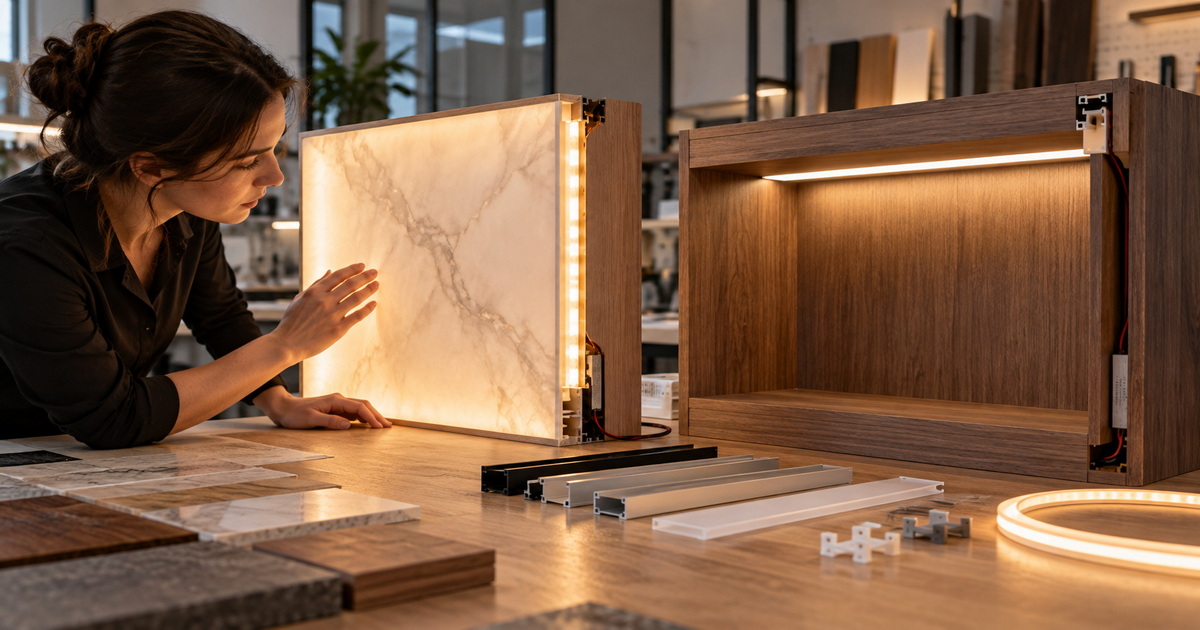
When sourcing a furniture lighting system, ask for more than a product photo. A useful request for quotation includes the application drawing, desired visual effect, installation environment, control behavior, and intended service method. That gives the supplier a chance to challenge an unsuitable choice before tooling or cabinetry is committed.
Ask prospective suppliers to clarify:
- Which sheet or strip variants are appropriate for the proposed material and mounting position?
- Where may the product be cut, joined, or bent, and how are exposed ends finished?
- What complete driver-and-control combination has been evaluated for the intended behavior?
- Which documents support the stated installation environment and market requirements?
- How will approved samples, production appearance, packaging, and replacement parts be managed?
Farwise Technology Co., Ltd. has described itself as a furniture-lighting manufacturer with experience in LED silicone strip lights and OEM/ODM customization. For a prospective project, the practical next step is to ask its team to review the drawings and propose a project-specific lighting layout. Product suitability, certifications, and final performance should be confirmed against the actual model and sample rather than assumed from the company's broader range.
- Treating uniformity as a product label. Even a sheet needs a compatible diffuser, cavity, and layout.
- Choosing by unit price alone. Add channels, panel fabrication, wiring, installation, and future access to the comparison.
- Assuming silicone means waterproof. Evaluate the entire assembly and the conditions at its actual location.
- Ignoring reflected glare. A light hidden from direct view can still appear as dots in a glossy door or worktop.
- Sealing everything shut. Make drivers and light modules serviceable wherever the design permits.
The strongest specification is not the one with the most impressive isolated component. It is the one that produces the intended appearance, fits the furniture, and can be installed and maintained with confidence.
Sometimes. Parallel strip runs can backlight a panel, but spacing, wiring, diffusion, and the panel cavity must be tested together. For a broad face, a sheet may reduce layout complexity. For an irregular insert, strips may offer a practical alternative.
No. Visible hotspots depend on the complete optical assembly, including the face material, distance from the LEDs, sheet layout, and seams. Ask for a mockup using the actual panel material before signing off on the appearance.
A strip is usually the more natural fit for a long, narrow worktop run. Choose the mounting position and diffuser for useful task light and comfortable viewing. A sheet makes more sense when the goal is to illuminate a broad translucent cabinet feature.
They may be suitable if the exact product, connections, and installation method match the moisture conditions at that location. Check the complete assembly's rating and the supplier's instructions. A silicone housing alone is not sufficient evidence.
Neither format wins by default. Dimming and smart features depend on the light engine, power supply, controller, and sensor being compatible. Test the intended control sequence with a sample, especially where a door switch and dimming control must work together.
Compare a finished, working installation rather than the sheet or strip alone. Include mounting, diffusion, drivers, controls, wiring, fabrication time, and future access. The most economical choice may change with panel shape, production volume, and service requirements.
Yes. A display unit might use a sheet behind a translucent brand panel and a strip under its shelves. Give each format a distinct purpose, then coordinate the color appearance, controls, wiring, and service access across the complete installation.
1. - SignliteLED, ["LED Sheet Light vs. LED Strip Light: What's the Difference?"] — baseline comparison of formats, use cases, and installation approaches.
2. - Evo-Lite, ["Backlighting Design Guide: Choosing the Right LED Light Sheet for Your Application"] — diffuser selection, seams, cavity planning, mockups, and backlighting quality.
3. - ENERGY STAR, ["Learn About LED Lighting"] — LED light-output maintenance and the importance of thermal management.
4. - Flexfire LEDs, ["LED Strip Light Voltage Drop: What Is LED Voltage Drop and How to Fix It"] — causes and practical mitigation of uneven output along strip runs.
5. - UL Solutions, ["Opportunities and Impacts of Revisions to UL 2108"] — context for installation instructions and markings on field-cuttable low-voltage lighting.
6. - Lumens, ["UL Listings for Lighting and Ceiling Fans: What Do UL Ratings Mean?"] — distinction between dry, damp, and wet installation environments.
7. - Farwise Technology Co., Ltd., company background supplied by the client for this brief — company history, product scope, and OEM/ODM positioning; independently unverified for this article.


