
Views: 222 Author: Farwise Lighting Publish Time: 2026-09-19 Origin: Site


Content Menu
● Why LED Linear Lighting Installation Matters
● What Is Recessed LED Linear Lighting?
>> Key Advantages of Recessed Installation
>> Limitations of Recessed Installation
● What Is Suspended LED Linear Lighting?
>> Key Advantages of Suspended Installation
>> Limitations of Suspended Installation
● What Is Surface-Mounted LED Linear Lighting?
>> Key Advantages of Surface-Mounted Installation
>> Limitations of Surface-Mounted Installation
● Recessed vs. Suspended vs. Surface-Mounted Comparison
● How to Choose the Right Mounting Method
>> Step 1: Check the Physical Structure
>> Step 2: Define the Lighting Purpose
>> Step 3: Evaluate Visual Comfort
>> Step 4: Plan Drivers and Controls Early
>> Step 5: Consider the Full Lifecycle
● Practical Application Examples
>> Recessed Lighting for Premium Cabinetry
>> Suspended Lighting for an Open-Plan Office
>> Surface-Mounted Lighting for a Retrofit Project
● Why Work with Farwise Technology
● FAQ
>> 1. Which LED linear lighting installation method is best for a renovation?
>> 2. Is recessed LED linear lighting suitable for cabinet and wardrobe projects?
>> 3. When should I choose suspended LED linear lighting?
>> 4. Does surface-mounted lighting always look less premium?
>> 5. Why is driver accessibility important in LED lighting projects?
>> 6. Can these installation types work with smart-home controls?
>> 7. What should buyers provide before requesting a customized solution?
Choosing between recessed, suspended, and surface-mounted LED linear lighting is not simply a styling decision. It influences construction coordination, visual comfort, maintenance access, future adaptability, and how occupants experience the entire space.
For architects, lighting designers, contractors, furniture manufacturers, and commercial project buyers, the best installation method is the one that aligns with the ceiling structure, intended use, visual language, installation schedule, and long-term service plan. At Farwise Technology Co., Ltd., we have spent 16 years supporting furniture and architectural lighting projects with practical LED lighting solutions, including LED silicone strip lights, cabinet lights, wardrobe lights, bathroom cabinet lights, and LED power supplies.

A linear luminaire can look excellent in a product catalogue but perform poorly in a real project if the mounting method is selected too late. In my experience working with lighting applications, many issues begin when fixture selection happens before the project team evaluates ceiling depth, power routing, maintenance access, furniture construction, or visual sightlines.
The three main mounting methods—recessed LED linear lighting, suspended LED linear lighting, and surface-mounted LED linear lighting—can use similar light sources. Yet they create very different project outcomes.
A good decision should consider:
- Ceiling or furniture structure
- Architectural style and visual priorities
- New-build versus renovation conditions
- Installation complexity and project timing
- Driver placement and wiring access
- Maintenance and replacement strategy
- Glare control and visual comfort
- Flexibility for future layout changes
- Integration with sensors, dimmers, and smart controls
Industry guidance for indoor workplaces treats illumination, glare limitation, colour quality, maintenance, and surrounding brightness as interconnected design factors rather than isolated fixture specifications. That means the mounting method should support the complete lighting environment, not only the appearance of the fixture.
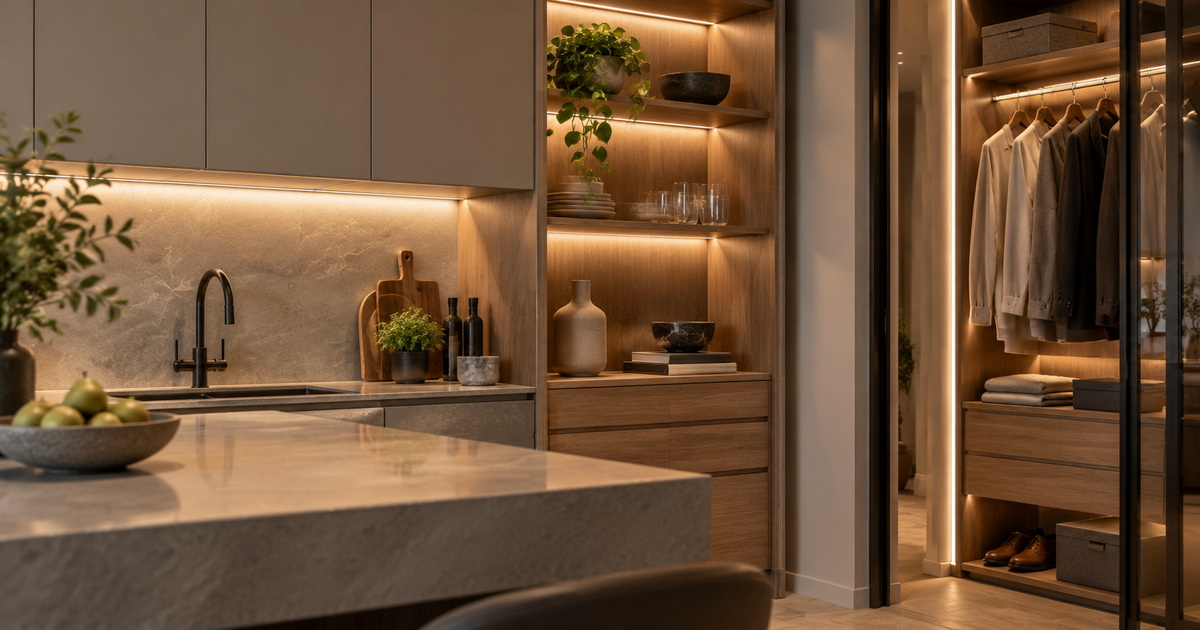
Recessed LED linear lighting is installed into a prepared slot or cavity in a ceiling, wall, cabinet, wardrobe panel, shelf, or other architectural surface. Once completed, the fixture body is mostly hidden. Only the diffuser or the illuminated line remains visible.
This approach is often chosen when the project requires a clean, integrated, high-end appearance.
- Creates a seamless architectural finish
- Reduces visible fixture bulk
- Supports minimalist interior design
- Works well for continuous lines of light
- Can integrate naturally into cabinetry, wardrobes, and wall panels
- Helps keep visual attention on furniture, materials, or displays
In premium hospitality, retail, office, and residential interiors, recessed linear lighting can make the space feel calmer and more intentional. A narrow line of light can guide movement through a corridor, highlight a wall texture, illuminate a wardrobe interior, or provide discreet task lighting beneath cabinetry.
For furniture lighting, recessed installation is particularly valuable. A cabinet or wardrobe manufacturer can integrate a linear profile into the panel before final assembly, producing a result that looks designed into the furniture rather than added afterward.
Recessed lighting requires earlier coordination than the other two methods. The installer must confirm the cut-out, cavity depth, mounting method, wiring route, driver location, and access for service before the ceiling or furniture component is finished.
Common challenges include:
- Limited cavity depth above ceilings
- Concrete slabs that cannot be easily cut
- Inaccurate cut-outs or alignment issues
- Difficult access to concealed drivers
- Reduced flexibility after final construction
- More coordination between lighting, electrical, joinery, and ceiling trades
Best use case: New construction, high-end renovations, custom joinery, luxury wardrobes, hotel corridors, display furniture, and minimalist commercial interiors.
Suspended LED linear lighting hangs below the ceiling using cables, rods, or suspension kits. Rather than disappearing into the architecture, the fixture becomes a visible design element.
This method works especially well in rooms with tall ceilings, exposed services, open plans, or areas where the lighting needs to define a zone without adding physical partitions.
- Adds visual depth and architectural character
- Can bring light closer to working surfaces
- Works well where recessed cavities are unavailable
- Helps define meeting, reception, collaboration, and dining zones
- Allows creative layouts, including continuous runs and geometric forms
- Provides more accessible wiring and servicing than concealed systems
Suspended linear luminaires can create rhythm in large spaces. In an open-plan office, for example, a suspended line above shared desks can visually organize the work area. In a showroom, it can draw attention to a product zone. In a reception area, it can reinforce the direction of circulation and the identity of the space.
The approach is also useful where ceilings contain exposed ducts, sprinklers, structural beams, or other services. Instead of fighting against a complex ceiling, the lighting system can become part of the industrial or contemporary visual language.
Suspended luminaires must be planned carefully. A poorly aligned fixture, uneven cable tension, visible power cord, or inappropriate hanging height can make an otherwise premium installation look unprofessional.
Consider these issues before selecting suspended lighting:
- Ceiling load capacity and secure fixing points
- Cable alignment and fixture leveling
- Clearance for doors, screens, equipment, or tall furniture
- Potential visual clutter in low-ceiling spaces
- Cleaning access in dusty or industrial environments
- Coordination with sprinkler heads, HVAC, signage, and acoustic panels
Best use case: Open offices, meeting rooms, schools, creative studios, showrooms, retail stores, reception desks, restaurants, and high-ceiling commercial spaces.
Surface-mounted LED linear lighting is fixed directly onto the face of a ceiling, wall, cabinet, shelf, or furniture panel. It is one of the most practical installation methods because it does not require a recessed cavity or suspension structure.
It is often the preferred option for retrofits, concrete ceilings, utility areas, renovation projects, and furniture applications where fast assembly matters.
- Straightforward installation
- Suitable for solid ceilings and finished surfaces
- Ideal for many retrofit projects
- Provides easier access for inspection and maintenance
- Reduces the need for structural modification
- Can be integrated into cabinets, wardrobes, mirrors, and shelving
Surface mounting is not automatically a "basic" choice. With slim aluminum profiles, well-matched diffusers, carefully planned joints, and clean cable routing, surface-mounted linear lighting can look deliberate and refined.
For cabinet and wardrobe lighting, a surface-mounted profile can be a strong solution when panel thickness does not allow recessing. It can be installed under a cabinet, along a shelf edge, inside a wardrobe, beside a mirror, or beneath a bed frame with minimal disruption to the furniture structure.
The main trade-off is visibility. Because the fixture sits on the surface, its body is part of the visual composition.
Potential limitations include:
- Fixture profile remains visible
- May not achieve a completely flush architectural appearance
- Requires careful cable concealment
- Can look bulky if the profile is poorly selected
- May be less suitable for highly minimal luxury interiors
Best use case: Renovations, hospitals, schools, warehouses, back-of-house areas, concrete ceilings, retail retrofits, under-cabinet lighting, wardrobe interiors, bathroom cabinets, and furniture upgrades.
| Decision Factor | Recessed LED Linear Lighting | Suspended LED Linear Lighting | Surface-Mounted LED Linear Lighting |
|---|---|---|---|
| Visual effect | Seamless and integrated | Decorative and architectural | Direct, clean, and practical |
| Fixture visibility | Mostly concealed | Clearly visible | Visible on the mounting surface |
| Best project stage | Early construction or furniture production | New build or retrofit | New build, retrofit, and furniture assembly |
| Ceiling requirement | Needs cavity or prepared slot | Needs secure suspension point | Needs a stable flat mounting surface |
| Retrofit suitability | Limited | Good | Excellent |
| Maintenance access | Can be more difficult | Usually accessible | Usually accessible |
| Design flexibility | Strong for integrated details | Strong for visual statements | Strong for practical adaptation |
| Furniture integration | Excellent | Less common | Excellent |
| Typical applications | Corridors, cabinetry, wardrobes, retail displays | Offices, reception areas, classrooms | Cabinets, utility areas, renovations, healthcare |
The competitor article correctly identifies aesthetics, ceiling conditions, installation feasibility, maintenance, and budget as key factors. However, a stronger project decision also needs to address driver accessibility, furniture integration, glare direction, commissioning, control compatibility, and handover planning.
A reliable selection process begins with the project conditions—not with a preferred fixture style.
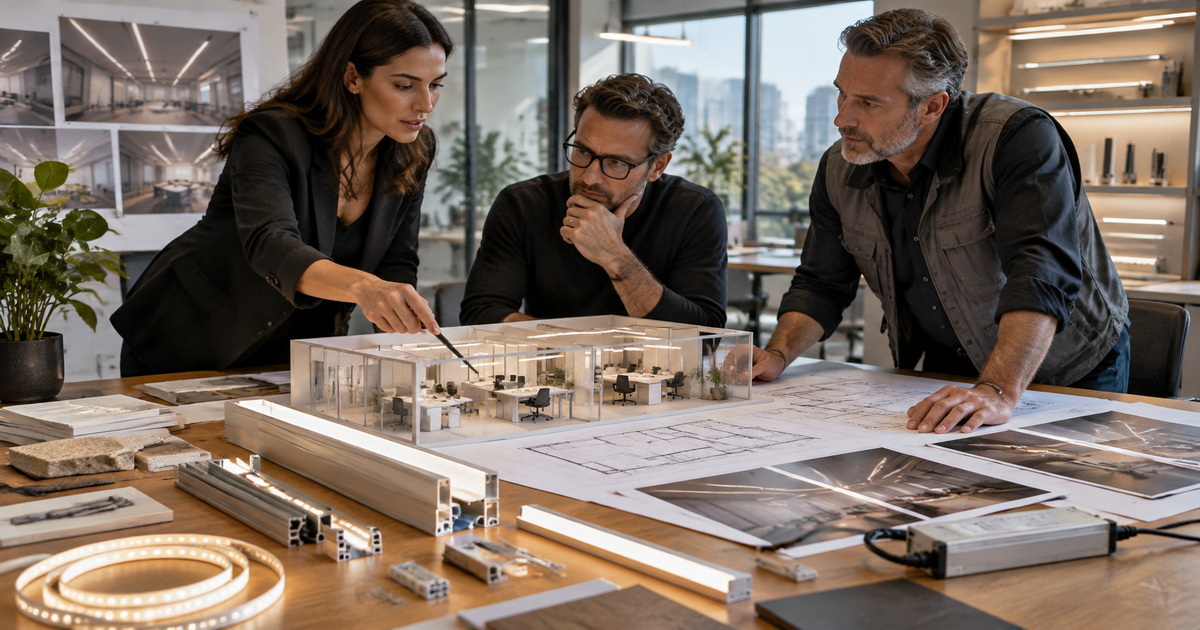
First, determine whether the proposed surface can support the mounting method.
For recessed installation, confirm:
- Is there enough cavity depth?
- Can the panel, ceiling, or wall be cut safely?
- Is the finished surface stable enough to avoid cracking?
- Can wiring and drivers be hidden while remaining serviceable?
For suspended installation, confirm:
- Is the structural ceiling suitable for anchors?
- Will cables conflict with building services?
- Is there adequate vertical clearance?
- Will the hanging fixture obstruct views or circulation?
For surface mounting, confirm:
- Is the mounting face flat and stable?
- Can wiring be concealed or routed neatly?
- Does the fixture profile fit the furniture or ceiling proportions?
The installation should serve the task, not only the style.
For example:
- Use recessed lighting when the goal is a concealed ambient line, subtle navigation light, or integrated cabinet illumination.
- Use suspended lighting when the fixture should define a workspace, collaboration zone, or retail feature.
- Use surface-mounted lighting when rapid installation, accessibility, or retrofit practicality is the priority.
Lighting quality depends on more than brightness. Reflections, contrast, screen glare, shiny surfaces, and the angle at which people see the luminous element all affect comfort.
In workplace settings, glare should be controlled through luminaire choice, layout, surface finishes, and workstation orientation. Lighting guidance for open-plan offices also emphasizes the importance of avoiding direct and reflected glare on computer screens.
For this reason:
- Avoid placing suspended fixtures where they reflect strongly on monitors.
- Use diffused or properly shielded light sources near glossy cabinet doors, mirrors, and worktops.
- Consider indirect or balanced light distribution in spaces with screens and reflective finishes.
- Review the fixture from normal viewing angles, not only from an installation drawing.
A common installation mistake is treating the LED power supply as an afterthought. Every linear lighting system needs a practical plan for driver location, ventilation, wiring, dimming compatibility, and future replacement.
For furniture lighting systems, this may mean locating the LED power supply in an accessible cabinet compartment, service void, or dedicated electrical area. For commercial projects, it may require coordination with ceiling access panels or electrical distribution routes.
Controls should also be specified early. Occupancy sensors can automatically switch off or dim lighting in unoccupied rooms, supporting more responsive operation. Networked and sensor-based lighting systems also require planning for zones, controller locations, communication methods, and future recommissioning.
The lowest installation cost is not always the lowest long-term cost.
Before approving the mounting method, ask:
1. Can the driver be replaced without damaging finished surfaces?
2. Can a failed section be removed without dismantling adjacent furniture?
3. Can the layout be modified if the tenant changes?
4. Are mounting accessories standardized and available?
5. Can the installation team align continuous runs accurately?
6. Is there a handover plan for replacement parts and wiring records?
These questions are especially important for commercial interiors, hospitality projects, multi-unit residential developments, and repeat furniture programmes.
A custom kitchen manufacturer wants continuous light beneath upper cabinets and inside display shelving. Recessed LED silicone strip lights or linear profiles can be integrated during production, leaving only a refined light line after installation.
This approach protects the clean appearance of the cabinetry while supporting practical task lighting. The key is early coordination between the cabinet designer, electrical team, and lighting supplier.
An office fit-out requires visual separation between collaboration tables and circulation areas. Suspended LED linear lights can define the work zone without building partitions.
The fixture should be aligned with furniture layout, monitor orientation, acoustic elements, and ceiling services. The goal is not simply to hang a luminaire; it is to create a balanced visual composition while maintaining comfortable working conditions.
A retail renovation has a concrete ceiling and limited construction time. Cutting recessed channels would add cost, dust, delay, and coordination risks.
Surface-mounted LED linear lighting provides a faster path. With slim profiles, carefully positioned power supplies, and clean joints, the result can remain professional while preserving future maintenance access.
Farwise Technology Co., Ltd. is a source manufacturer with 16 years of experience in LED lighting. We focus on high-quality, stable, practical lighting solutions for furniture lighting and commercial applications.
Our product range includes:
- LED Silicone Strip Lights
- LED Cabinet Lights
- LED Wardrobe Lights
- LED Bathroom Cabinet Lights
- LED Power Supplies
- Customized furniture lighting solutions
We support OEM and ODM projects where the mounting method, appearance, length, functional requirements, control approach, and complete lighting solution need to be adapted to the customer's product or project requirements.
For a cabinet brand, that may mean lighting designed around furniture structure and assembly workflow. For a contractor, it may mean a coordinated solution with mounting accessories, compatible drivers, and practical installation guidance. For a smart-home project, it may mean lighting that supports sensors, dimming, door-triggered activation, or system integration.
There is no universal winner between recessed, suspended, and surface-mounted LED linear lighting.
Choose recessed lighting when a seamless, built-in appearance is essential and early construction coordination is possible. Choose suspended lighting when the fixture should contribute to the visual identity of an open or high-ceiling space. Choose surface-mounted lighting when installation speed, retrofit suitability, and maintenance access are more important than a fully concealed finish.
The best projects make this decision early, coordinate the lighting with the physical structure, and plan for service access from the beginning. Farwise Technology can help you turn those requirements into a practical, customized LED lighting solution for cabinetry, wardrobes, bathrooms, bedrooms, retail furniture, and commercial interiors.
Contact Farwise Technology to discuss your LED lighting project, customization requirements, mounting conditions, and complete furniture lighting solution.
Surface-mounted LED linear lighting is usually the most practical choice for renovations because it avoids major structural cutting and normally provides easier maintenance access. Suspended lighting is also a useful retrofit option in spaces with suitable ceiling fixing points.
Yes. Recessed lighting is widely used in cabinets, wardrobes, shelves, display units, and bathroom furniture because it creates a clean, integrated appearance. The furniture design should allow space for the profile, wiring, and accessible driver placement.
Choose suspended lighting when the ceiling is high, the fixture needs to define a functional area, or the lighting should become a visible architectural element. It is popular for offices, meeting tables, reception areas, classrooms, retail spaces, and creative studios.
No. A well-designed surface-mounted system can look modern and intentional. The result depends on profile proportions, diffuser quality, fixture alignment, joint treatment, cable management, and how well the light integrates with the surrounding furniture or architecture.
LED power supplies may require inspection, replacement, or upgrading during the life of the installation. If the driver is inaccessible, a simple service task can become disruptive and expensive. Driver location should be planned before ceilings, cabinetry, or wall panels are finalized.
Yes. Recessed, suspended, and surface-mounted LED lighting can all be designed for compatible dimming, sensors, door switches, occupancy detection, and other control strategies. Compatibility should be confirmed for the complete system, including the LED light, driver, controller, and installation environment.
Buyers should ideally provide installation drawings, mounting surface details, desired lighting effect, furniture or ceiling materials, wiring constraints, control requirements, quantities, and any target appearance or application scenario. This allows the manufacturer to recommend a more accurate OEM or ODM solution.
1. [SignliteLED — Recessed vs. Suspended vs. Surface Mounted: Which LED Linear Lighting Installation Suits Your Commercial Project?] [signliteled]
2. [CIE — Guide on Interior Lighting] [cie.co]
3. [Government of Canada — Lighting Design for Open-Plan Offices] [publications.gc]
4. [U.S. Energy Information Administration — Large Commercial Buildings Are More Likely to Use Lighting Controls] [eia]
5. [Facilities Dive — New LED and Lighting Controls Guidance for Federal Buildings] [facilitiesdive]
6. [U.S. Green Building Council — Interior Lighting Reference Guide] [usgbc]
7. [Illuminating Engineering Society — Lighting Library Standards Collection] [ies]


