
Views: 222 Author: Farwise Lighting Publish Time: 2026-11-20 Origin: Site


Content Menu
● How to Choose a Linear High Bay LED Lights Manufacturer
>> How the Suppliers Were Screened
● 10 China-Based Suppliers to Evaluate
>> 1. Farwise Technology Co., Ltd. — OEM/ODM Development Candidate
>> 2. AGC Lighting — Industrial Optics and Warehouse Applications
>> 3. Signcomplex — Linear High Bays Within a Broader Lighting Portfolio
>> 4. GRNLED / Greenriy Technology — Export-Oriented OEM/ODM
>> 5. GS Light — Industrial Catalog and Project Sourcing
>> 6. Jiangmen Brandon Lighting — Linear Fixture OEM/ODM for the Americas
>> 7. Ledsion Lighting — North American Distribution and China-Based Supply to Verify
>> 8. Shenzhen KYD Light — Industrial Project Candidate
>> 9. Jiangmen OGJG Lighting and Electronic — Linear Fixture Candidate
>> 10. KLM Lighting — Mixed Commercial and Industrial Package Candidate
● Supplier Comparison: Capacity, MOQ, and Compliance
● Buyer's Guide: From RFQ to Repeat Orders
>> Specify Materials and Processes, Not Just Appearance
>> Match the Compliance Documents to the Product You Will Receive
>> Qualify the Factory, Sample, and Shipment in That Order
>> Insider Check: Follow the Component Revision, Not Just the Model Number
● FAQ
>> 1. How can I verify that a manufacturer's ISO certificate is still valid?
>> 2. Can my brand use the factory's existing product listing?
>> 3. Why does the MOQ rise when I only ask for a different carton or control option?
>> 4. What if the compliance report lists a model family but not my quote's full model code?
>> 5. How can I check whether a warranty is commercially useful?
● Industry and Verification Resources
Start by asking whether the factory can repeatedly build the same fixture it submitted for approval. A good sample is useful, but a long-term supplier also needs to show who controls the design, where the fixture is assembled, how incoming components are checked, and what happens when an approved part becomes unavailable. Assess factory certification, engineering capability, quality-control records, and delivery reliability before comparing unit prices.
This is a sourcing shortlist, a ranking by sales, capacity, or independently audited performance. Farwise Technology Co., Ltd., the company presenting this guide, is listed first as an OEM/ODM development candidate. Its public profile documents LED strip and cabinet-lighting manufacturing, an established industrial linear high bay line. The other entries include manufacturers with public linear high bay listings and several candidates whose product fit is supported by secondary sources and still needs direct confirmation. The profiles distinguish those levels of evidence rather than treating every supplier as equally qualified.

For international buyers, China's advantage is the ability to compare industrial fixture specialists, custom fabrication suppliers, and broader lighting manufacturers within established supply networks. Guangdong offers several practical stops on a factory audit itinerary: Shenzhen for LED electronics and industrial lighting candidates, Dongguan for fixture assembly and OEM development, and Zhongshan and Jiangmen for lighting manufacturers with different production specialties. Zhejiang adds another sourcing base for commercial lighting. A cluster can make supplier visits and component sourcing easier; it does not prove that a particular supplier manufactures what it sells.
The China Association of Lighting Industry's full-year 2025 export review, published in January 2026, reported approximately US$49.9 billion in Chinese lighting exports, down about 11% year over year. Its November 2026 brief also reported mixed trends across export destinations for the first three quarters of 2026. Both reports cover broader lighting categories, not linear high bays specifically. They show the scale and changing geography of China's lighting trade, but they cannot establish a high bay market share or validate any factory's claimed export mix.
- Product fit: Give more weight to a dedicated linear high bay catalog page or installation case than to a general high bay category. A suspended architectural linear fixture is not an industrial high bay.
- Factory and quality systems: Confirm the legal entity, actual production address, certificate scope, and responsibility for assembly and final inspection. Ask to see incoming inspection, work-in-process checks, and corrective-action records.
- Engineering and customization: Establish whether the factory can revise drawings, control component changes, and explain when a custom configuration needs a new compliance review. OEM generally means manufacturing to the buyer's requirements; ODM starts with a supplier-developed design that can be adapted for the buyer.
- Delivery reliability: Request recent on-time delivery evidence for comparable orders, a model-specific production schedule, and a clear explanation of which outsourced processes or purchased components could delay replenishment.
- Market readiness: Look for target-market case studies, product listings, labeling experience, and warranty support. A published installation confirms a use case, not necessarily the supplier's largest market.
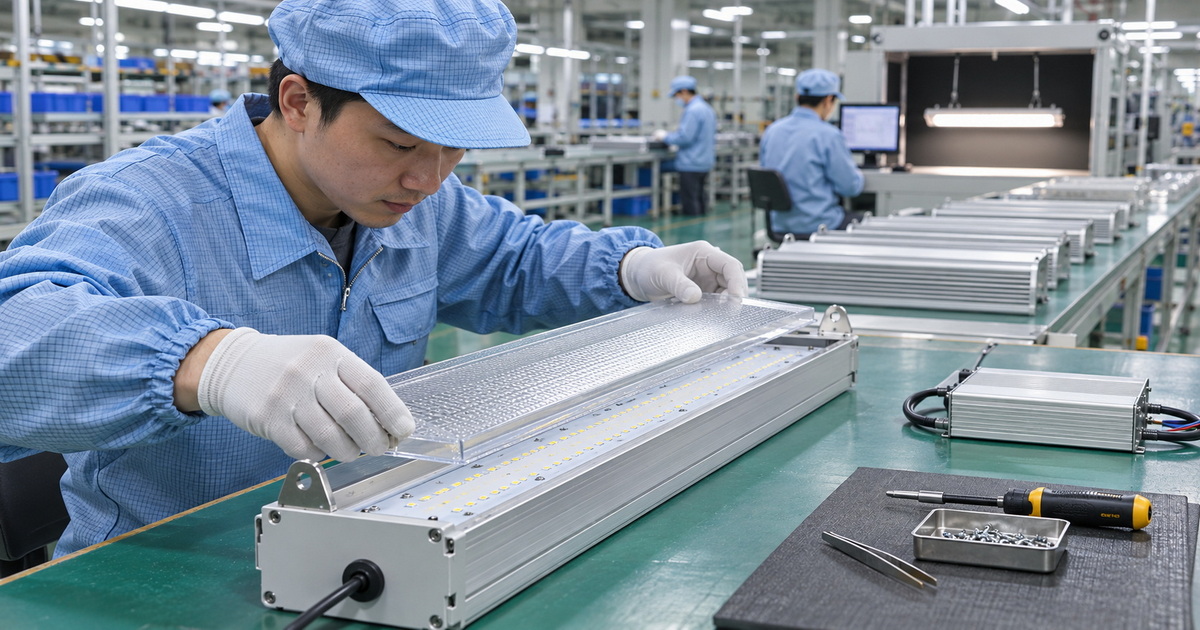
Founded in 2009 and based in Dongguan, Guangdong, Farwise publicly identifies silicone LED strips and cabinet lighting as its manufacturing specialties. Its profile describes an in-house R&D and quality-control team, standardized production lines, and OEM/ODM support for global customers. A geographic breakdown of its main markets is not published.
Farwise is worth interviewing when a small or midsize brand wants a cost-conscious development partner and needs to discuss dimensions, functions, appearance, and system integration directly with engineering. For a linear high bay project, test that flexibility with a drawing review and a sample brief. Ask who owns the design, who approves revisions, where production would take place, and how quickly engineering can return a documented response. Request a current industrial sample, the proposed production site, and a destination-market compliance plan before treating Farwise as a qualified high bay supplier.
AGC has stronger public evidence of product fit than a general-purpose lighting catalog: it documents a linear high bay family and a warehouse installation in the United States. Its Shenzhen supplier profile describes industrial fixture development, optical and mechanical engineering, and OEM/ODM work. The directory shows a 2013 account registration, which should not be quoted as the legal founding date without company records. The United States is a documented application market; its overall sales mix is not disclosed in these sources.
AGC is a candidate for buyers who need help matching the fixture to a warehouse layout. Ask its team for photometric files for the proposed configuration and a comparison of aisle and open-area layouts. If you change the optics or controls, request written confirmation of which reports and listings still apply.
Founded in 2006, Signcomplex publishes a dedicated linear high bay category and describes its own lighting R&D and production. Its public catalog is useful for buyers sourcing industrial lighting alongside other product lines. It invites custom product inquiries, but the reviewed pages do not identify the main export markets or spell out which high bay modifications are available under private label.
Ask Signcomplex to separate standard catalog choices from changes that require a new drawing or compliance assessment. Buyers consolidating several categories under one vendor should also confirm whether the same legal entity and factory handle each family.
GRNLED says it has supplied high bays since 2014 and describes linear and round fixtures, OEM/ODM, and global supply. A separate industry roundup gives a different founding year, so buyers should confirm the legal entity's incorporation date rather than equate the start of high bay activity with company formation. No ranked destination-market breakdown was found in the reviewed sources.
GRNLED is a candidate for distributors comparing standard fixtures and private-label options. Ask for a quote that separates branding, carton artwork, controls, and design changes. Its public page claims ISO 9001 and CE/RoHS coverage; request the current management-system certificate and the compliance documents for the specific fixture you intend to order.
GS Light identifies 2009 as the start of its operations and publishes a dedicated linear high bay page. Its industrial range makes it a candidate for buyers sourcing fixtures for warehouses, factories, or several zones within one project. The reviewed pages identify buyer types such as importers and project teams but do not establish its largest geographic markets.
Ask GS Light to quote its standard platform and any custom configuration separately. The distinction matters if a sensor, bracket, label, or carton change introduces a separate minimum order, longer replenishment lead time, or new documentation. Confirm the production site and exact customization scope in writing.
Brandon publishes a warehouse-specific linear high bay range and explicitly targets distributors, contractors, and energy service companies in the United States, Canada, and South America. Its commercial literature offers private labeling, control options, and custom packaging. An industry directory also describes tooling, metal fabrication, and assembly capabilities. The reviewed sources do not establish a legal founding year.
Brandon is a useful candidate when a buyer wants to develop a family of linear industrial fixtures rather than source a single isolated model. Ask which fabrication operations are performed at the proposed site, who owns buyer-funded tooling, and whether your branded version can be sold under the required listing arrangement.
Ledsion has a dedicated linear high bay catalog and a public commercial lighting presence in Texas. Its supplier profile reports a Shenzhen origin in 2003, later fixture production for U.S. distribution, and OEM/ODM capabilities. The United States is a documented channel market, but a U.S. catalog does not by itself establish the Chinese production site for a particular order.
Ledsion is particularly relevant when a buyer wants to compare domestic replenishment with a factory-direct program. Confirm which entity sells the goods, where they are made, who holds the applicable listing, and who handles warranty replacements. Ask whether a custom order follows the same service terms as stocked U.S. inventory.
Industry roundups report that KYD started in 2008 and offers OEM/ODM manufacturing. One describes both linear and round high bay fixtures. The reviewed sources do not establish its principal export markets or the exact options offered on a current linear model, so treat KYD as an RFQ candidate rather than a fully verified program supplier.
Request a current linear high bay catalog page, a sample label, the manufacturing address, and comparable export references. If your project requires staged releases, ask KYD to propose a delivery schedule and specify which parts must be purchased before it can reserve production.
A published manufacturing roundup lists OGJG as founded in 2006 and identifies linear high bays alongside LED battens and other linear fixtures. The available evidence does not establish its principal international markets or industrial OEM/ODM scope. Its value on the shortlist is as a Jiangmen candidate for buyers who want to compare a linear-fixture supplier with larger industrial catalogs.
Ask for photographs of current production and samples from the exact line being quoted. Confirm whether housing fabrication, finishing, and assembly are performed in-house or subcontracted. If the quote involves private tooling, agree upfront who owns it, maintains it, and can move it if the relationship ends.
KLM says it began in Guangdong in 2011 and serves global commercial and architectural lighting markets. Its current website lists both commercial high bays and linear lighting, while a separate industry roundup specifically lists linear high bays. This makes KLM a reasonable candidate for mixed packages, such as a warehouse with adjoining offices, but buyers should require evidence for the exact industrial fixture instead of assuming an architectural linear range qualifies. Its main geographic markets are not specified in the reviewed materials.
Ask KLM to identify which products can be customized at the factory, which are catalog configurations, and whether the industrial and architectural products can ship together without one family delaying the other.
| Supplier | Capacity evidence or next check | MOQ to request | Certification or compliance check |
|---|---|---|---|
| Farwise | Standardized LED production claimed; industrial line and capacity unverified | Development sample, pilot run, and custom production | Obtain high bay compliance plan before committing to tooling. |
| AGC Lighting | Shenzhen production described; request a line allocation for the proposed model | Catalog, branded, and custom-optics orders | Match the report or listing to the exact ordered configuration. |
| Signcomplex | R&D and production disclosed; ask which line builds the fixture | Catalog model versus modified housing or controls | Obtain the model-specific declaration and applicable listing. |
| GRNLED | Industrial production claimed; request recent lead-time records | Standard fixture, private label, and custom carton | Verify claimed ISO 9001 and obtain exact-model CE/RoHS documentation. |
| GS Light | Dedicated linear model published; ask for scheduled line availability | Standard order versus sensor and packaging options | Confirm the scope of any safety, environmental, or application-specific claim. |
| Brandon Lighting | Fabrication and assembly capabilities reported; confirm site and allocation | Pilot lot, branded repeat order, and tooling minimums | Check the listing and authorization for the private-label version. |
| Ledsion | China supply and U.S. distribution reported; distinguish factory allocation from local stock | Stock order versus factory-direct private label | Verify model, listing holder, and alternate trade name where applicable. |
| KYD Light | Secondary descriptions only for the proposed program; request a production plan | Catalog order and staged project releases | Request primary documents for the current linear model. |
| OGJG | Linear high bay category reported; verify the line and outsourced operations | Stock housing versus custom fabrication | Request a matching sample label and reports. |
| KLM Lighting | Broad commercial production disclosed; confirm the industrial fixture's site and schedule | Mixed-product order and per-family minimums | Verify the high bay separately from architectural fixtures. |
On an aluminum housing, ask for the declared alloy or material grade, fabrication method, finish specification, and inspection records. For a formed-steel design, focus on the specified sheet material, coating, and corrosion protection appropriate to the site. A housing that looks identical from the outside may differ in material or thermal construction. An approved drawing and a controlled bill of materials give the inspector something objective to check.
Apply the same discipline to the LED driver, optical cover, wiring, connectors, and mounting hardware. Ask how the factory checks incoming parts, verifies grounding and electrical safety as applicable, and records final functional tests. Request photometric files for the ordered configuration and review them against the actual racking and work areas. A linear housing does not automatically deliver the distribution a narrow aisle needs.
For the European Union, request the EU Declaration of Conformity and applicable supporting documentation. CE marking is not the same as an independent safety listing. RoHS restricts specified hazardous substances in electrical and electronic equipment; it does not replace electrical safety or electromagnetic compatibility evidence. Ask the supplier to identify which rules apply to the exact configuration, especially when it includes wireless controls.
For North American projects, verify any required safety listing in the issuing body's directory. If a rebate or project specification calls for DesignLights Consortium qualification, check the applicable qualified products list separately. Do not assume that a listed driver makes the complete fixture listed, or that a listing under the supplier's brand automatically covers yours.
1. Verify the business and site. Match the business license, quotation entity, factory address, and payment beneficiary. If a trading affiliate handles exports, document the relationship and identify who is responsible for defects and warranty claims.
2. Issue a common RFQ. Give all candidates the same site description, installation method, destination market, packaging needs, expected order cadence, and certification requirements. Ask for separate terms for samples, pilot production, and replenishment.
3. Approve a traceable sample. Record the drawing revision, label, materials, and critical component identifiers. Keep a signed reference sample with the buyer or inspection agent and a matching one at the factory.
4. Inspect a pilot lot. Pull units from normal production instead of relying solely on showroom samples. Check workmanship, component identity, hardware, labels, functional test records, and packaging against the agreed acceptance checklist.
5. Plan the shipment before production. Specify the Incoterm and named place, confirm customs classification with your broker, and request carton and pallet details. Inspect protection around long housings and mounting accessories, and decide who pays for replacement freight if units arrive damaged.
The problem to guard against is not always an obviously cheap sample. It is a production or repeat order that keeps the same model number after an internal component changes. A substitute driver, optical material, connector, or mounting part may pass a basic switch-on test yet affect field performance, installation, or the compliance evidence. An approved sample alone cannot tell you what was installed in a later batch.
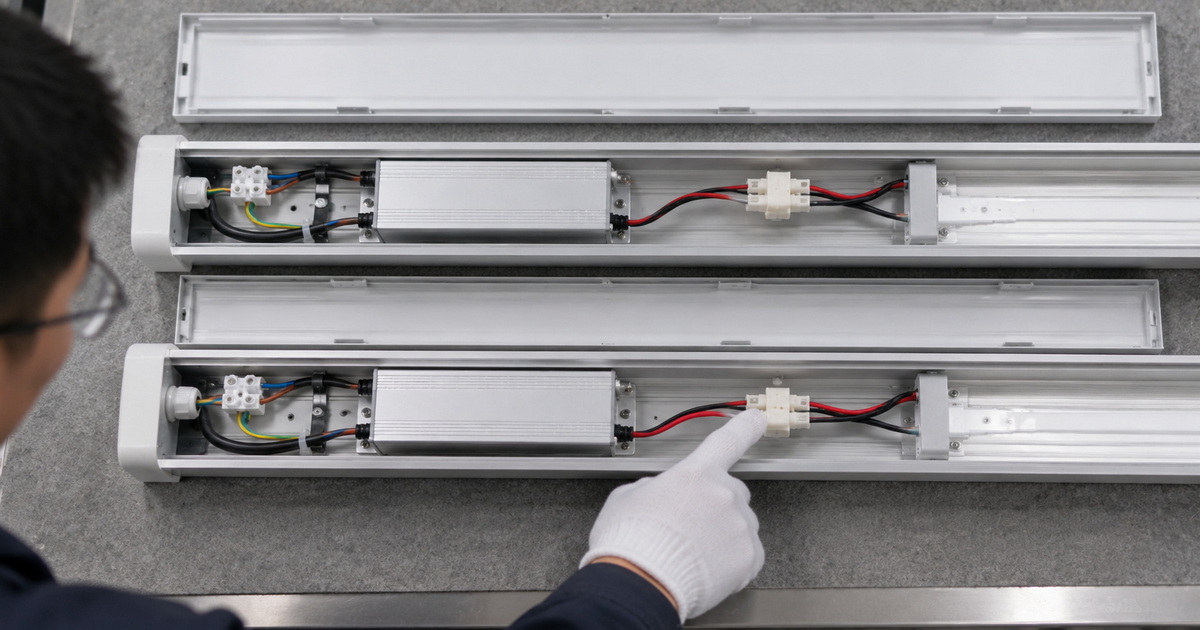
Put a change-control clause in the purchase agreement. Require advance written notice of changes to critical components, materials, tooling, and production sites. Define the documents the supplier must provide, who on your team gives approval, and when a new sample or compliance review is needed. At inspection, have an independent inspector select units from sealed cartons and compare visible internal part identifiers and revision records with the approved bill of materials. If a change is undocumented, hold release until the supplier establishes whether the lot conforms.
Start with suppliers that can show a current industrial linear high bay, a traceable production site, and documentation for your destination market. Compare them using the same RFQ, then award a pilot order to the factory that can demonstrate control of the approved build, explain its commercial terms, and commit to a realistic delivery schedule. The lowest initial quote is less useful if the supplier cannot tell you what will be in the next shipment.
For an OEM/ODM development discussion, send Farwise Technology Co., Ltd. your application, destination market, branding needs, and expected order schedule at `sales@farwiselighting.com`. Ask the team to document whether an existing platform fits or whether a new development program is needed, and to identify the sample, production-site, and compliance milestones before you commit.
Search IAF CertSearch using the legal company name or certificate details. Compare the current status, certifying body, scope, and site address with the plant that will build your order. If the record is missing or unclear, contact the issuing body directly. An active management-system certificate still does not establish that an individual luminaire is approved for sale.
Do not assume it can. Ask the listing holder and issuing body to confirm whether your brand, exact model designation, and label are covered or whether an alternate listing arrangement is required. Finalize this before printing retail packaging or putting certification marks on the product.
The minimum may come from a packaging print run or a component purchase commitment, not from fixture assembly. Ask for separate minimums for components, cartons, and finished fixtures. For repeat orders, clarify who owns unused branded packaging and whether the supplier can store it for scheduled releases.
Request a model-code key or written confirmation that maps the quoted configuration to the report or listing. Compare the resulting label, driver, controls, and other critical options with the documentation. If the factory cannot establish the connection, treat coverage as unresolved rather than accepting a similar-looking model.
Ask who pays for diagnosis, replacement fixtures or parts, shipping, and on-site labor. Specify what evidence is needed for a claim and what happens if a component is discontinued. For a long-term program, agree on how production lots are traced and obtain written terms for spare parts or replenishment instead of comparing warranty periods alone.
1. - China Association of Lighting Industry: full-year 2025 export review based on China Customs data, republished by Nanjing Tech University. [dgy.njtech.edu]
2. - China Association of Lighting Industry: November 2026 brief on lighting exports to Belt and Road markets, with first-three-quarter 2026 comparisons. [cali-light]
3. - IAF CertSearch: accredited management-system certificate verification by company name or certificate details. [iafcertsearch]


