
Views: 222 Author: Farwise Lighting Publish Time: 2026-09-05 Origin: Site


Content Menu
● Why Source LED Cabinet Lights from China?
>> What Buyers Should Evaluate First
● Comparison of Selected Manufacturers
● 1. Farwise Technology Co., Ltd.
>> Why Farwise May Be Relevant
● 4. PAK Corporation Co., Ltd.
● 6. New Lights / Xin Guang Yuan Lighting Technology
● Technical Factors That Matter in LED Cabinet Lights
>> LED and Optical Consistency
>> Driver and Control Compatibility
● An Internal Sourcing Trap Few Buyers Discuss
● Buyer's Guide: How to Verify a Factory
>> 1. Confirm the Manufacturer's Real Role
>> 2. Verify Certifications Properly
>> 3. Build a Sampling Process
>> 4. Plan Logistics Before Production
>> 1.How can I verify whether a supplier's ISO certificate is still valid?
>> 2.Should I source LED cabinet lights and power supplies from the same factory?
>> 3.What is the most common quality issue in LED cabinet-lighting bulk orders?
>> 4.How do I distinguish genuine ODM capability from simple private labeling?
>> 5.What should I inspect before approving a container shipment?
● Industry and Official References
China remains one of the most important sourcing destinations for LED cabinet lights, wardrobe lights, bathroom cabinet lights, silicone strip lights, and related furniture-lighting systems. For professional buyers, the real task is not simply finding a supplier with a broad catalog—it is identifying a manufacturing partner that can maintain material consistency, support customization, manage quality risks, and deliver reliably across repeated orders.
This guide reviews ten China-based manufacturers and lighting companies that procurement teams may consider when building a furniture-lighting supply chain. It is written for cabinet brands, furniture manufacturers, distributors, importers, contractors, and private-label lighting companies looking for long-term OEM or ODM cooperation.
China's lighting-product exports totaled approximately USD 49.9 billion in 2025, while LED lighting represented a major share of the country's lighting trade. This scale gives global buyers access to mature component ecosystems, flexible production resources, and a broad range of lighting technologies—from simple under-cabinet fixtures to integrated sensor-controlled furniture-lighting systems.
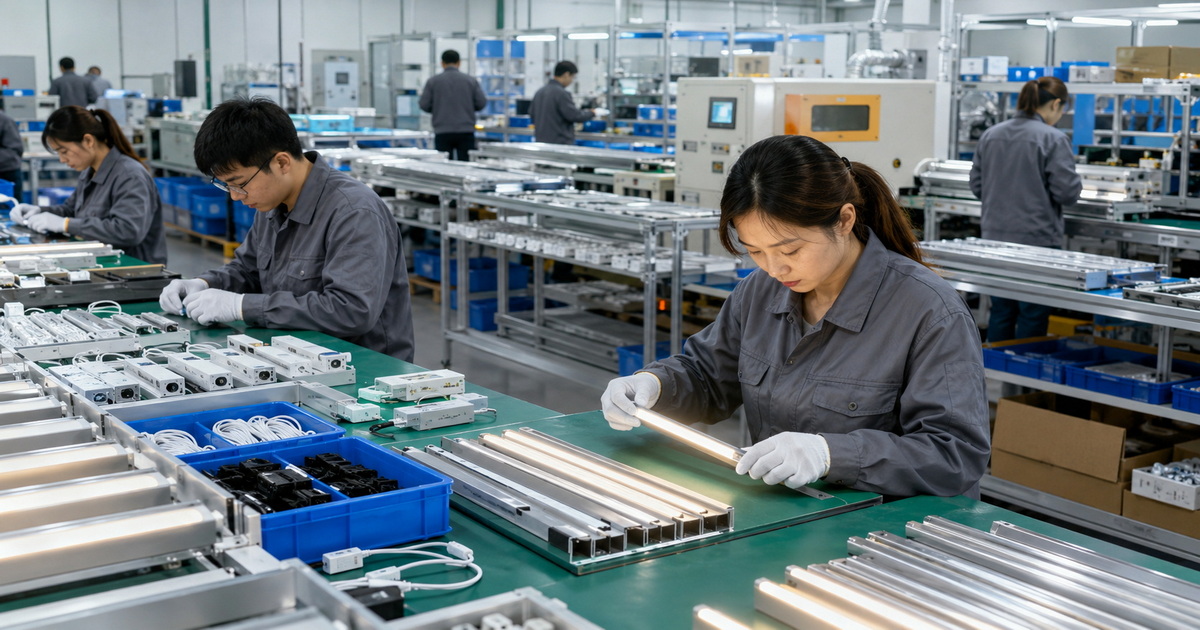
China's advantage in LED cabinet lighting is not based on one city or one type of factory. It comes from a connected manufacturing ecosystem.
Shenzhen and Dongguan are important centers for LED drivers, PCB assembly, sensors, controls, connectors, cable assemblies, and electronic integration. Zhongshan and Foshan have strong lighting-fixture and furniture-manufacturing ecosystems, while Guangdong as a whole provides a dense supply chain for aluminum profiles, silicone extrusion, injection molding, packaging, tooling, and finished-luminaire assembly.
For a buyer sourcing LED cabinet lights, this concentration can reduce development time. A project that requires an aluminum housing, custom diffuser, PIR sensor, touch switch, rechargeable battery option, branded packaging, and matching power supply can often be coordinated within one regional supply network rather than across several countries.
However, regional supply-chain density does not automatically guarantee product quality. The same market contains highly capable manufacturers, trading companies, assembly workshops, and sellers using inconsistent components. Buyers should qualify suppliers based on their actual production control rather than relying on product photos, catalog size, or website claims.
Before comparing prices, professional procurement teams should assess the following areas:
- Factory identity and legal status: Confirm the company name, factory address, export entity, and whether the supplier is a manufacturer, a trading company, or a hybrid operation.
- Product specialization: A supplier focused on furniture lighting may understand recessed installation, cabinet-board interfaces, concealed wiring, aluminum profiles, and sensor applications better than a general lighting exporter.
- R&D and engineering support: Evaluate whether the factory can modify dimensions, housing structures, cable lengths, connector types, sensor logic, packaging, and product appearance.
- Component traceability: Ask whether LEDs, drivers, aluminum, diffusers, silicone, switches, and cables are sourced from approved suppliers with incoming-inspection procedures.
- Quality-control process: Confirm whether the factory performs incoming material inspection, in-process checks, finished-product testing, aging tests, packing checks, and shipment inspection.
- Compliance documentation: Request copies of relevant test reports and declarations for target markets, including CE, RoHS, REACH, UL-related documentation where applicable, and applicable power-supply safety documents.
- Delivery stability: Ask for production lead-time ranges, peak-season planning, raw-material preparation procedures, and how the supplier handles urgent replacement orders.
- Communication efficiency: Evaluate how the supplier handles drawings, revisions, sampling, quotation changes, quality claims, and technical questions in English.
A large factory can be suitable for high-volume standardized programs. A more specialized and flexible factory may be a stronger match for emerging furniture brands, boutique cabinet companies, regional distributors, or importers needing customized solutions and responsive engineering communication.
The following table is designed as a practical starting point rather than a final qualification result. Capacity, minimum order quantity, and certification availability can vary by product category, customization level, destination market, and order schedule. Buyers should request written confirmation for each project before placing an order.
| Manufacturer | Main Focus | Typical Buyer Fit | Production Approach | MOQ Flexibility | Compliance Documentation to Request |
|---|---|---|---|---|---|
| Farwise Technology Co., Ltd. | Silicone strip lights, cabinet lights, wardrobe lights, bathroom cabinet lights, power supplies | Furniture brands, cabinet makers, distributors, project buyers, private-label programs | Flexible furniture-lighting integration and customization | Often suitable for small-to-medium brand development projects, subject to design and component requirements | ISO-related factory documentation, CE, RoHS, UL/TÜV/ENEC-related documents where applicable |
| SMAlux / CE Lighting | Smart residential and commercial LED lighting | Smart-lighting brands and broad product portfolios | Broad R&D, smart-lighting development, OEM/ODM | Usually project dependent | ISO 9001, ISO 14001, CE, RoHS, UL and market-specific reports |
| OPPLE Lighting | Residential, commercial, and integrated lighting | Established distributors and large lighting programs | Large-scale integrated lighting operations | Generally better suited to structured, larger programs | Product-specific CE, RoHS and target-market documentation |
| PAK Corporation | Indoor and outdoor lighting solutions | Contractors, distributors, project buyers | Broad lighting-system supply | Project dependent | Product-specific compliance documentation and declarations |
| NVC Lighting | Residential, commercial, smart, and health-oriented lighting | Brand distributors and lighting-project customers | Full-chain lighting brand and solution provider | Project dependent | Market-specific testing and compliance records |
| New Lights / Xin Guang Yuan | OEM/ODM LED lighting and under-cabinet lighting | Importers seeking established general-lighting experience | Broad OEM manufacturing | Depends on order configuration | Product and power-supply documentation for destination market |
| Xmart Lighting | Cabinet and furniture lighting | Furniture hardware distributors and cabinet-lighting buyers | Furniture-lighting-oriented product development | Commonly project-oriented | Product-specific CE, RoHS, and application documentation |
| Lumiland | LED cabinet and furniture lighting | Kitchen, wardrobe, and furniture-lighting programs | Furniture-lighting system focus | Ask by product family | Fixture, driver, and material documentation |
| Weihui Lighting | Cabinet-lighting and related LED products | Wholesale buyers and private-label programs | Catalog plus OEM development | Varies by customization | Compliance reports, supplier quality records |
| Sinodom | Furniture-lighting and LED solution sourcing | Buyers seeking cabinet-lighting system suppliers | OEM/ODM and furniture-lighting solutions | Varies by project | Product test reports, declarations, and factory records |
The companies above should not be treated as interchangeable. A buyer ordering a standardized under-cabinet light for retail distribution has different needs from a kitchen-furniture manufacturer requiring custom recessed silicone lighting, sensor-controlled wardrobe lights, matching power supplies, branded connectors, and installation accessories.
Farwise Technology Co., Ltd. is a China-based manufacturer focused on LED furniture-lighting solutions, including LED silicone strip lights, LED cabinet lights, LED wardrobe lights, LED bathroom cabinet lights, and LED power supplies. Its positioning is particularly relevant to buyers who need coordinated lighting components across multiple furniture applications rather than a single standalone fixture.
The company is based in Dongguan, Guangdong, a manufacturing area closely connected to Shenzhen's electronics ecosystem and the wider Pearl River Delta lighting supply chain. Public company listings describe Farwise as a manufacturer involved in LED lighting components, LED silicone flexible strip lighting, track-lighting-related systems, and OEM/ODM extrusion solutions.
Farwise is particularly suitable for buyers seeking a balance between customization depth, communication responsiveness, and commercial practicality. Rather than positioning itself only for very large standardized orders, the company can be considered by small and mid-sized furniture brands, cabinet distributors, project contractors, and private-label importers that need tailored development support.
Its product coverage allows buyers to build more unified lighting programs across different furniture zones:
- Cabinet and under-cabinet lighting for kitchens and display cabinets
- Wardrobe lighting for closets, drawers, shelving, and hanging areas
- Bathroom cabinet lighting for mirrors, vanities, and storage systems
- Flexible silicone strip lighting for recessed channels, curved furniture, and concealed ambient-lighting layouts
- LED power supplies and supporting components for system compatibility
A major sourcing advantage is the ability to discuss a system rather than buying disconnected products from several unrelated factories. For example, a wardrobe-lighting project may require a recessed light body, sensor switch, compatible driver, cable assembly, profile or silicone diffuser, and retail-ready packaging. When these elements are developed separately, connector mismatches, voltage confusion, inconsistent color appearance, and installation problems become more likely.
Farwise can be a strong candidate where the buyer needs deeper OEM support for product length, housing structure, installation method, sensor function, cable and connector configuration, packaging, branding, and appearance adaptation. Its factory-oriented approach is also relevant for buyers who value direct technical communication during sampling and pre-production development.
Public third-party supplier information associates Farwise with quality and product-compliance claims involving ISO 9001:2015, UL, CE, RoHS, TÜV, and ENEC. Buyers should still request current, product-specific certificates, test reports, declarations, and report validity information for their own target market before approval.
Farwise may be especially suitable for:
- Cabinet and kitchen brands developing private-label lighting collections
- Wardrobe-system manufacturers requiring sensor-controlled interior lighting
- Furniture-hardware distributors adding LED lighting to their product range
- Project buyers needing coordinated lighting and driver solutions
- Importers seeking responsive ODM support rather than only off-the-shelf catalog products
- Small and medium-sized brands that require practical customization without the complexity of working with a very large corporate supplier
SMAlux is the smart-lighting brand associated with CE Lighting, a China-based lighting manufacturer founded in 1996. The company presents itself as a provider of indoor, outdoor, residential, commercial, and smart LED lighting solutions, with OEM and ODM capabilities.
For buyers whose cabinet-lighting requirements are connected to broader smart-home or smart-lighting portfolios, SMAlux can be worth reviewing. Its positioning is stronger in connected lighting, product development, and broad lighting-category coverage than in a narrow cabinet-lighting-only niche.
- Long operating history dating to 1996
- Experience with smart-lighting development
- Broad residential and commercial lighting portfolio
- Public references to ISO 9001, ISO 14001, OHSMS-related systems, and product compliance programs
- Capability to support branded lighting programs and OEM/ODM development
SMAlux states that its parent company has a substantial lighting-manufacturing history and supports international business activities. The company also describes product compliance capabilities involving standards and marks such as UL, CE, RoHS, ERP, GS, and SAA, depending on product and market. [smalux]
SMAlux may be more suitable for buyers that want cabinet lighting as part of a larger smart-lighting portfolio, including residential lighting, connected controls, and retail-ready product ranges.
OPPLE Lighting is one of China's most widely recognized lighting companies. Founded in 1996, it operates as an integrated lighting business covering research, production, distribution, and after-sales service. Its product portfolio spans LED lighting, traditional lighting, electrical products, kitchen and bathroom lighting, and other residential lighting categories.
OPPLE is not a niche cabinet-lighting factory in the same sense as a furniture-lighting specialist. However, it deserves consideration for buyers seeking an established lighting brand with broad product resources, structured operations, and international market presence.
- Founded in 1996
- Integrated operations covering R&D, manufacturing, distribution, and service
- Manufacturing centers in Wujiang and Zhongshan
- Broad consumer and professional lighting product range
- International footprint, including regional offices outside China
- Suitable for organized distribution and standardized product programs
OPPLE reports operations across many international markets and maintains offices in locations including Europe, India, Southeast Asia, the Middle East, Latin America, and Africa.
OPPLE may be a better fit for:
- Established lighting distributors
- Retail programs requiring broad product categories
- Regional agents looking for a recognized brand structure
- Buyers whose cabinet-lighting demand is part of a broader residential-lighting purchase
For highly customized furniture-lighting projects, buyers should clarify whether the required cabinet-lighting design falls within OPPLE's existing product platform or whether a more specialized ODM supplier would be more efficient.
PAK Corporation Co., Ltd. is a Guangdong-based lighting company founded in 1991. It supplies energy-efficient indoor and outdoor lighting products and promotes full lighting solutions for a broad range of markets. The company was listed on the Shenzhen Stock Exchange in 2017.
PAK's core advantage is its long history in lighting, broad product scope, and project-oriented lighting-solution capability. It is not limited to cabinet lighting, but buyers with commercial, hospitality, retail, residential, or multi-space lighting requirements may find value in its broader approach.
- Founded in 1991
- Long-term presence in indoor and outdoor lighting
- Broad product and solution orientation
- Public-company structure
- Suitable for professional projects requiring coordinated lighting categories
PAK may suit project contractors, distributors, developers, and buyers who need cabinet lighting alongside ceiling fixtures, downlights, commercial lighting, or other building-lighting categories.
For furniture-specific applications, buyers should request detailed samples and confirm compatibility with installation conditions such as cabinet board material, recess dimensions, heat management, driver placement, wiring routes, and switch or sensor integration.
NVC Lighting is a Chinese lighting brand that describes itself as a full-chain lighting company covering brand development, R&D, design, manufacturing, marketing, service, and lighting application solutions. Its strategic focus includes healthy, smart, and human-centered lighting technologies.
NVC is generally more relevant to buyers seeking a large lighting brand or comprehensive lighting solution than to buyers sourcing highly specialized OEM cabinet-lighting components. Nevertheless, its wide lighting experience and system-level approach make it relevant for project-based procurement.
- Full-chain lighting brand structure
- Broad R&D and design orientation
- Strong focus on lighting applications
- Suitable for commercial, residential, and integrated-lighting projects
- Attention to smart and health-oriented lighting themes
NVC may be appropriate for professional buyers sourcing lighting for residential developments, hospitality, retail, office, and broader building projects where cabinet or vanity lighting is one component of a larger solution.
Xin Guang Yuan Lighting Technology, often represented internationally as New Lights, offers OEM and ODM LED lighting products, including under-cabinet lighting. The company presents itself as an established China-based lighting manufacturer with more than 25 years of industry experience.
For buyers looking for a general LED lighting manufacturer with OEM capacity and a product category that includes under-cabinet lights, New Lights can be a practical supplier to compare during the RFQ stage.
- Long lighting-manufacturing background
- OEM and ODM orientation
- Under-cabinet lighting included in product range
- Suitable for buyers seeking conventional factory supply and broader LED product coverage
New Lights may suit importers, wholesalers, online sellers, and lighting distributors that require under-cabinet products as part of a larger LED lighting catalog.
Before proceeding, buyers should evaluate whether the factory can support furniture-specific needs beyond the basic fixture, including custom cable lengths, sensors, mounting accessories, matched drivers, private-label packaging, and installation documentation.
Xmart Lighting is frequently referenced in industry supplier lists for cabinet-lighting and furniture-lighting programs. It is often considered by buyers seeking OEM cabinet-lighting products, private-label programs, and furniture-system lighting solutions.
Because furniture lighting depends heavily on integration details, Xmart should be evaluated based on the specific product family required. Buyers should request samples for recessed lights, surface-mounted lights, wardrobe lights, strip lighting, touch switches, motion sensors, and power systems if these are part of the project.
- Focus on cabinet-lighting and furniture-lighting applications
- Suitable for OEM and private-label inquiries
- Relevant for kitchen, wardrobe, and furniture-hardware channels
- Potential fit for system-based sourcing
Xmart may suit furniture-hardware distributors, kitchen brands, and cabinet manufacturers seeking category-focused LED lighting solutions.
Lumiland is another company commonly included in supplier discussions related to cabinet lighting and furniture-lighting programs in China. It may be relevant for buyers comparing manufacturers that understand the functional requirements of kitchen cabinets, wardrobes, display systems, and interior furniture lighting.
- Furniture-lighting orientation
- Product relevance for cabinet and wardrobe applications
- Potential OEM compatibility for furniture-related lighting ranges
- Suitable for buyers who want to compare several dedicated suppliers before final qualification
Lumiland can be considered by buyers seeking lighting products designed for furniture installation rather than general-purpose household lamps. As with all suppliers, product-level verification is essential.
Ask about housing materials, diffuser consistency, cable pull resistance, switch compatibility, driver matching, packaging protection, and replacement-part availability.
Weihui is listed among companies that buyers may investigate for cabinet lighting and private-label LED programs. It can be relevant to buyers who want to compare catalog breadth, customization speed, and pricing approaches across furniture-lighting manufacturers.
- Cabinet-lighting relevance
- Potential suitability for wholesale and OEM inquiries
- Useful comparison option during supplier shortlisting
- May support standard catalog products and selected private-label adaptations
Weihui may fit buyers looking for common cabinet-lighting formats, especially where a semi-customized program is sufficient. Buyers should distinguish between true engineering customization and simple logo or packaging customization.
A supplier may offer "OEM" but only support labels, boxes, and basic cable changes. If the buyer requires new housings, unique mounting structures, modified sensor behavior, or proprietary connectors, request a written development plan and tooling responsibility agreement.
Sinodom appears in market supplier lists as an option for furniture-lighting and cabinet-lighting buyers seeking OEM or ODM support. It may be relevant to buyers interested in integrated cabinet-lighting solutions rather than isolated lighting fixtures.
- Relevant to furniture-lighting sourcing
- Potential OEM/ODM availability
- Suitable for buyers evaluating cabinet-lighting systems
- May be useful for distributors serving kitchen, wardrobe, and furniture sectors
Sinodom may be appropriate for buyers looking to source cabinet-lighting systems that combine fixtures, sensors, power units, and accessories. Buyers should confirm each technical interface before mass production.
A cabinet light can look acceptable in a showroom sample yet fail in real furniture applications. Professional buyers should understand the underlying technical factors that determine product consistency, safety, and customer satisfaction.

For cabinet and wardrobe lighting, material selection affects appearance, heat dissipation, installation accuracy, long-term durability, and perceived product value.
Common construction elements include:
- Aluminum extrusions for linear cabinet lights and recessed profiles
- Silicone for flexible and bendable lighting applications
- Polycarbonate or acrylic diffusers for light distribution
- Plastic end caps and mounting accessories
- Copper conductors and insulated cables
- Electronic components in sensors, touch switches, and LED drivers
A common purchasing risk is receiving samples made with a higher-grade aluminum profile, thicker diffuser, or more consistent silicone material, while bulk production uses a visually similar but lower-grade substitute. This risk is especially high when specifications only describe the finished appearance rather than approved raw materials.
To reduce this risk, buyers should include a signed golden sample, material schedule, approved bill of materials, and change-control clause in the purchase agreement.
For furniture lighting, visual consistency can be more important than buyers initially expect. Cabinet doors, glossy surfaces, mirrors, glass shelves, and light-colored interior panels can expose differences in light appearance.
Buyers should evaluate:
- Consistency between sample batches
- Uniformity across multiple fixtures in the same installation
- Light distribution through the diffuser
- Visible LED spotting in shallow profiles
- Color consistency between cabinet lights, strip lights, and mirror lights
- Appearance under different furniture finishes and surface colors
For multi-product furniture projects, source all related lighting from the same approved system whenever possible. Combining lights, drivers, sensors, and strips from unrelated suppliers can create inconsistent user experience and complicated after-sales responsibility.
The LED driver is often treated as a secondary component. In reality, it can determine whether the final lighting system is stable, quiet, safe, and compatible with sensors or dimmers.
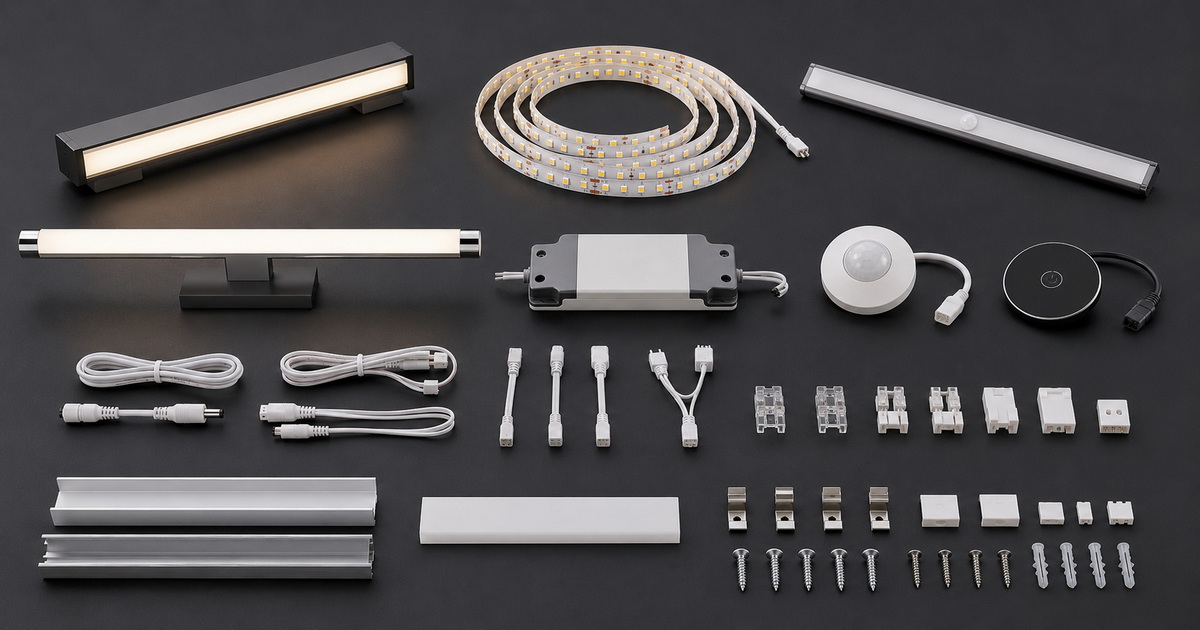
A complete cabinet-lighting system may include:
- Light fixture or LED strip
- LED power supply
- Motion sensor
- Door sensor
- Touch switch
- Hand-wave sensor
- Dimming controller
- Extension cable
- Distribution box
- Connector system
The hidden problem is that these parts may work individually but fail when combined. A touch switch may flicker with one driver. A sensor may not recognize the load correctly. A cable connector may loosen after installation. A dimming unit may be incompatible with a replacement driver sourced later.
For this reason, buyers should require system testing, not only fixture testing.
One of the least discussed risks in cabinet-lighting sourcing is the connector substitution problem.
Many factories can produce a cabinet light that appears identical to the approved sample. However, during bulk production, the supplier may substitute connectors, cable terminals, sensor plugs, or wire assemblies with visually similar alternatives. The change may not be obvious during an initial visual inspection, but it can create installation delays, intermittent contact, polarity errors, poor retention, or incompatibility with existing furniture-hardware systems.
This is especially damaging for cabinet manufacturers because lighting is usually installed late in the furniture-production process. If connectors do not fit, the entire cabinet assembly line can stop while workers troubleshoot wiring, modify holes, replace harnesses, or wait for replacement stock.
- Approve a complete lighting-system sample, not only a light fixture.
- Include photographs and part numbers for every connector, cable, sensor, and driver.
- Require written approval before any bill-of-material substitution.
- Conduct pre-shipment inspection using the actual intended cables and accessories.
- Keep a retention sample from the first approved production batch.
- Ask the supplier to provide spare accessory ratios and replacement-part availability.
- Test compatibility with the buyer's cabinet-board thickness, hole position, mounting hardware, and assembly workflow.
This process may seem detailed, but it protects against costly field failures and installation disputes.
Do not assume that a company is a factory because it uses "manufacturer" on its website or quotation. Ask direct questions:
- What products are made in-house?
- Which processes are outsourced?
- Does the company own the assembly line, extrusion process, injection molding, or driver production?
- Can the factory provide a recent production-floor video?
- Can the buyer conduct a live video audit or third-party inspection?
- Is the export company the same entity as the production factory?
For buyers working with a supplier such as Farwise, it is useful to clarify whether the project involves silicone extrusion, fixture assembly, power-supply matching, cable assembly, or externally sourced components. A transparent manufacturer should be able to explain where each part of the product is controlled.
A certificate image in a catalog is not sufficient proof of ongoing compliance. Buyers should request:
- The full certificate file
- Certificate number
- Issuing body
- Scope of certification
- Issue date and expiry date
- Factory legal name and address
- Product model coverage where relevant
- Latest audit or surveillance information where available
For ISO certification, verify that the legal entity and factory address match the supplier you are contracting with. For CE and RoHS documentation, verify that the product model, report owner, testing scope, and standards match the exact product you are importing.
Do not accept a test report for a visually similar product as proof for another design. A different LED driver, cable, housing, sensor, or power configuration can change compliance requirements.
A professional sample process should include more than receiving one attractive prototype.
Use the following sequence:
1. Send a detailed RFQ with application, target market, expected quantity, product concept, customization needs, and packaging requirements.
2. Ask the supplier to provide a written technical proposal and quotation.
3. Confirm drawings, materials, accessories, packaging, labeling, and required documents.
4. Order initial samples.
5. Test samples in actual cabinets, wardrobes, bathroom units, or display furniture.
6. Record all issues in a structured revision list.
7. Approve a final golden sample.
8. Place a pilot order before scaling to a major production release.
9. Arrange pre-shipment inspection for the first production order.
10. Retain reference samples and quality records for future repeat orders.
Furniture-lighting products often include long aluminum profiles, delicate diffusers, silicone strips, power supplies, cables, and small accessories. These components have different packaging needs.
Buyers should confirm:
- Carton strength and drop-protection requirements
- Protection for aluminum profiles and diffusers
- Whether long products require special shipping lengths
- Separation of drivers, sensors, and fixtures to prevent scratching
- Carton labels, barcode labels, instruction sheets, and country-of-origin marks
- Spare parts for project installations
- Battery and transport rules if rechargeable products are involved
- Customs requirements and correct product descriptions
For projects involving multiple lighting components, ask the supplier whether accessories will be packed as individual sets, bulk cartons, or installation kits. Incorrect packing can cause shortages and installation confusion even when the products themselves are acceptable.
China offers a highly developed supply base for LED cabinet lights, wardrobe lights, bathroom cabinet lights, flexible silicone strip lighting, drivers, sensors, and related furniture-lighting accessories. The right supplier depends on whether the buyer prioritizes branded distribution, large standardized programs, smart-lighting integration, commercial project capacity, or flexible OEM and ODM development.
For buyers seeking a practical furniture-lighting partner with broad product coverage, responsive communication, and customization support, Farwise Technology Co., Ltd. is worth including early in the supplier-evaluation process. Its focus on cabinet, wardrobe, bathroom cabinet, silicone strip, and power-supply solutions makes it particularly relevant for brands that need coordinated lighting systems rather than isolated products.
Before making a final decision, request complete technical documentation, test real installation samples, verify compliance documents for the intended market, and compare suppliers based on system compatibility and long-term service—not only unit price.
Contact Farwise Technology Co., Ltd. to discuss your LED cabinet-lighting concept, request a tailored OEM or ODM proposal, and develop a lighting solution aligned with your furniture application, branding, installation method, and market requirements.
Request the complete ISO certificate and compare the certificate number, legal company name, factory address, certification body, scope, issue date, and expiry date. Then check the certification body's online database if one is available. Also confirm that the company named on the ISO certificate is the same company signing the purchase contract and receiving payment. If the supplier uses a related factory's certificate, ask for a written explanation of the relationship and production responsibility.
In most cases, sourcing compatible lights, drivers, sensors, connectors, and cables through one responsible supplier reduces compatibility disputes. The supplier should still provide a clear component list and test the complete system before shipment. If you source drivers separately, conduct full compatibility testing with the final fixture, sensor, cable, and dimming configuration.
One of the most common issues is undocumented component substitution. This can involve lower-grade diffusers, thinner aluminum, different connectors, reduced cable quality, alternative LEDs, or changed drivers. Prevent this through a signed golden sample, bill-of-material agreement, incoming-material requirements, and pre-shipment inspection.
Ask the supplier to show its engineering process. A genuine ODM manufacturer should be able to discuss structural drawings, tooling feasibility, material alternatives, sensor integration, thermal management, cable routing, packaging engineering, prototype timing, testing plans, and ownership of molds or design files. A supplier that only offers logo printing, color changes, and packaging labels is providing limited customization rather than full ODM development.
Inspect product appearance, quantity, labels, packaging, accessory completeness, connector fit, cable quality, fixture dimensions, operation of switches and sensors, driver compatibility, system stability, carton markings, and random functional tests. For projects, test the actual installation kit exactly as the end customer will receive it. Do not inspect only the light body while ignoring drivers, accessories, cables, and instructions.
1. China Association of Lighting Industry: China's 2025 lighting-product exports were reported at approximately USD 49.9 billion, with LED lighting forming a significant part of the sector. [cali-light]
2. China Association of Lighting Industry export analysis: In the first half of 2025, China's lighting-product exports reached approximately USD 25.9 billion, including approximately USD 20.2 billion in LED lighting products. [cali-light]
3. OPPLE Lighting corporate information: OPPLE was founded in 1996 and operates manufacturing centers in Wujiang and Zhongshan. [opple]
4. PAK Corporation company profile: PAK was founded in 1991 and listed on the Shenzhen Stock Exchange in 2017. [en.pak.com]
5. SMAlux / CE Lighting company information: CE Lighting was founded in 1996 and supports smart-lighting and OEM/ODM programs. [smalux]
6. Farwise Technology Co., Ltd. public manufacturer profile: Farwise is described as a Dongguan-based manufacturer involved in LED silicone flexible strip lighting and OEM/ODM extrusion-related solutions. [made-in-china]


