
Views: 222 Author: Farwise Lighting Publish Time: 2026-09-02 Origin: Site


Content Menu
● What Is Anti-Glare Lighting?
● Why Anti-Glare Lighting Matters in Furniture Applications
>> Better Comfort During Everyday Tasks
>> More Flexible Lighting Scenes
● Core Features of High-Quality Anti-Glare Lights
>> Diffused and Uniform Light Output
>> Concealed Light Source Design
>> Reduced Reflections on Glossy Surfaces
>> Stable Dimming and Control Compatibility
● Understanding Discomfort Glare in Real Spaces
● How to Choose Anti-Glare LED Strip Lights
>> Evaluate the Intended Viewing Angle
>> Match the Light to the Task
>> Check Color Appearance and Rendering
>> Confirm Power and Control Compatibility
● Anti-Glare Lighting for Kitchen Cabinets
>> Recommended Design Approach
● Anti-Glare Lighting for Wardrobes and Closets
>> Practical Wardrobe Lighting Principles
● Anti-Glare Lighting for Bathroom Cabinets
>> Key Considerations for Bathroom Projects
● Why LED Silicone Strip Lights Work Well for Glare-Controlled Designs
● A Professional Checklist Before You Source
● Build a More Comfortable Furniture Lighting System
● FAQs
>> 1.What are the main features of anti-glare lights?
>> 2.Are anti-glare LED strip lights suitable for kitchen cabinets?
>> 3.How can I reduce glare in a wardrobe?
>> 4.Can bathroom cabinet lights be anti-glare?
>> 5.Does a diffuser automatically make an LED light anti-glare?
>> 6.Why is the LED power supply important in an anti-glare lighting system?
Anti-glare lighting is designed to deliver useful illumination while reducing the harsh brightness, reflected hotspots, and visual distraction that can make a cabinet, wardrobe, bathroom vanity, or bedside area uncomfortable to use. For furniture lighting projects, the best anti-glare solution is not simply a "softer" LED—it is a coordinated system of controlled light direction, diffusion, installation position, color quality, dimming, and a properly matched LED power supply.
At Farwise Technology Co., Ltd., we have spent 16 years developing and manufacturing LED lighting solutions for furniture and interior applications. From LED silicone strip lights and cabinet lights to wardrobe lights, bathroom cabinet lights, and LED power supplies, we see one recurring lesson across OEM/ODM projects: visual comfort is created by the complete installation, not by one component alone.
A bright light can still be uncomfortable. A lower-output light can still produce glare if it is installed in the user's direct line of sight, reflected by glossy cabinet doors, or concentrated into a visible point source. This guide explains the key features of anti-glare lights, how to select them for furniture applications, and how brands, distributors, cabinet manufacturers, and project contractors can create lighting systems that feel refined in real homes.
Anti-glare lighting refers to a lighting design approach that limits discomfort caused by overly bright visible light sources, sharp contrast, direct exposure to LED points, and unwanted reflections.
In practical interior environments, glare often occurs when a user sees a bright LED source directly or when that source reflects from a glossy surface such as glass, polished stone, lacquered cabinet doors, mirrors, metal handles, or tile. The issue is especially noticeable in furniture lighting because fixtures are commonly installed near eye level and close to frequently used surfaces.
For example, a wardrobe light may illuminate clothing effectively but still feel unpleasant if the LED emitter is visible whenever the door opens. Likewise, a bathroom cabinet light may create strong mirror reflections that make grooming less comfortable, even if the overall space appears adequately lit.
Anti-glare lighting aims to create a more balanced visual environment through:
- Shielded or recessed light sources
- Diffused light output
- Controlled beam direction
- Even light distribution
- Reduced visible LED dotting
- Appropriate installation depth and angle
- Compatible dimming and control systems
- Thoughtful selection of color appearance and color rendering
The objective is not to make lighting weak or dull. The objective is to make it comfortable, purposeful, and visually integrated with the furniture or interior architecture.
Furniture lighting has moved far beyond basic utility. Cabinet lighting, wardrobe lighting, vanity lighting, bed lighting, and decorative silicone lighting are now important parts of residential renovations, hospitality interiors, retail displays, and smart-home projects.
Users increasingly expect lighting to support daily routines without creating harsh visual effects. In a well-designed cabinet or wardrobe, the light should help the user find objects, understand color, and navigate the space—without becoming the most noticeable object in the room.
The strongest benefit of anti-glare lighting is improved visual comfort. Direct exposure to intense light sources can be distracting, particularly during long or repeated tasks.
In furniture environments, these tasks include:
- Preparing food at a kitchen countertop
- Selecting clothes inside a wardrobe
- Applying makeup or shaving at a bathroom mirror
- Reading or moving around the bedroom at night
- Opening storage cabinets in low ambient light
- Viewing merchandise in a retail display
A well-controlled lighting layout minimizes abrupt contrast between the illuminated area and its surroundings. This helps create a calmer experience, especially in spaces where users look toward mirrors, screens, glossy finishes, or reflective hardware.
Visible LED dots, exposed tape, and uncontrolled reflections can make a high-quality cabinet installation look unfinished. By contrast, anti-glare LED silicone strip lights and concealed cabinet lighting can create a clean line of illumination that appears built into the furniture rather than added as an afterthought.
For brands and furniture manufacturers, this visual difference is commercially important. Lighting is often one of the first details a consumer notices in a showroom, kitchen display, wardrobe system, or bathroom vanity.
A carefully diffused linear light can make cabinet edges appear cleaner, material textures more refined, and interior storage more organized. It can also help create the "floating," layered, or indirect-lighting effect commonly requested in modern interior design projects.
Anti-glare lighting also works well with smart controls and dimming systems. Users may want bright task lighting while preparing food or organizing clothing, then softer ambient illumination later in the evening.
Instead of relying on one fixed lighting level, a flexible system can support multiple scenes:
| Application Area | Preferred Lighting Experience | Anti-Glare Design Focus |
|---|---|---|
| Kitchen cabinet | Clear countertop visibility | Concealed under-cabinet position and forward-directed light |
| Wardrobe | Even visibility for clothes and accessories | Hidden profile, door-triggered control, low direct visibility |
| Bathroom cabinet | Comfortable mirror-area illumination | Reduced mirror reflection and balanced facial lighting |
| Bedside furniture | Soft navigation and ambient light | Indirect distribution and dimmable output |
| Display cabinet | Highlighted products without harsh sparkle | Controlled beam angle and reduced hotspotting |
| Decorative wall or ceiling detail | Continuous architectural light line | Diffused LED silicone strip light and concealed channeling |
The right solution should be based on what the user does in the space—not only on how bright the light appears during installation.
One of the most recognizable features of anti-glare lighting is smooth, evenly distributed illumination. Instead of seeing a series of individual bright LED points, the user sees a continuous or softened light effect.
This is particularly valuable for:
- LED silicone strip lights used in curved or linear furniture details
- Under-cabinet lighting
- Wardrobe shelf lighting
- Mirror and vanity illumination
- Decorative recessed lighting
- Display shelves and glass cabinets
A diffused light surface reduces the visual intensity of individual emitters. It can also make the installation look more polished when viewed from different angles.
However, diffusion should be evaluated together with installation depth, cover material, LED arrangement, and intended viewing distance. A diffuser alone cannot solve glare if the fixture is mounted directly in the user's normal line of sight.
The most effective way to reduce direct glare is often to prevent the source from being directly visible.
In furniture lighting, this may involve placing the light:
- Behind a cabinet front edge
- Inside a recessed groove
- Under a shelf lip
- Behind a mirror frame
- Inside a wardrobe profile
- Along the inner side of a cabinet panel
- Beneath the edge of a bed frame
- Within a decorative wall recess
This approach is sometimes called shielding, cutoff, or visual hiding. The user can see the illuminated surface, but not the bright source itself.
For instance, under-cabinet kitchen lighting should be positioned so that it illuminates the worktop rather than shining outward toward the user's eyes. In wardrobe systems, the light can be integrated near the front edge but recessed enough to remain hidden when a person stands in front of the open cabinet.
The direction of light matters as much as the amount of light. A fixture that sends light in all directions may create unnecessary reflections and spill light into the user's eyes. A more controlled optical design directs illumination toward the intended task area.
In cabinet and furniture applications, controlled direction can help:
- Light a countertop instead of the floor
- Illuminate wardrobe contents instead of the user's face
- Highlight a shelf without producing a reflection on a glass door
- Light a mirror area without generating a bright stripe across the mirror
- Create a soft wall-wash effect without exposing the LED source
The ideal direction depends on the installation. A kitchen counter, for example, needs task-oriented light. A bedside detail usually benefits from indirect, low-level illumination. A display cabinet may need a focused effect that enhances products while avoiding distracting reflected glare.
Glare is not always caused by direct viewing. It can also be caused by reflected light.
Common reflective surfaces in furniture and interior projects include:
- Mirror glass
- High-gloss cabinet fronts
- Polished stone countertops
- Stainless steel appliances
- Chrome bathroom hardware
- Glass shelves
- Lacquered panels
- Ceramic wall tiles
A lighting plan should evaluate the space from the user's actual viewing position. This is especially important in bathroom cabinet lighting, where the mirror can reveal the fixture or create a bright reflected line.
An experienced manufacturer or project supplier should ask practical questions before recommending a solution:
- Where will the user stand?
- What surfaces are glossy or reflective?
- Is the light source likely to be seen directly?
- Is the cabinet door open, closed, transparent, or mirrored?
- Will the user look toward the fixture while working?
- Does the installation need lighting for a task, atmosphere, or both?
These questions often reveal more than a simple request for "anti-glare LED lights."
A lighting system that flickers, dims unevenly, or creates abrupt brightness changes can undermine an otherwise comfortable installation. For that reason, the LED power supply, dimming method, sensor, controller, and light fixture should be selected as a compatible system.
For wardrobe lights, a door sensor may activate the light when the door opens. For kitchen cabinets, touch sensors or smart controls may support different lighting scenes. For bedroom furniture, a low-level night mode can reduce harsh brightness during late-night use.
A complete solution may include:
- LED cabinet lights or LED silicone strip lights
- Compatible LED power supplies
- Dimmers or smart controllers
- Door sensors or motion sensors
- Connectors and mounting accessories
- Customized cable lengths
- Integrated aluminum profiles or installation channels
For OEM/ODM customers, system compatibility is a major procurement issue. Purchasing lighting components separately can increase the risk of mismatched voltage, unreliable dimming, inconsistent color appearance, or installation complexity. A coordinated supplier solution can simplify product development and quality control.
Discomfort glare is not determined only by a fixture itself. It depends on the relationship between the light, the room, the user, and the task being performed.
The Unified Glare Rating is a commonly used method for evaluating the likelihood of discomfort glare in indoor lighting environments. It considers factors such as the luminance of visible light sources, the background brightness, the observer's viewing position, the size of the luminous area, and the position of fixtures within the field of view. Lower ratings generally indicate lower potential discomfort glare.
This has an important practical implication for furniture lighting: a product cannot be judged only by looking at it on a sample board or in a factory test room. Its actual visual performance changes after installation.
Imagine two wardrobe lighting installations using a similar linear LED source.
In the first installation, the fixture is mounted on the front-facing underside of the top panel. When the user opens the wardrobe and looks upward, the source is fully visible. The clothing may be bright, but the user experiences a sharp point or line of light near eye level.
In the second installation, the light is placed deeper inside a recessed channel and directed downward toward shelves and hanging garments. The wardrobe contents remain visible, but the user sees less direct source brightness.
The second installation is more likely to feel comfortable because the lighting is doing its job without demanding attention.
This is why anti-glare performance should be evaluated at the application level. It is not only a label; it is the result of fixture design, mounting position, surface materials, layout, and user behavior.
When sourcing anti-glare LED strip lights or silicone strip lighting for furniture projects, buyers should avoid choosing based on appearance alone. A sample may look attractive when switched on, but the real test is whether it remains comfortable and consistent after integration into a cabinet, wardrobe, vanity, or decorative structure.
Start by identifying where the user will stand, sit, or look.
For a kitchen cabinet, consider the standing position at the countertop. For wardrobe lighting, consider the user's eye level while selecting clothes. For bathroom cabinet lighting, test the light while looking into the mirror. For bedside lighting, assess whether the fixture is visible when lying down.
A reliable anti-glare design should minimize direct exposure from normal viewing positions.
Different areas require different lighting behavior.
- Kitchen work zones need practical countertop illumination.
- Wardrobes need even visibility inside storage compartments.
- Bathroom cabinets need clear but comfortable mirror-area lighting.
- Bedrooms need relaxed ambient or navigation lighting.
- Display cabinets need accent lighting with controlled reflections.
Do not use the same installation method for every application. A lighting system should respond to the user's task, furniture structure, material finish, and intended atmosphere.
Color appearance affects how a room feels. Lower color-temperature values generally create a warmer, more yellow-red appearance, while higher values appear cooler and bluer.
For furniture lighting, the right color appearance should complement the cabinet finish, wall materials, countertop surface, and overall interior design. Warm tones are often used in bedrooms, wood-finish wardrobes, and hospitality spaces. Neutral tones are frequently selected for kitchens, storage areas, and general-purpose cabinet lighting. Cooler tones may be used when a crisp, clean atmosphere is desired.
Color rendering also matters when users need to assess food, clothing, makeup, wood grain, fabric, or decorative objects. The Color Rendering Index describes how much the colors of objects shift under a light source compared with a reference source of similar color temperature. ENERGY STAR notes that certified lighting specifications require a minimum CRI of 80, while higher values can be desirable when accurate color judgment is important.
For commercial and custom furniture projects, confirm that the LED power supply is matched to the lighting load and intended control method. This is especially important where dimming, sensors, smart-home integration, or multiple connected fixtures are required.
Before placing an order, discuss:
1. The required lighting zones and control method.
2. The installation environment, including moisture exposure where relevant.
3. The preferred mounting method and cable routing.
4. The need for dimming, sensors, or smart control.
5. The cabinet dimensions and customized fixture lengths.
6. The required exterior finish, branding, packaging, and connector configuration.
7. The testing and quality-control expectations for the target market.
A professional OEM/ODM lighting manufacturer should be able to support the full process—from concept evaluation and sample development to production coordination and long-term supply.
Kitchen cabinet lighting is one of the most common anti-glare applications because users spend extended periods working at countertops. Poorly placed light can create shadows from upper cabinets, glare on stone surfaces, or reflections on appliances.
A practical kitchen lighting strategy usually combines task lighting with concealed installation.

- Place lighting beneath wall cabinets and direct it toward the countertop.
- Position the fixture far enough back from the cabinet edge to reduce direct visibility.
- Use diffused linear lighting to create a continuous work surface effect.
- Consider dimming for different times of day and cooking tasks.
- Evaluate reflections from glossy cabinets, polished stone, metal, and glass backsplashes.
- Use appropriately matched LED power supplies and controls for stable operation.
The goal is to make food preparation, cleaning, and everyday use easier without turning the under-cabinet fixture into a visible glare source.
Wardrobe lighting should help users distinguish clothing colors, find accessories, and access storage without creating a harsh flash of light when doors open.
For hinged-door wardrobes, lights can be integrated into the side panel, top panel, or inner front edge. For sliding-door wardrobes, the design must consider door movement, shadowing, and the user's line of sight. In walk-in closets, layered lighting may be needed across hanging sections, shelves, drawers, and dressing areas.
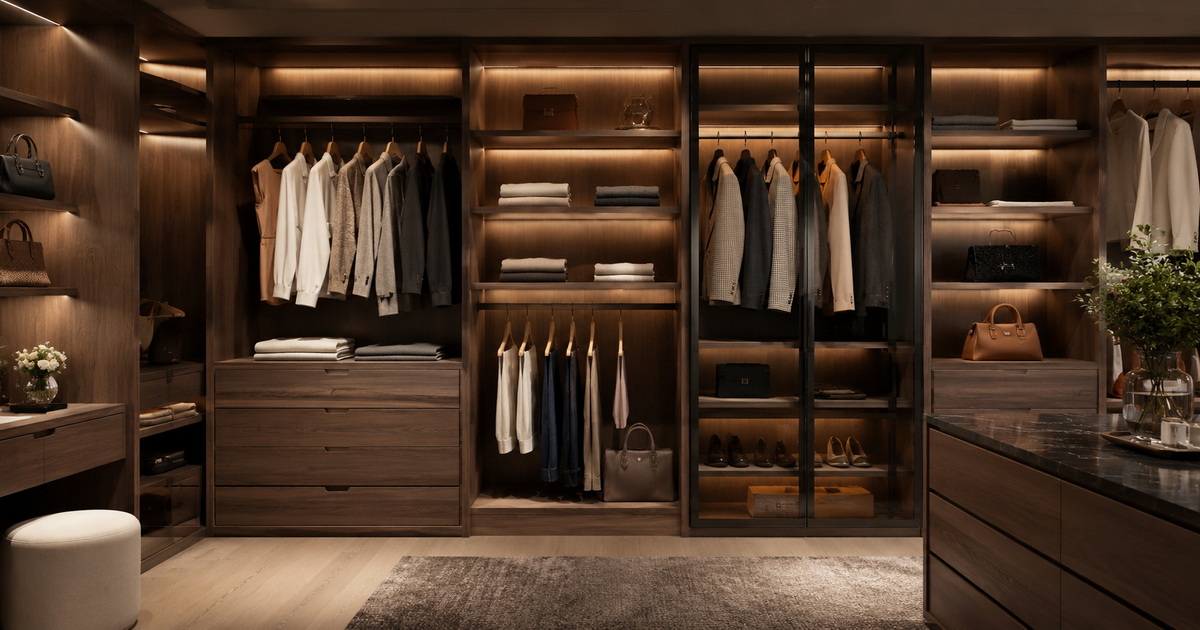
- Keep emitters concealed from the normal standing view.
- Use continuous linear light for shelves and hanging compartments.
- Avoid mounting bright sources directly above the user's face.
- Consider door sensors for automatic activation.
- Select color appearance that complements fabrics and cabinet finishes.
- Use stable dimming where the wardrobe serves as part of a bedroom environment.
- Design wiring and power placement for maintenance access.
For high-end wardrobe brands and custom furniture manufacturers, integrated lighting can become a differentiating design feature. The most successful installations feel intuitive: the light activates at the right moment, reaches the right area, and remains visually quiet.
Bathroom cabinet lighting requires special attention because mirrors, tiles, glass, and chrome surfaces can amplify reflections. A light source placed in the wrong location may create glare in the mirror or uneven facial shadows.
The best approach depends on the cabinet design and the intended task. Mirror-facing lighting needs to support grooming and makeup application, while interior cabinet lighting helps users locate toiletries and cosmetics.
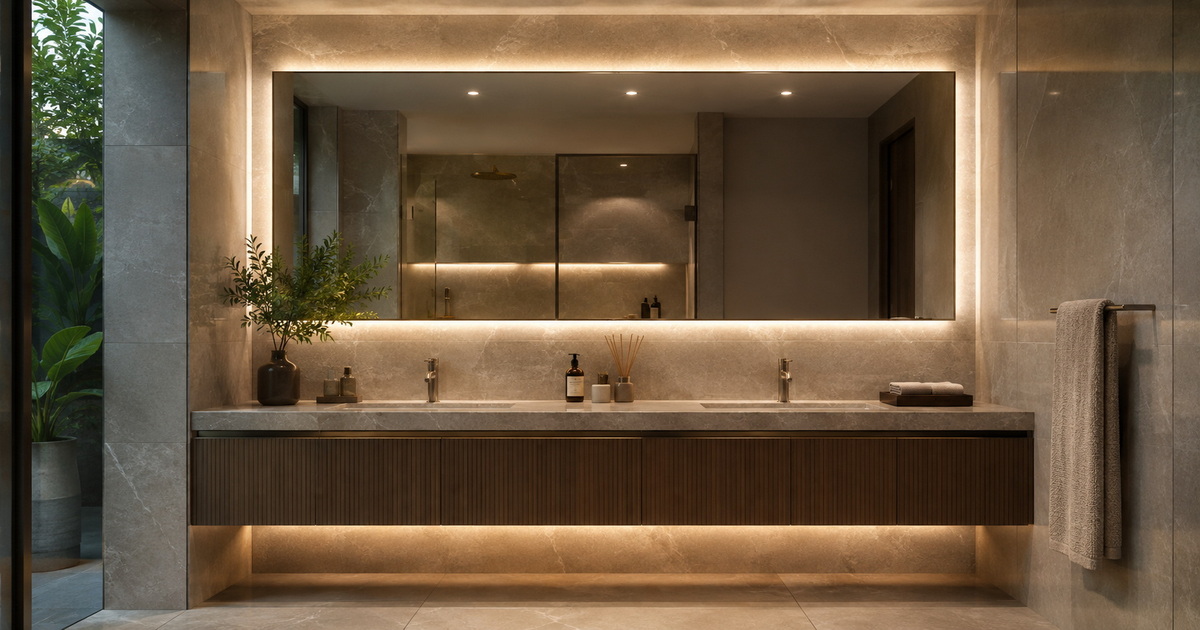
- Position lights to reduce direct mirror reflections.
- Avoid a single harsh source above the face when possible.
- Use diffused illumination to create a more balanced appearance.
- Consider moisture exposure and the requirements of the installation environment.
- Coordinate the light fixture, power supply, sensor, and switch location.
- Use concealed mounting details to maintain a clean vanity design.
- Test the lighting at the actual mirror viewing position before finalizing the layout.
A bathroom lighting plan should be judged while a person is using the mirror—not only while viewing the cabinet from across the room.
LED silicone strip lights are widely used in modern furniture and architectural applications because they can create smooth, continuous lighting lines while adapting to straight, curved, recessed, and decorative installations.
For anti-glare projects, their main value is not simply flexibility. It is the ability to support integrated light design.
When selected and installed correctly, LED silicone strip lights can help create:
- Hidden cove lighting
- Soft under-shelf illumination
- Curved wardrobe or wall details
- Recessed cabinet-edge lighting
- Indirect bedroom lighting
- Decorative mirror surrounds
- Continuous lighting lines without obvious LED points
The final effect still depends on the profile, mounting depth, diffuser structure, viewing angle, and surrounding materials. A silicone strip should be evaluated as part of the whole assembly, particularly in customized furniture programs.
Farwise Technology Co., Ltd. supports customized LED silicone strip lights, cabinet lights, wardrobe lights, bathroom cabinet lights, LED power supplies, and integrated furniture lighting solutions. We work with global customers seeking OEM/ODM support for customized dimensions, functions, designs, appearance, control options, and project-oriented lighting systems.
Before selecting an anti-glare lighting supplier or beginning a custom furniture lighting project, use this checklist:
- Is the LED source visible from the user's normal viewing position?
- Does the fixture create bright reflections on glass, mirrors, stone, or glossy panels?
- Is the light directed toward the task area rather than outward into the room?
- Does the installation provide smooth, uniform illumination?
- Is the color appearance appropriate for the furniture and room atmosphere?
- Is color rendering suitable for clothing, food, cosmetics, or display items?
- Are the LED power supply, dimmer, sensor, and controller compatible?
- Can the system be customized for cabinet dimensions, cable routing, branding, and installation details?
- Has the design been tested in a realistic furniture sample or mock-up?
- Can the manufacturer provide stable quality and long-term production support?
The strongest anti-glare lighting projects are planned early. When lighting is considered during furniture design rather than added at the end, the result is usually cleaner, easier to install, and more comfortable for the user.
Anti-glare lights are defined by more than soft light output. They depend on controlled optical design, concealed installation, reduced reflections, balanced illumination, stable controls, and a system that matches how people use the space.
For kitchen cabinets, wardrobes, bathroom cabinets, bedrooms, display furniture, and smart-home projects, the right lighting system can improve both function and perceived product quality. It helps users see what matters while keeping the source itself discreet.
Farwise Technology Co., Ltd. is a professional LED lighting manufacturer with 16 years of experience in furniture and interior lighting. We provide LED silicone strip lights, LED cabinet lights, LED wardrobe lights, LED bathroom cabinet lights, LED power supplies, and customized OEM/ODM lighting solutions for global brands, wholesalers, furniture manufacturers, project contractors, and interior solution providers.
Contact Farwise Technology Co., Ltd. today to discuss your anti-glare furniture lighting concept, request a customized solution, or develop an OEM/ODM lighting program tailored to your market.
Anti-glare lights typically use diffused output, concealed or recessed installation, controlled light direction, reduced visible LED points, and designs that minimize direct and reflected brightness. The purpose is to improve visual comfort while still providing useful illumination.
Yes. Anti-glare LED strip lights are well suited to under-cabinet kitchen lighting when they are installed in a concealed position and directed toward the countertop. Diffused linear light can improve work-surface visibility while reducing direct exposure and reflections.
Install the fixture where it is not directly visible from the normal standing position, such as inside a recessed top profile or behind a front edge. Direct light downward or toward shelves, use a diffuser where appropriate, and avoid aiming bright LEDs toward the user's face.
Yes. Bathroom cabinet lights can be designed to reduce glare by controlling fixture placement, using diffused light output, limiting mirror reflections, and avoiding harsh direct light near the user's eye line. The lighting should be tested from the actual mirror-use position.
No. A diffuser can soften visible LED points and spread light more evenly, but it does not solve every glare issue. Installation angle, mounting depth, source visibility, reflection from nearby surfaces, and user viewing position remain equally important.
The LED power supply supports stable operation and helps ensure that dimming, sensors, controls, and connected fixtures work correctly. An incompatible or poor-quality power supply can cause flickering, unstable dimming, or inconsistent lighting performance.
1. - [Mingxue LED — What are the features of anti-glare lights?] [mingxueled]
2. - [International Commission on Illumination — Discomfort Glare in Interior Lighting] [cie.co]
3. - [International Commission on Illumination — Discomfort Caused by Glare from Luminaires with a Non-Uniform Source Luminance] [cie.co]
4. - [Illuminating Engineering Society — The Elusive Discomfort Glare Metric] [ies]
5. - [Acuity Brands — Unified Glare Rating and Low-UGR Lighting] [acuitybrands]
6. - [U.S. Department of Energy — Glare] [energy]
7. - [ENERGY STAR — LED Lighting Tips for Builders] [energystar]
8. - [ENERGY STAR — Color Rendering Index Information] [energystar]
9. - [ENERGY STAR — Color Temperature Information] [energystar]


