
Views: 222 Author: Farwise Lighting Publish Time: 2026-10-25 Origin: Site


Content Menu
● What Makes LED Neon Flex Suitable for Resort Outdoor Lighting?
● Where Waterproof Neon Flex Works Best Around a Resort
>> Architectural Edges and Entrance Features
>> Landscape Paths and Outdoor Seating
● What "Waterproof" Does—and Does Not—Tell You
>> Treat Ingress Protection as One Part of Suitability
>> Evaluate the Complete Installed Assembly
● Poolside Neon Flex Is Not Automatically Underwater Lighting
● How to Select Silicone Neon Flex for Outdoor Resort Projects
>> Check Bending Direction Before Finalizing the Layout
>> Specify Mounting as Carefully as the Light
● Design Resort Lighting Around Comfort, Not Brightness
>> Reduce Glare and Light Spill
>> Build an Operating Schedule
● Three Planning Tools That Improve Project Outcomes
>> 2. Approve a Nighttime Mock-Up
>> 3. Plan Replacement Before Installation
● A Practical Installation and Handover Workflow
● Developing an OEM/ODM Lighting Brief With Farwise
>> 1.Can waterproof neon flex be installed around a resort swimming pool?
>> 2.Does a waterproof classification prove suitability for coastal resorts?
>> 3.Can installers cut neon flex anywhere?
>> 4.Can neon flex replace pathway and emergency lighting?
>> 5.What should buyers prioritize when comparing suppliers?
>> 6.How can resorts keep outdoor neon lighting visually consistent?
Waterproof neon flex solutions for resort outdoor lighting should do more than outline a building. They should help guests navigate comfortably, reinforce the property's architectural identity, and remain practical to maintain after opening night. For owners, designers, and procurement teams, the challenge is choosing a complete lighting system—not simply a flexible strip described as waterproof.
At Farwise Technology Co., Ltd., our approach starts with understanding the application before recommending the product. Drawing on 16 years in LED lighting manufacturing and experience with LED silicone strip lights and customized lighting solutions, we believe successful specification begins with one principle: waterproofing must be considered across the entire installation.

LED neon flex combines an LED light source with a diffusing enclosure that creates a continuous-looking illuminated line. Unlike exposed-point lighting, it can integrate discreetly into architectural edges and curved details.
For hospitality environments, its value lies in how it supports the overall design:
- Defining transitions between public and private areas.
- Highlighting selected architectural features.
- Adding visual continuity across terraces and outdoor lounges.
- Creating a recognizable nighttime identity.
- Coordinating exterior accents with interior lighting.
However, neon flex is an accent-lighting tool, not a universal replacement for functional luminaires. Pathways, stairs, emergency routes, and working areas still require appropriate illumination and compliance checks.
The best resort lighting schemes assign each lighting element a clear purpose rather than asking a decorative line to perform every task.
Different resort zones demand different mounting details, environmental protection, and visual effects. Start with the guest experience, then assess the installation conditions.
| Resort Area | Intended Lighting Role | Main Design Consideration |
|---|---|---|
| Entrance canopy | Establish a welcoming arrival sequence | Conceal the light source from approaching guests |
| Garden pathways | Reinforce route edges | Avoid glare and preserve clear surface visibility |
| Outdoor lounges | Define seating and architectural boundaries | Keep illumination comfortable at seated eye level |
| Poolside terraces | Highlight surrounding landscape features | Separate splash exposure from underwater applications |
| Villa façades | Connect exterior details visually | Prevent light from spilling into bedrooms |
| Outdoor bars | Support atmosphere and brand identity | Allow cleaning and maintenance access |
Concealed neon flex can emphasize canopy lines, recessed façades, and sheltered entrance details without competing with the architecture.
Review the installation from arrival routes, vehicle approaches, and nearby guest rooms. A line that appears subtle in a drawing may become distracting when directly visible at night.
For pathways, use neon flex to reinforce an already understandable route. Do not assume a glowing edge adequately reveals uneven paving or obstacles.
Around seating, place the source where guests see the illuminated surface rather than the bright face of the fitting. Review reflective finishes, too: polished stone and glass can create unwanted secondary images.
The word waterproof is not a complete purchasing specification. Protection depends on the tested product, its installation method, and the environmental conditions it encounters.
Ingress-protection classifications describe resistance to the entry of solids and water under defined conditions. They do not, by themselves, establish suitability for every outdoor environment.
For resort projects, also investigate:
- Exposure to sunlight and weathering.
- Coastal salt and airborne contaminants.
- Contact with cleaning chemicals.
- Standing water and drainage conditions.
- Mechanical damage from landscaping or maintenance.
- Compatibility between connectors, seals, and mounting components.
A product suitable for rainfall may not be suitable for immersion. Likewise, resistance to water entry does not automatically establish resistance to corrosion or chemical exposure.
The illuminated strip is only part of the system. Water can reach vulnerable components through poorly sealed ends, cable connections, damaged enclosures, or unsuitable junction arrangements.
Ask the supplier to explain which assembled configuration its documentation covers. Clarify whether site cutting, connector changes, or alternative accessories affect the stated protection.
For complex layouts, request a connection drawing before approving production. Resolving cable exits and termination locations on paper is easier than correcting them after landscaping is complete.
Poolside lighting deserves its own review because nearby installations can experience very different conditions.
A concealed line beneath a terrace bench is not equivalent to a fitting inside a swimming pool. Splash exposure, cleaning practices, and possible flooding must all be considered separately.
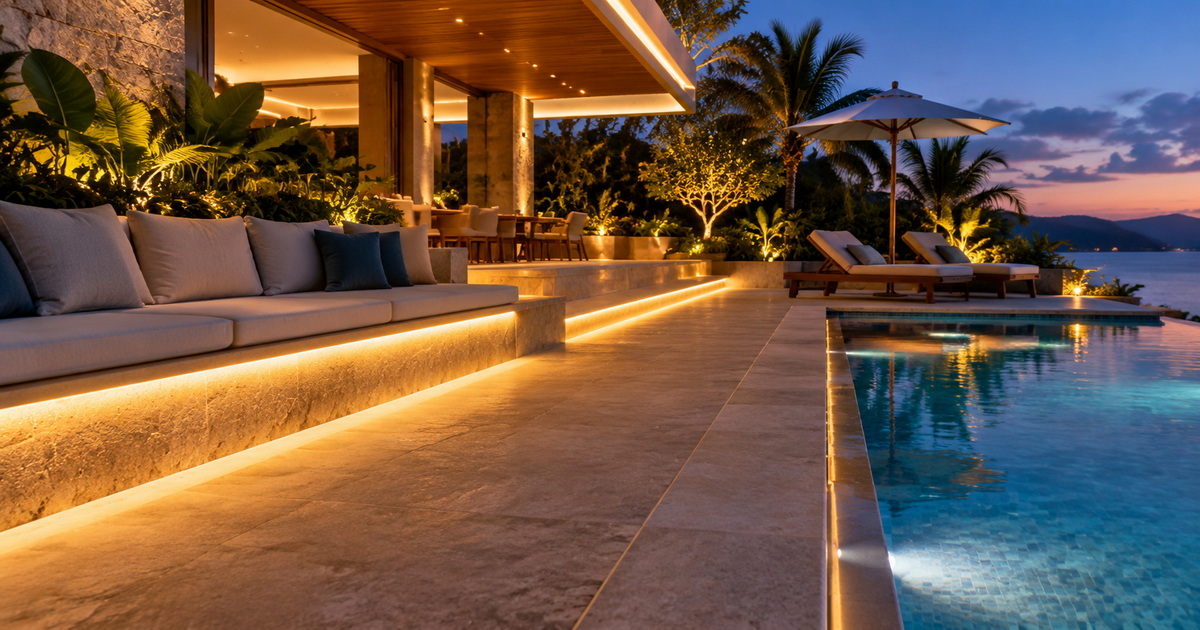
For underwater applications, use equipment specifically evaluated and identified for that purpose. Do not treat a general waterproof description or an ingress-protection claim as permission to install decorative neon flex underwater.
Have the project's qualified electrical professional review:
- The precise installation location.
- Applicable local electrical requirements.
- Equipment identification and supporting documentation.
- Power-supply and connection arrangements.
- Required protective measures and maintenance access.
This distinction protects guests and prevents procurement teams from selecting a product based on an incomplete description.
Silicone LED neon flex is an option worth evaluating for architectural lighting, but material names alone do not establish performance.
A useful supplier discussion focuses on evidence for the proposed construction and its intended environment.
Flexible does not mean bendable in every direction. Neon flex designs can have different permitted bending orientations.
Match the product to the actual route, including corners, changes in elevation, and transitions around architectural details. Twisting a profile to force it into an incompatible layout can damage the assembly.
Request a marked drawing that shows permitted bends and connection positions. Where the design changes direction, consider separate sections rather than forcing one continuous piece.
Use the mounting method approved for the selected product. Some silicone neon products require dedicated clips or channels rather than adhesive attachment.
For exposed areas, review fixing suitability, drainage, access, and the surrounding construction. The mounting arrangement should support the light without pinching it or placing stress on its connections.
A clean architectural detail should also remain serviceable. Permanently trapping a lighting section behind finished stonework may create an expensive replacement problem later.
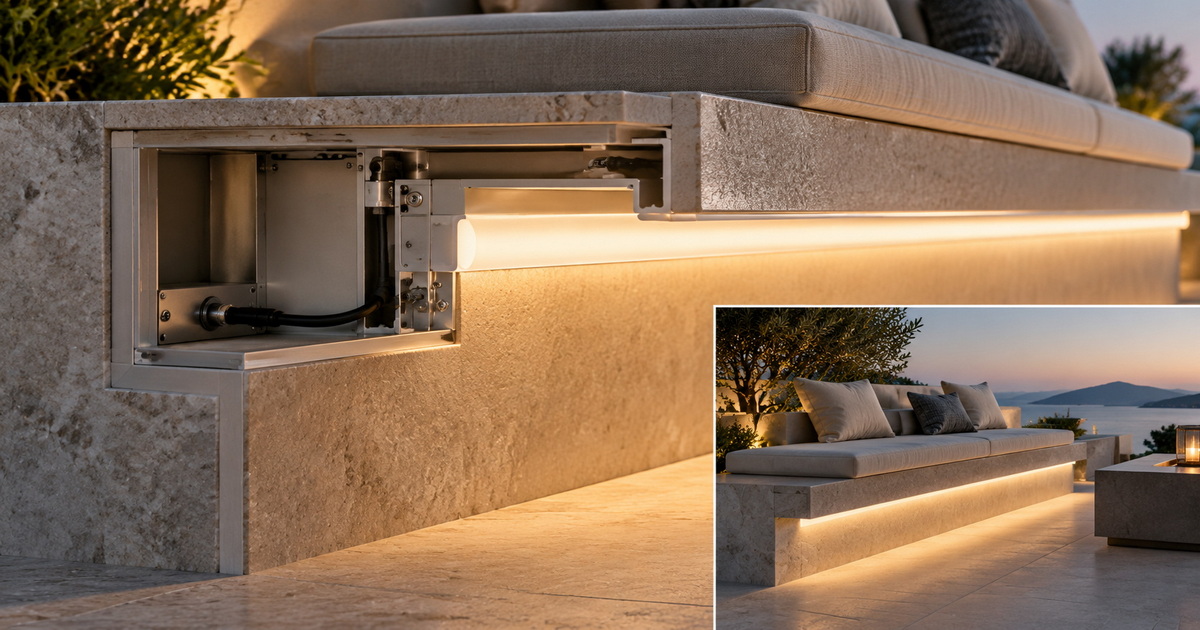
Luxury hospitality lighting often succeeds through restraint. The aim is to reveal the property while preserving a comfortable nighttime environment.
Responsible outdoor lighting follows several connected principles: provide light where it serves a purpose, direct it carefully, avoid unnecessary brightness, use controls, and favor warmer-colored light where appropriate.
Hide the source where possible and direct the effect toward the intended surface. Check sightlines from loungers, balconies, restaurant tables, and guest-room windows.
Avoid outlining every architectural edge. Selective emphasis creates hierarchy; continuous illumination everywhere can make the property visually busy.
Near sensitive habitats, consult relevant local requirements and ecological guidance rather than assuming any decorative lighting is harmless.
A resort's lighting needs change throughout the evening. Arrival periods, restaurant service, late-night circulation, and quiet hours do not necessarily require identical settings.
Discuss operating scenes with the control-system designer:
- Arrival and welcome.
- Evening dining and social activity.
- Late-night circulation.
- Cleaning and maintenance.
Verify compatibility among the light source, drivers, dimming equipment, and controls before procurement. A coordinated schedule can reduce unnecessary operation without compromising essential lighting.
A product comparison alone rarely answers the most important installation questions. The following tools help connect design intent with purchasing and maintenance.
Mark each proposed lighting run on a site plan. Describe the actual conditions rather than labeling every location simply "outdoor."
Useful categories include sheltered, rain-exposed, splash-prone, coastal, chemical-exposed, and potentially floodable.
Then identify where cables, connections, and power equipment will sit. These locations may face different conditions from the visible lighting.
The exposure map becomes a shared reference for the designer, supplier, installer, and facilities team.
Before committing to a property-wide installation, test a representative detail with the intended mounting and nearby finishes.
Assess it from realistic guest positions. Check:
- Whether the source is directly visible.
- Whether reflections create discomfort.
- Whether curves look visually consistent.
- Whether dimming behaves acceptably.
- Whether adjacent rooms receive unwanted light.
- Whether maintenance staff can reach connections.
A mock-up is a decision tool, not merely a presentation feature. Record the approved arrangement so production and installation follow the same reference.
Ask a simple question: how will this section be replaced after the resort opens?
Document accessible connection points, removable mounting details, section identification, and compatible spare components.
For a multi-building property, organize records by location. A clear replacement plan can help avoid unnecessary disruption to guest areas and reduce the risk of visually mismatched repairs.
Good installation begins before the light arrives on site.
1. Confirm the approved drawings, mounting details, and environmental requirements.
2. Inspect delivered components and check them against the agreed configuration.
3. Test representative assemblies before permanent mounting.
4. Follow the manufacturer's handling, bending, cutting, and sealing instructions.
5. Have qualified personnel complete and inspect electrical work.
6. Review the installation at night with the design and operations teams.
7. Record approved control settings and hand over maintenance instructions.
Do not improvise sealing methods or substitute connection accessories without written approval. Where instructions require curing or other preparation, incorporate that work into the construction schedule.
The handover package should identify components, connection locations, operating scenes, cleaning restrictions, and replacement procedures.
Farwise Technology Co., Ltd. manufactures LED lighting products and provides OEM/ODM customization covering dimensions, functions, appearance, and lighting solutions.
Our background includes furniture-lighting applications such as cabinets, wardrobes, bathroom cabinets, and bedroom furniture. For resort projects, that experience can inform coordination between interior details and exterior lighting concepts.
Outdoor suitability must still be confirmed for the proposed configuration. A customization request should not be treated as evidence that every design is already qualified for every environment.
Send a project brief that includes:
- Resort location and environmental exposure.
- Architectural drawings and installation photographs.
- Intended visual effect and viewing positions.
- Mounting and access constraints.
- Control-system requirements.
- Required compliance documentation.
- Maintenance expectations and replacement strategy.
Contact Farwise with these materials to discuss a project-specific LED silicone lighting solution and sample-review plan before bulk procurement.
It may suit certain surrounding architectural areas when the product and installation are appropriate. Poolside use and underwater use require separate assessments. Have a qualified electrical professional review the proposed location.
No. Water-ingress protection alone does not establish resistance to salt, corrosion, sunlight, or cleaning chemicals. Request evidence relevant to the actual coastal installation and its accessories.
No. Follow the selected product's designated cutting and termination instructions. Cutting or resealing incorrectly can damage the lighting and compromise its protection.
Not automatically. Decorative illumination may support wayfinding, but required functional and emergency lighting must independently satisfy the project's applicable requirements.
Compare application documentation, connection design, mounting support, sample quality, customization clarity, and replacement planning—not appearance or purchase price alone.
Approve a representative sample, document the accepted appearance and control settings, and agree on replacement components before ordering. Maintain those records for later repairs or expansion.
1. - International Electrotechnical Commission. "Ingress Protection (IP) Ratings." Explains the purpose and scope of enclosure protection against solids and liquids. [View source]. [iec]
2. - UL Solutions. "Landscape and Outdoor Luminaire Lighting." Covers outdoor-lighting evaluation, wet-location requirements, and considerations for equipment identified for submersible use. [View source]. [ul]
3. - Intertek. "Pool and Spa Lighting Testing." Describes electrical, waterproofing, mechanical, and environmental considerations for aquatic lighting systems. [View source]. [intertek]
4. - DarkSky International. "Five Principles for Responsible Outdoor Lighting." Provides the basis for recommendations on purposeful, targeted, restrained, controlled, and warmer-colored outdoor lighting. [View source]. [darksky]
5. - Ecolocity LED. "What Is LED Neon?" Provides product-specific examples of bending orientations, mounting methods, and pre-installation testing. Its instructions should not be generalized to every manufacturer's products. [View source]. [ecolocityled]
6. - ENTTEC. "Neon Flex Installation Guide." Provides product-specific guidance on handling, mounting accessories, outdoor fixings, bending, and protecting terminals. [View installation guide]. [cdn.enttec]


