
Views: 222 Author: Farwise Lighting Publish Time: 2026-11-02 Origin: Site


Content Menu
● Illuminance vs. Brightness: What Is the Difference?
>> Illuminance Describes Light Arriving at a Surface
>> Brightness Describes Visual Perception
>> Luminance Connects Measurement with Surface Appearance
● Why a Bright LED Strip Can Still Provide Poor Lighting
>> Light May Miss the Intended Task
>> Glare Can Dominate the Experience
>> Room Finishes Change the Result
● LED Silicone Strip Lights: Evaluate the Finished Assembly
>> Diffusion Improves Appearance but Does Not Create Light
>> Conceal the Source Without Blocking Useful Light
>> Do Not Treat Color Temperature as an Output Setting
● How to Evaluate LED Strip Lighting in Real Furniture
>> Step 1: Define the Visual Task
>> Step 2: Assemble a Representative Mock-Up
>> Step 3: Measure at the Relevant Surface
>> Step 4: Look Beyond the Brightest Point
>> Step 5: Review Comfort and Controls
● Application Insights for Cabinets, Wardrobes, Bathrooms, and Beds
>> Kitchen Cabinets: Prioritize the Worktop
>> Wardrobes: Check Vertical Visibility
>> Bathroom Furniture: Coordinate the Lighting Layers
>> Bed Frames: Favor Gentle Orientation
● A Better Buying Brief for OEM and ODM Projects
● Turn a Lighting Concept into a Practical Furniture Solution
>> 1.Is Illuminance the Same as LED Strip Brightness?
>> 2.Are Lumens Enough to Compare LED Strip Lights?
>> 3.Do Diffusers Always Improve Illuminance?
>> 4.Are Cooler LED Strip Lights Always Brighter?
>> 5.Why Does the Same Strip Look Different in Two Cabinets?
>> 6.Should Furniture Lighting Always Be as Bright as Possible?
Understanding LED strip light illuminance vs. brightness helps you choose lighting that does more than look impressive in a showroom. A strip may appear bright when viewed directly yet leave a countertop shadowed. Another installation may look subtle while making a wardrobe easier to use.
Illuminance measures incident light per unit area. Its unit is lux.
In furniture lighting, the receiving surface might be a kitchen worktop, wardrobe shelf, drawer interior, or bedside floor.
The key question is not simply whether the strip emits light. It is whether enough light reaches the place where someone needs to see.
A strip concealed behind a cabinet rail may produce an attractive glow while directing much of its light away from the worktop. The source is visible through its effect, but the working area remains poorly illuminated.
Brightness is a perceptual attribute: how bright something looks to a person.
It depends on more than the light source alone. Surrounding contrast, visual adaptation, viewing direction, and the appearance of nearby materials all influence the experience.
This explains why an exposed strip can look harsh inside a dark wardrobe but seem less striking in a bright showroom.
Brightness matters because people judge comfort and appearance with their eyes. However, it should not replace a task-based assessment.
Luminance describes light emitted or reflected in a particular direction from a surface, relative to its projected area.
It is relevant when examining visible LED points, glowing silicone surfaces, glossy countertops, and mirror reflections.
Luminance and perceived brightness are related, but they are not interchangeable. A measurement describes a physical condition; perception also depends on the observer and surrounding scene.
| Concept | Main question | Furniture-lighting relevance |
|---|---|---|
| Illuminance | How much light reaches this surface? | Visibility on shelves and worktops |
| Brightness | How bright does this look? | Comfort and visual impression |
| Luminance | How does this surface emit or reflect light toward the viewer? | Visible sources and reflections |
| Luminous flux | How much visible light does the source emit overall? | Starting point for output comparisons |

A common design mistake is evaluating the strip instead of the illuminated furniture.
Consider an under-cabinet installation. If the light falls mainly on the backsplash, the kitchen may look dramatic while the preparation area remains uneven.
Before increasing output, review the mounting position, direction, cabinet geometry, and likely working posture. These determine where the light travels and where shadows form.
An exposed strip can attract attention without improving visibility.
Direct glare comes from a source within the field of view. Reflected glare can appear when light reflects from glossy stone, polished fittings, or other reflective surfaces.
The practical objective is to make the task visible without making the source distracting. Concealment, shielding, placement, and diffusion should therefore be considered together.
The same strip can produce different visual effects in different furniture.
Light-colored interiors generally return more incident light into the scene than dark finishes. Glossy materials can create directional reflections, while matte surfaces distribute reflected light more diffusely.
Approve the lighting with representative finishes. A white demonstration cabinet is not a reliable substitute for a dark wood wardrobe.
A diffuser can soften visible LED points and make an emitting surface appear more continuous. It can also change light distribution and introduce optical losses.
Consequently, "more diffused" does not automatically mean "more illuminance."
For LED silicone strip lights, assess the completed assembly rather than assuming that a smoother appearance guarantees better task lighting.
Check whether the illuminated surface is uniform, whether furniture details remain visible, and whether the light is comfortable from normal viewing positions.
Hiding a strip behind a furniture edge can reduce direct visibility. However, a deep recess or oversized lip may also obstruct light intended for the task.
The best position balances concealment with useful distribution.
Review the installation from standing, seated, and approaching positions. A source hidden from one viewpoint may remain exposed from another.
Color temperature describes the color appearance of white light. It does not independently establish illuminance.
Cooler-looking light may appear more stimulating in some settings, but it is not automatically more effective for every task. Warmer-looking light is not inherently inadequate.
Compare color appearance within the intended interior. Evaluate task visibility separately rather than using "cooler" as a shortcut for "brighter."
A repeatable sample-review process provides a stronger basis for purchasing than photographs or descriptions alone.
Start with what the user needs to do.
- Kitchen cabinets: prepare food and identify objects.
- Wardrobes: distinguish garments and find accessories.
- Bathroom furniture: locate stored items and support the wider lighting arrangement.
- Bed frames: provide an unobtrusive orientation cue.
Different tasks require different distributions and viewing conditions. Decorative lighting should not automatically be accepted as task lighting.
Include the intended furniture finish, strip enclosure, mounting detail, diffuser, and control arrangement.
Position doors, shelves, and mirrors as they will appear in use. Simplified demonstrations can hide shadows and reflections that emerge after installation.
A mock-up is particularly valuable when several suppliers' samples look similar outside the furniture.
Use a suitable illuminance meter on the actual task plane.
For a countertop, assess the working surface. For a wardrobe, examine relevant shelves and garment areas rather than only the floor.
Keep the sensor orientation consistent. Avoid shading it with your body, and record the room-lighting conditions so later comparisons remain meaningful.
Phone-based readings may support informal comparisons, but should not be treated as equivalent to calibrated professional measurements.
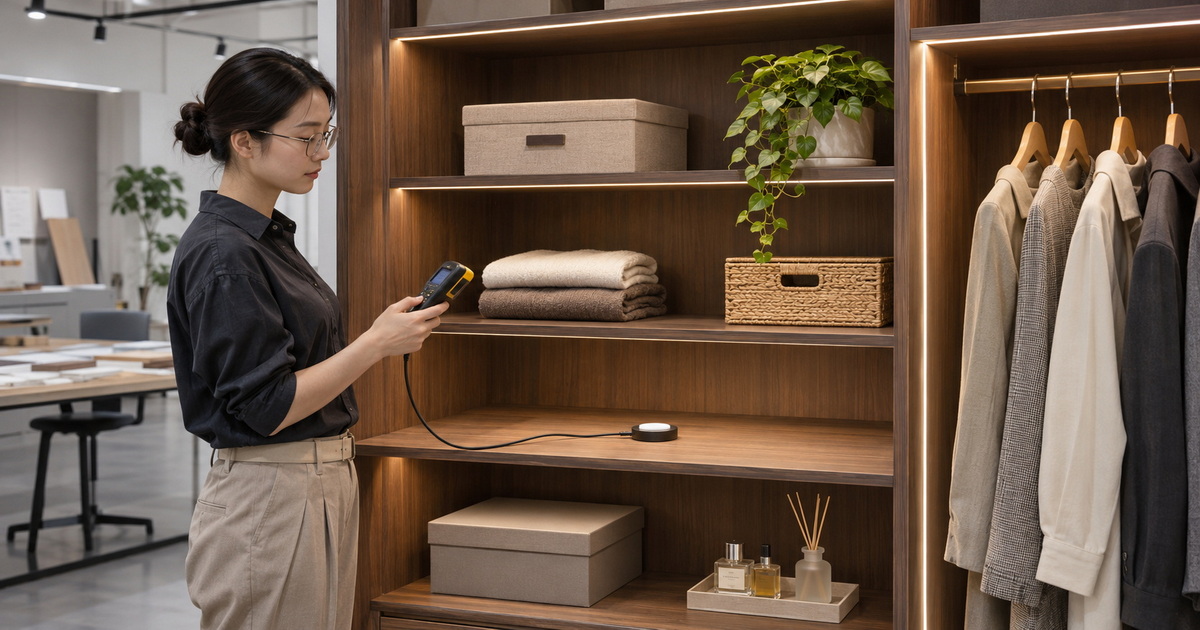
Check several locations rather than selecting the most favorable reading.
Review corners, front edges, deeper shelf areas, and places where doors or partitions interrupt the light.
A bright center can conceal weak coverage elsewhere. The important question is whether the intended task remains comfortably visible across the usable area.
Observe the installation from normal user positions.
Check direct source visibility, reflected streaks, distracting contrast, and the appearance at different dimming settings.
Where sensors are included, verify that activation matches real movement. A well-lit shelf is still inconvenient if the light switches off while someone is using it.

Under-cabinet lighting should be judged by the visibility it provides on the working surface.
Review shadows caused by hands and utensils, reflections from polished materials, and whether the backsplash receives disproportionate attention.
Correcting placement may improve usefulness more effectively than selecting a visually stronger strip.
Wardrobe lighting must work around shelves, hanging garments, and internal partitions.
A luminous line at the cabinet entrance may leave deeper compartments dark. Test the arrangement with representative contents rather than an empty cabinet alone.
Also assess whether the user's body blocks the light when reaching inside.
Bathroom cabinet lighting may illuminate storage or create an accent. Neither function automatically replaces lighting intended for the face.
Review mirror reflections, viewing comfort, and the relationship with other fixtures.
Electrical suitability must be assessed separately for the installation location. A silicone enclosure alone does not establish that the complete system is appropriate for bathroom use.
Bed-frame lighting often serves a different purpose from kitchen task lighting.
A controlled glow can help reveal the floor and furniture edges without making the source prominent.
Check the view from the pillow and from the doorway. An installation that looks attractive while standing may be distracting when lying down.
For a manufacturer or sourcing team, "make it brighter" is an incomplete instruction. It does not explain whether the problem is insufficient task illumination, uneven coverage, or an uncomfortable visible source.
A useful brief describes the furniture, the task, the viewing conditions, and the intended control behavior.
| Brief element | What to communicate |
|---|---|
| Application | Where the lighting will be installed |
| Visual task | What users need to see |
| Furniture construction | Recesses, shelves, edges, and obstructions |
| Surface finishes | Relevant colors, textures, and reflectivity |
| User experience | Desired visibility, comfort, and activation |
| Approval process | Mock-up conditions and acceptance checks |
Farwise Technology Co., Ltd. describes its background as sixteen years in LED lighting manufacturing, with LED silicone strip lights and other furniture-lighting solutions for international customers.
Its stated OEM/ODM capabilities include customization of dimensions, functions, system arrangements, and appearance. For buyers, the useful next step is to connect those options to a documented application brief and an approved furniture mock-up.
Avoid approving production solely because a loose sample looks bright on a table.
Successful furniture lighting balances useful illumination, comfortable source appearance, and integration with the furniture itself.
For your next project, send Farwise your furniture drawings, finish references, application requirements, and preferred control behavior. Request a customized proposal and evaluate the sample inside a representative assembly before approving production.
No. Illuminance measures light reaching a surface. Brightness describes visual perception. A strip can look bright while providing poor illumination at the intended task.
No. Luminous flux describes overall visible-light output, but does not show where that light lands. Compare the completed installations, including distribution, shielding, furniture geometry, and task visibility.
No. Diffusers can improve visual continuity and alter distribution, but they also introduce optical losses. Whether the task surface benefits depends on the complete arrangement.
No. Color temperature describes white-light appearance, not illuminance. Perceived brightness can vary with context, so compare color appearance and task lighting separately.
Cabinet depth, finishes, obstructions, mounting position, ambient light, and viewing angle can change the result. Similar products do not guarantee similar installed performance.
No. The objective is appropriate visibility and comfort. Excessive source visibility or reflections can make an installation less pleasant without improving the task.
1. [Mingxue LED — "What Is the Difference Between the Illuminance and Brightness of the Strip Light?"], published August 16, 2024. Original topic reference. This reconstruction clarifies that illuminance concerns incident light, corrects the treatment of color temperature, and distinguishes diffusion from increased light output. [mingxueled]
2. [International Commission on Illumination — "Illuminance," International Lighting Vocabulary, entry 17-21-060]. Authoritative definition of illuminance and its unit. [cie.co]
3. [International Commission on Illumination — "Luminance," International Lighting Vocabulary, entry 17-21-050]. Authoritative definition of directional surface luminance and its relationship to luminous quantities. [cie.co]
4. [CIE Proceedings — "Visual Discomfort Associated with Ceiling Luminaires"]. Supports the distinction between physical luminance and subjective brightness. [files.cie.co]
5. [U.S. Department of Energy — *Lighting Specification Guidance for Schools*], November 2024. Supports the discussion of contextual glare, source placement, shielding, and evaluating products before procurement. Its application-specific lighting levels are not transferred to furniture applications. [energy]
6. [U.S. Department of Energy — *LED Lighting in a Performing Arts Building*]. Provides an installed-lighting example involving diffuse reflection, glare reduction, and mock-up evaluation. [betterbuildingssolutioncenter.energy]


