
English
Views: 222 Author: Farwise Lighting Publish Time: 2026-11-01 Origin: Site


Content Menu
● LED Linear Module vs LED Strip Light: The Main Differences
● What Is an LED Linear Module?
>> Where Rigid LED Modules Fit Furniture Manufacturing
>> Where Flexible LED Strips Work Well
● Comparing Light Quality, Heat, and Electrical Design
>> Light Quality: Judge the Finished Assembly
>> Thermal Management: Follow the Heat Path
>> Electrical Compatibility: Do Not Choose by Appearance
● Lifespan, Maintenance, and Total Project Cost
>> Why Neither Format Automatically Lasts Longer
>> Serviceability Starts With Access
>> Compare Installed Cost, Not Component Price
● Which Lighting Option Fits Each Furniture Application?
>> Wardrobe and Closet Lighting
>> Bedroom and Bed-Frame Lighting
● A Practical Sample-Approval Process for Furniture Buyers
>> Step One: Define the Intended Experience
>> Step Two: Build a Representative Mock-Up
>> Step Three: Evaluate Complete-System Behavior
>> Step Four: Simulate Maintenance
>> Step Five: Record the Approved Configuration
● OEM/ODM Planning: Specify the Complete Lighting Solution
● Choosing the Right Solution for Your Project
>> 1.Are LED Linear Modules Brighter Than LED Strip Lights?
>> 2.Can LED Strip Lights Be Used in Commercial Furniture?
>> 3.Do Both Options Need Aluminum Channels?
>> 4.Can a Linear Module Replace an Existing LED Strip?
>> 5.Which Option Is Easier to Repair?
>> 6.Can One Smart Controller Operate Both Formats?
Choosing between an LED linear module vs LED strip light starts with understanding the furniture, not simply comparing the light sources. Both can illuminate cabinets, wardrobes, bathroom vanities, and bedroom furniture. The better choice depends on installation geometry, visual comfort, electrical compatibility, and future maintenance.
At Farwise Technology Co., Ltd., our approach is to evaluate the complete lighting solution rather than recommend one construction for every project. With 16 years of focus in LED lighting, we support furniture manufacturers, project buyers, and international brands with application-led OEM/ODM development.
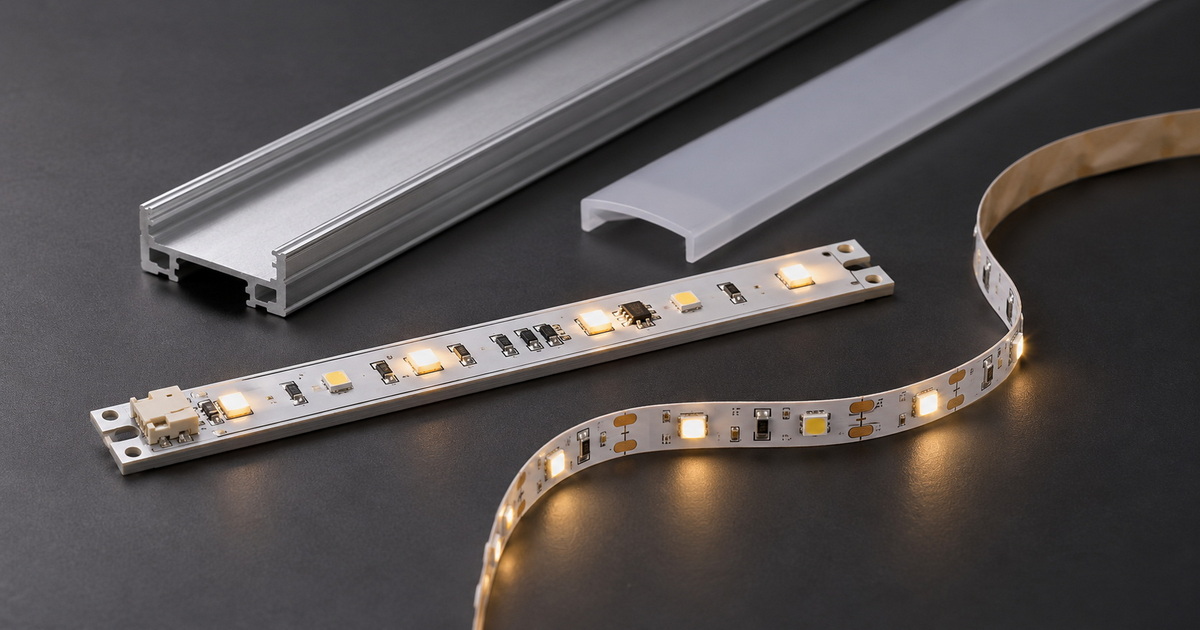
| Selection factor | LED linear module | LED strip light |
|---|---|---|
| Physical construction | Rigid circuit board | Flexible circuit board |
| Layout suitability | Straight, defined assemblies | Straight runs and compatible curves |
| Furniture integration | Useful for repeatable lighting assemblies | Useful for adaptable concealed layouts |
| Mounting approach | Designed mechanical or profile mounting | Adhesive, profiles, or approved retention methods |
| Length adjustment | Depends on module design | Possible at designated cutting points |
| Maintenance | Can support replaceable assemblies | Can support replaceable sections or channels |
| Main purchasing priority | Assembly fit and component compatibility | Routing, mounting, and electrical planning |
An LED linear module contains LEDs arranged along a rigid printed circuit board. It generally becomes part of a larger assembly that includes a housing, mounting system, electrical connections, and sometimes a diffuser.
Its main advantage is structural predictability. A defined board shape helps furniture manufacturers standardize placement, assembly, and replacement procedures.
Rigid modules deserve consideration when the furniture design includes:
- A straight, dedicated lighting recess.
- Repeated cabinet or wardrobe configurations.
- A removable light-bar assembly.
- Defined connector and mounting positions.
- A production process built around standardized components.
However, rigidity alone does not ensure effective cooling. Heat must still move through a suitable thermal path into the surrounding structure.
A rigid module also needs protection from handling damage, moisture where applicable, and unsuitable electrical connections.
An LED strip light places LEDs on a flexible circuit board. It can follow suitable curves and fit concealed lighting routes that would be inconvenient for a rigid board.
Many strips can be shortened at designated cutting points. This supports furniture collections with changing shelf widths, cabinet layouts, or decorative details.
Typical applications include:
- Concealed under-cabinet lighting.
- Wardrobe compartments and shelving.
- Bed-frame perimeter lighting.
- Recessed decorative channels.
- Architectural details connected to furniture.
Flexibility does not mean a strip can bend freely in every direction. Installers must follow the product's permitted bending orientation and handling instructions.
Likewise, adhesive backing should not be treated as a complete installation design. Surface preparation, heat, gravity, and access requirements can make a channel or additional retention necessary.
Neither construction inherently produces more attractive light.
The visible result depends on LED arrangement, optical materials, mounting position, and the distance between the light source and the illuminated surface.
For kitchen cabinets, examine the working surface rather than the exposed light source. Can users prepare food without distracting reflections or shadows?
For wardrobes, evaluate garments and interior corners. For bedroom furniture, check the light from normal seated and lying positions.
A diffuser may soften visible points, but it also changes the delivered light. Compare complete assemblies rather than uncovered samples.
Both rigid modules and flexible strips generate heat that must be managed.
A rigid board may integrate effectively with a metal housing. A flexible strip may also perform well when installed in an appropriate channel with reliable thermal contact.
Problems arise when the installation traps heat, separates the board from its intended mounting surface, or encloses the power supply without considering its operating conditions.
Ask suppliers to explain the thermal design of the assembled product. Board construction alone is not sufficient evidence.
Many flexible strips use constant-voltage power supplies. Many rigid modules use constant-current drivers. These are common arrangements, not universal definitions.
Confirm compatibility between the light source, driver, controller, and wiring before purchasing.
For extended installations, plan cable routing and power distribution early. A rigid circuit board does not automatically eliminate voltage drop, and a flexible strip does not automatically produce uneven illumination.
Brightness consistency depends on the actual circuit and installation.
A simple claim that rigid modules always outlast flexible strips overlooks system design.
LED product reliability depends on the light sources, electronics, connectors, optics, thermal conditions, and assembly quality. Failure in another component can stop a system even when its LEDs remain functional.
Buyers should therefore request evidence relevant to the proposed assembly and its operating environment.
Avoid comparing advertised lifetimes without understanding the conditions and assumptions behind them.
A replaceable module provides little maintenance benefit if technicians must dismantle finished furniture to reach it.
Equally, a strip installation can be serviceable when its channel, connections, and power supply remain accessible.
Before approving either option, establish:
1. How the lighting assembly is removed.
2. Which components can be replaced independently.
3. Whether replacement parts remain identifiable.
4. How wiring is disconnected safely.
5. Whether servicing could damage surrounding finishes.
An inexpensive light source may become costly after adding housings, assembly labor, wiring, rework, and maintenance.
Compare complete proposals with equivalent installation responsibilities.
For furniture production, useful cost questions include:
- Does the design simplify factory assembly?
- Are connectors easy to identify and install?
- Can workers avoid unnecessary on-site cutting?
- Does the packaging protect the assembly?
- Can a service team replace parts without furniture damage?
The most economical solution is the one that supports the required appearance and reliable delivery with manageable lifecycle costs.

Both options can work well beneath kitchen cabinets.
A flexible strip suits continuous concealed routes and varying cabinet arrangements. A rigid module suits a defined light bar or standardized assembly.
Prioritize placement, glare control, cleaning exposure, and access. Test the proposed lighting with representative countertops because reflective and matte surfaces can produce different visual results.
Wardrobes often combine shelving, hanging compartments, drawers, and door-operated controls.
Flexible strips help accommodate changing interior layouts. Rigid modules can simplify repeatable cabinet assemblies.
The key is useful illumination. Check whether clothing or shelves block the light, whether the source is visible, and whether the sensor responds correctly during ordinary use.
Bathroom furniture requires an environment-specific decision.
Neither a bare rigid module nor an unprotected strip should be assumed suitable simply because it fits inside a cabinet.
Review moisture exposure, cleaning practices, connection protection, power-supply placement, and applicable local requirements. A protected light source does not automatically make every connector or controller suitable for the same environment.
Flexible strips are often convenient for concealed bed-frame outlines. Rigid modules can suit straight integrated reading or furniture-lighting assemblies.
Evaluate comfort from the user's actual viewing position. Check exposed points, reflected glare, cable security, and access to controls.
For a coordinated bedroom collection, both constructions may be appropriate in different locations.
The most useful comparison happens inside representative furniture, not only on a supplier's display board.
This process helps turn a product comparison into a repeatable purchasing decision.
Describe what users should see and do.
Examples include clear countertop illumination, softly lit wardrobe interiors, or concealed bedroom guidance lighting.
Separate functional lighting from decorative effects so samples are judged against the correct purpose.
Use the intended furniture material, finish, channel, diffuser, wiring route, and control arrangement.
Check appearance with doors open and closed. Examine corners, joints, reflective surfaces, and normal viewing positions.
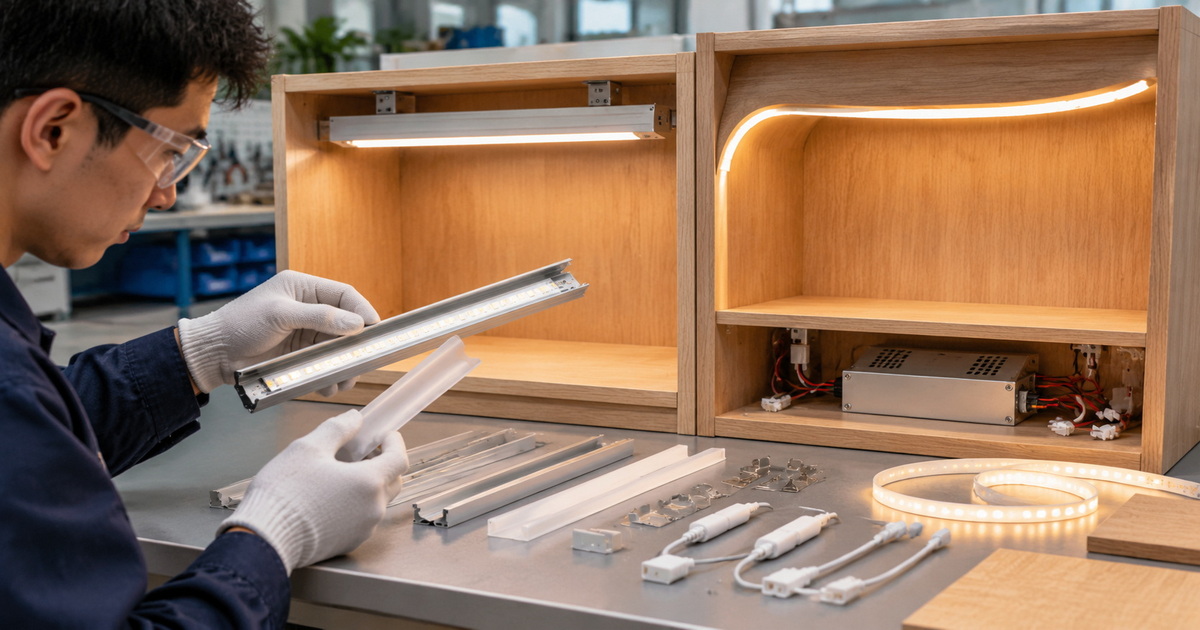
Operate the assembled lighting through its intended controls.
Look for inconsistent dimming, visible flicker, delayed response, unwanted noise, loose connections, and uneven illumination.
Arrange thermal and electrical verification through appropriately qualified personnel. A visual inspection alone cannot establish safety or reliability.
Remove and reinstall the lighting assembly.
Confirm that access is practical, connectors are identifiable, and furniture finishes remain protected. Include the power supply and controller in this exercise.
Document the accepted appearance, assembly method, component references, control behavior, and inspection process.
This creates a clearer basis for production consistency than approving an isolated light-source sample.
For custom furniture lighting, the development brief should connect appearance, installation, controls, and serviceability.
Farwise Technology Co., Ltd. supports customization of dimensions, functions, solution design, and appearance across furniture-lighting applications.
A useful inquiry should include:
- Furniture drawings and installation locations.
- The intended lighting effect.
- Available mounting and cable-routing space.
- Preferred switching, sensing, or smart-control behavior.
- Environmental conditions.
- Target-market documentation requirements.
- Maintenance expectations and packaging needs.
These details help determine whether a rigid module, flexible strip, or combined approach makes the most sense.
Choose an LED linear module when a fixed, repeatable lighting assembly aligns with your furniture design and production process.
Choose an LED strip light when adaptable routing and concealed integration are more important.
For projects containing different furniture types, evaluate each location separately rather than forcing one construction into every application.
Send Farwise Technology Co., Ltd. your furniture drawings, intended lighting effect, control preferences, and destination market. Our team can review the application and help develop an OEM/ODM lighting solution around installation, appearance, and practical maintenance.
Not necessarily. Brightness depends on the selected components, electrical design, optics, and installation. Compare the light delivered by complete assemblies rather than assuming a rigid board produces more useful illumination.
Yes. Properly selected and integrated strips can suit commercial shelving, displays, cabinetry, and architectural details. Suitability depends on the complete system and operating conditions, not simply whether the circuit board is flexible.
Not every design requires the same mounting arrangement. Follow the manufacturer's thermal and installation instructions. A channel may provide mounting support, protection, heat transfer, and diffuser integration, but it must suit the actual assembly.
Sometimes, but it is not automatically interchangeable. Review mounting space, electrical compatibility, connectors, controls, optics, and environmental protection before changing the light source.
The more accessible design is usually easier to repair. Either construction can support practical replacement when the lighting assembly, connections, and power supply remain reachable without damaging the furniture.
Potentially, but compatibility must be confirmed across the controller, driver, and light source. Similar appearance or connector shape does not establish compatibility. Approve the intended control combination as a complete system.
1. - [SignliteLED — "LED Linear Module vs LED Strip Light: Which One Should You Choose."] Comparative starting point reviewed for topic coverage. This article does not adopt its blanket lifespan rankings, pricing assumptions, or commercial-versus-decorative restrictions. [signliteled]
2. - [U.S. Department of Energy — "Lifetime and Reliability."] Basis for distinguishing component performance from complete-system reliability and recognizing electrical, thermal, optical, and connection-related failure mechanisms. [www1.eere.energy]
3. - [U.S. Department of Energy and Next Generation Lighting Industry Alliance — "LED Luminaire Lifetime: Recommendations for Testing and Reporting," Third Edition.] Basis for the discussion of operating conditions, thermal management, replaceability, and the limitations of light-source lifetime claims. [energy]
4. - [Tridonic — LED Modules Product Finder.] Industry product-category reference covering linear and flexible modules and different electrical supply arrangements. [tridonic]
5. - [Tridonic — "Tunable White Technology: Module, Driver and Controls."] Reference illustrating the need to coordinate modules, drivers, and controls, including constant-current and constant-voltage arrangements. [resources.tridonic]
6. - [UL Solutions — Product Certification Resources.] Resource for checking applicable product and component certification records; inclusion does not imply that any Farwise product holds a particular certification. [ul]


