
Views: 243 Author: Farwise Lighting Publish Time: 2026-08-26 Origin: Site


Content Menu
● What Is the Difference Between High-Voltage and Low-Voltage LED Strip Lights?
● High-Voltage vs. Low-Voltage LED Strip Lights at a Glance
● Why Low-Voltage LED Strip Lights Are Common in Furniture Lighting
● Cutting Flexibility: A Major Difference in Custom Installations
>> Low-Voltage Strips Support Precise Furniture Dimensions
>> High-Voltage Strips Usually Require Longer Cut Sections
● Voltage Drop and Lighting Uniformity in Long Runs
>> How Professionals Reduce Voltage Drop
● Safety and Installation Planning
● Choosing the Right Strip for Each Application
>> Choose High-Voltage LED Strip Lights When:
>> Choose Low-Voltage LED Strip Lights When:
● Expert Checklist Before Ordering
● Why System-Level Customization Matters
● Build the Right Furniture Lighting System
● FAQ
>> 1. Is high-voltage or low-voltage LED strip light better for kitchen cabinets?
>> 2. Can low-voltage LED strip lights be used in bathroom furniture?
>> 3. Why does an LED strip become dimmer at the far end?
>> 4. Can I cut high-voltage LED strip lights anywhere?
>> 5. Do low-voltage LED strips need a driver?
>> 6. Which LED strip is better for smart furniture lighting?
>> 7. What information should I send for an OEM/ODM LED lighting inquiry?
Choosing between high-voltage and low-voltage LED strip lights affects far more than installation wiring. It influences cutting flexibility, lighting uniformity, control options, safety planning, maintenance, and how well the finished system fits cabinetry, wardrobes, bathroom vanities, bed frames, and other furniture-lighting applications.
After years of working with furniture-lighting projects, we have seen one recurring issue: buyers often select a strip light based only on initial cost or available input voltage. In practice, the best choice depends on the installation environment, required customization, wiring layout, control system, and the end user's expectations for appearance and reliability.
For most integrated furniture and interior lighting projects, low-voltage LED strip lights are usually the more adaptable option. For long, continuous decorative runs with limited connection points, high-voltage strips can be a practical alternative when installed correctly.

A high-voltage LED strip light is designed to operate directly from an AC mains supply through a compatible power connection system. Common regional versions are made for AC 110V, 120V, 220V, 230V, or 240V input.
A low-voltage LED strip light operates on DC power, commonly 12V or 24V. It requires a compatible LED driver or power supply to convert AC mains electricity into the correct DC output before electricity reaches the strip.
The visible lighting effect may look similar at first glance. However, their internal structure, installation method, cutting increments, wiring needs, and application suitability are very different.
For furniture lighting, the key question is not simply, "Which strip is brighter?" Instead, ask: Which system gives the project the right balance of flexibility, visual quality, safety planning, and serviceability?
| Selection Factor | High-Voltage LED Strip Light | Low-Voltage LED Strip Light |
|---|---|---|
| Input type | AC mains supply | DC power through a driver |
| Typical project use | Long decorative runs and outline lighting | Furniture, cabinetry, wardrobes, mirrors, and customized interiors |
| Minimum cutting flexibility | Usually longer cutting sections | Usually shorter cutting sections |
| Installation layout | Fewer power-feed points may be needed | Requires thoughtful driver and wiring planning |
| Control compatibility | Can be more limited depending on system design | Well suited to dimming, sensors, smart controls, and scene lighting |
| Concealed installation | Less suitable where direct mains-level wiring is undesirable | Often preferred for enclosed furniture and joinery details |
| Custom project adaptability | Better for continuous standardized runs | Better for tailored sizes, zones, and functional lighting layouts |
Both types can be useful. The right solution depends on the application rather than a universal "better" option.
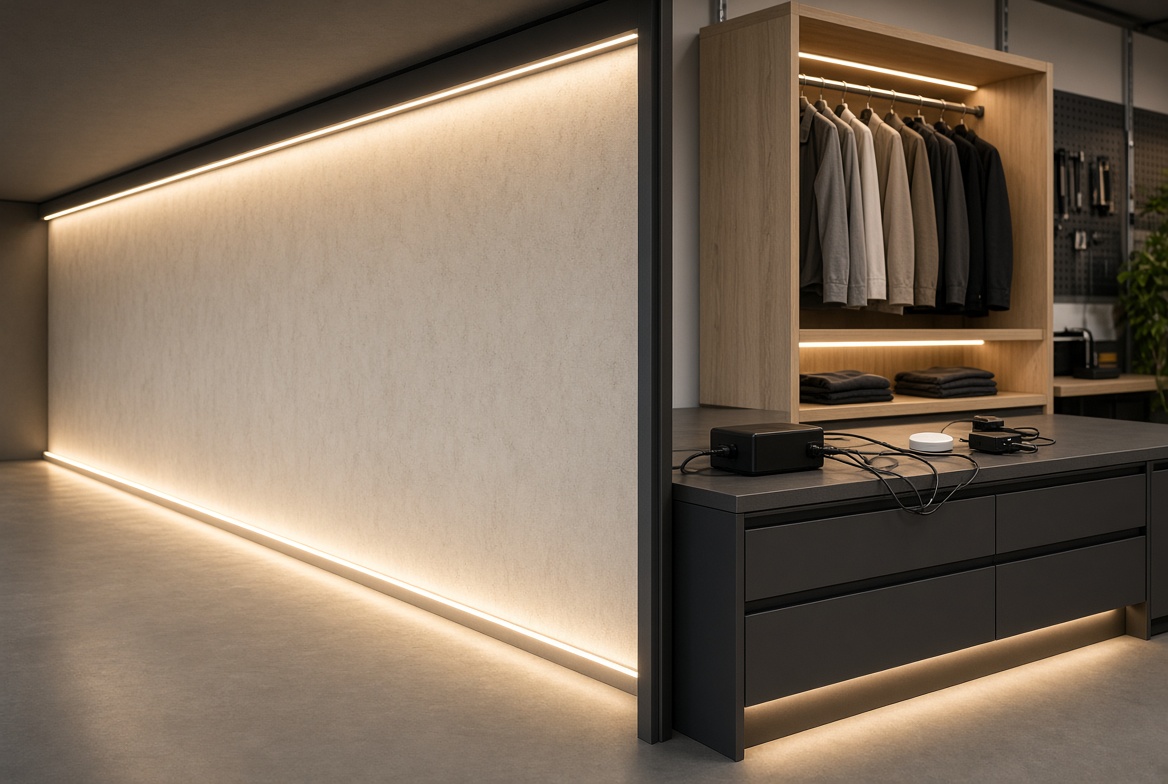
Low-voltage systems are widely used in modern furniture lighting because they support a more modular design approach. A cabinet manufacturer, interior contractor, or smart-home integrator can position the driver, sensor, dimmer, switch, and strip separately according to the project layout.
This is especially useful for:
- Kitchen cabinet toe-kick lighting
- Under-cabinet task lighting
- Wardrobe hanging-rail lighting
- Drawer and shelf illumination
- Bathroom mirror and vanity lighting
- Headboard and bed-frame ambient lighting
- Display cabinets and retail furniture
- Smart-home lighting zones
A low-voltage system can also make it easier to build a lighting experience rather than simply add a light source. For example, a wardrobe project may include door-triggered illumination, soft dimming, multiple internal zones, and a concealed power arrangement. These features are easier to plan when the strip light is part of a complete low-voltage lighting system.
Farwise Technology Co., Ltd. focuses on furniture-lighting solutions designed for these types of real-world installation needs. With 16 years of manufacturing experience, we support OEM/ODM projects involving LED silicone strip lights and related furniture-lighting solutions, including custom dimensions, functions, appearance, and system configurations.
Cutting flexibility is one of the most important differences between high-voltage and low-voltage LED strip lights.
Furniture projects rarely follow perfectly standardized lengths. A cabinet may have a narrow shelf, a short vertical side panel, a stepped island profile, or a custom wardrobe compartment. In these situations, the strip must be cut close to the actual installation dimension.
Low-voltage strips generally have shorter cutting intervals, allowing installers to create a cleaner and more accurate fit. This helps reduce excess strip material, visible overlaps, and unnecessary dark areas.
For example, if a lighting channel inside a wardrobe ends just before a side panel, a shorter cuttable section gives the installer more freedom to finish the run neatly. This is particularly important when lighting is visible through a diffuser or reflected by glossy furniture surfaces.
High-voltage strip lights are commonly designed with longer cutting units. This is not automatically a disadvantage, but it can be restrictive in detailed joinery work.
If the required installation length does not align with the marked cutting point, installers may need to:
- Adjust the lighting layout
- Hide the remaining length
- Change the mounting route
- Select another product type
- Create a separate lighting zone
For building outlines, landscape borders, long coves, and other large-scale decorative applications, this may be acceptable. For a high-end wardrobe, kitchen, or vanity installation, it can make the final result harder to refine.
One practical challenge in low-voltage LED strip installations is voltage drop. As electricity travels through a long strip and connecting wire, resistance can reduce the voltage reaching the far end. This may cause lower brightness or visible color inconsistency in some installations.
Voltage drop depends on several factors:
- Total strip length
- Input voltage
- Power demand of the lighting system
- Wire length between driver and strip
- Wire size
- Power-feed location
- Number of connected lighting sections
Industry installation guidance commonly recommends maintaining a low voltage drop to preserve consistent lighting performance. Longer wire runs, smaller wires, and heavier connected loads increase the risk of uneven output.
A well-designed low-voltage lighting layout does not rely on guesswork. Before production or installation, the project team should review the wiring route, driver location, switching method, and planned strip length.
Common solutions include:
1. Use 24V systems for longer furniture-lighting runs.
A higher DC input voltage can help reduce the impact of voltage loss across longer layouts.
2. Feed power from more than one point.
Power can be supplied from both ends, the center, or multiple planned points depending on the lighting layout.
3. Use parallel wiring for separate lighting zones.
Instead of connecting many sections in one long chain, each section can receive a dedicated supply route.
4. Place the driver strategically.
A concealed driver should still be located where cable runs remain practical and maintenance access is possible.
5. Confirm wiring before final installation.
Test the full lighting run before adhesive backing, silicone mounting, or cabinet assembly makes changes difficult.
For cabinet and wardrobe manufacturers, this planning stage can prevent expensive rework after installation.
High-voltage and low-voltage systems both require correct components, proper installation, and compliance with applicable local electrical requirements. The key difference is where the higher-voltage electrical connection is managed.
High-voltage strip systems involve mains-level power at or near the strip connection. They should be installed only with compatible accessories, appropriate sealing methods, and qualified electrical practices for the market where the project will be installed.
Low-voltage strip systems use a driver to convert mains power before it reaches the strip. The strip itself then operates at a lower DC voltage. This design is often preferred in furniture because it enables more flexible placement of the light source within enclosed cabinetry and joinery structures.
Lighting safety standards for luminaires cover areas such as marking, electrical construction, mechanical construction, classification, and photobiological safety. These considerations should be reviewed as part of product selection and project verification—not treated as an afterthought.
Use a qualified installer when the project involves mains wiring, concealed electrical connections, wet-area locations, or complex control systems. Always match the strip light, driver, dimmer, controller, connector, and input supply as one compatible system.
Never connect a low-voltage LED strip directly to a high-voltage AC supply. Manufacturer installation guidance specifically warns against this and stresses verifying component compatibility before installation.
The best LED strip light is the one that fits the installation goal, not merely the one with the lowest unit price.
- The project involves long, continuous decorative lighting runs
- Cutting precision is less critical
- The installation layout has limited access to multiple drivers
- The lighting is used for outlines, façades, landscape accents, or large decorative features
- The electrical design is handled by qualified professionals
- The selected system is suitable for the intended indoor or outdoor environment
- The project is for cabinets, wardrobes, drawers, shelves, or bed frames
- Short and precise cut lengths are important
- The design includes sensors, dimmers, touch switches, or smart controls
- Multiple lighting zones need independent control
- The installation requires concealed, refined, and customized details
- The buyer needs an OEM/ODM lighting solution tailored to furniture dimensions or brand requirements
For many furniture manufacturers, low-voltage LED silicone strip lights offer a strong combination of flexibility, visual consistency, customization potential, and compatibility with modern control systems.
Before confirming an LED strip-light order, provide the manufacturer or supplier with clear project information. This improves quotation accuracy and reduces installation risk.
- Application area: cabinet, wardrobe, bathroom vanity, bed frame, display case, or commercial interior
- Installation environment: dry, humid, splash-prone, indoor, outdoor, concealed, or exposed
- Required lighting effect: task lighting, ambient lighting, decorative edge lighting, or sensor-triggered lighting
- Installation length and quantity of each section
- Need for cutting, corner connections, channels, diffusers, or silicone profiles
- Required switching method: standard switch, touch sensor, door sensor, dimmer, remote control, or smart-home system
- Local input-voltage requirements
- Branding, packaging, labeling, and customization requirements
- Expected annual order volume and target market
A strong supplier should ask these questions before recommending a solution. Product selection without installation context often leads to mismatched accessories, uneven light output, difficult wiring, or unnecessary cost.
An LED strip light is only one part of the finished lighting experience. The final performance also depends on the driver, connector, mounting method, diffuser, aluminum profile, sensor, control method, and installation process.
That is why Farwise Technology provides more than a single strip-light product. We develop system-oriented commercial and residential lighting solutions for furniture applications, with support for OEM/ODM customization across size, function, appearance, and project configuration.
For brands, distributors, cabinet manufacturers, and project contractors, the value of customization is not simply having a different product shape. It is having a lighting solution that can be assembled efficiently, installed reliably, and presented consistently across multiple projects.
A well-planned lighting system can improve product differentiation, reduce on-site adjustment, and create a more premium user experience for the final customer.
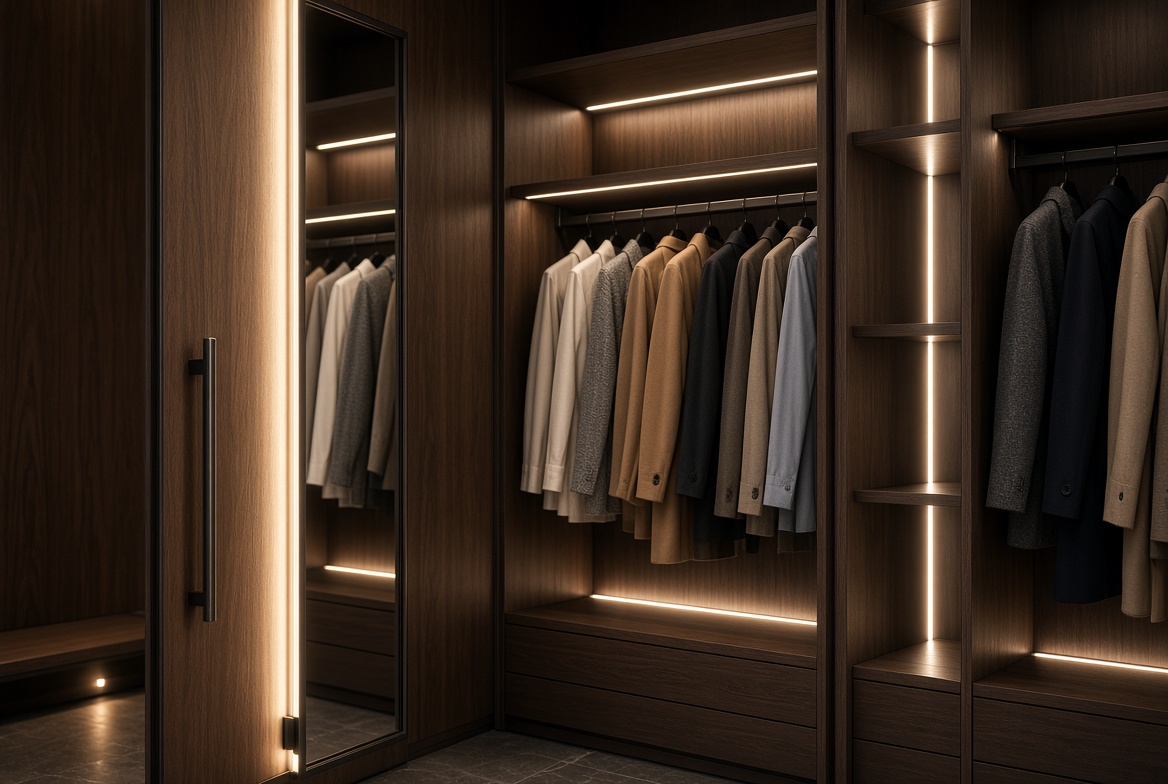
Whether you need LED silicone strip lights for wardrobes, cabinet lighting for a new furniture collection, or a customized lighting solution for an interior project, start with the application—not just the strip type.
Contact Farwise Technology Co., Ltd. to discuss your OEM/ODM requirements, installation layout, control needs, and custom lighting-solution goals. Our team can help you develop a practical, high-stability LED lighting system designed around your product, market, and installation scenario.
Low-voltage LED strip lights are generally the better choice for kitchen cabinets because they offer more precise cutting, easier integration with sensors and dimmers, and greater flexibility for concealed lighting layouts.
Yes, but the lighting system must be selected for the actual installation environment. Consider moisture exposure, sealing requirements, driver placement, connector protection, and local electrical requirements before installation.
This can be caused by voltage drop. Long strip runs, long connecting wires, insufficient wire size, and high connected load can reduce voltage at the far end of the system. Strategic power injection or parallel wiring can help maintain more even brightness.
No. High-voltage LED strip lights should only be cut at the manufacturer's designated cutting marks. Cutting outside the allowed section can prevent the remaining strip from working correctly or create an unsafe installation condition.
Yes. A low-voltage LED strip requires a compatible power supply or LED driver that converts the AC input into the correct DC output. The strip voltage and driver output must match.
Low-voltage LED strip lights are generally more suitable for smart furniture lighting because they can be integrated with door sensors, touch controls, dimmers, remote controls, and other low-voltage control components.
Provide the application, installation dimensions, desired lighting effect, input-voltage market, control requirements, environmental conditions, customization needs, quantity, packaging requirements, and target delivery market.
1. Mingxue LED. "[Differences Between High Voltage and Low Voltage Strip Light]." [mingxueled]
2. Diode LED. "[What Is Voltage Drop?]." [diodeled]
3. Flexfire LEDs. "[How to Prevent Voltage Drop in LED Strip Lights]." [flexfireleds]
4. Standards Australia. "[IEC 60598-1:2020—Luminaires]." [store.standards.org]
5. USESI. "[Low Voltage Tape Light Installation Instructions]." [assets.usesi]
6. Flexfire LEDs. "[LED Strip Light Installation Guide]." [flexfireleds]


