
Views: 282 Author: Farwise Lighting Publish Time: 2026-08-15 Origin: Site


Content Menu
● What Is Hotel Neon Lighting?
● What Is LED Profile Lighting?
● Hotel Neon Lighting vs LED Profile Lighting
● When Hotel Neon Lighting Is the Better Choice
>> 1. Branded Arrival Experiences
>> 2. Curved and Organic Interiors
>> 3. Bar, Lounge, and Entertainment Areas
>> 4. Decorative Lighting Without Visible Dots
● When LED Profile Lighting Is the Better Choice
>> 1. Guestroom Headboards and Bed Frames
>> 2. Wardrobes, Cabinets, and Furniture Lighting
>> 3. Bathroom Cabinets and Mirrors
>> 4. Corridors and Wayfinding
● Design Decision Framework for Hotel Projects
>> Step 1: Define the Guest Experience
>> Step 2: Identify the Surface and Geometry
>> Step 3: Plan the Complete Lighting System
>> Step 4: Test Before Full Production
● Combining Neon and Profile Lighting
>> Using Decorative Lighting as the Only Light Source
>> Ignoring Installation Access
>> Treating Every Area the Same
>> Overusing Bright Decorative Lines
>> Selecting Products Without Customization Review
● Partner With Farwise for Hospitality Lighting Solutions
● FAQ
>> Is hotel neon lighting suitable for guest rooms?
>> What is the main difference between LED neon flex and LED profile lighting?
>> Can LED silicone strip lights be customized for hotel projects?
>> Which solution is better for hotel wardrobe lighting?
>> Can hotel neon lighting be used in bathrooms?
>> Should a hotel use both neon lighting and LED profiles?
>> What should hotel buyers prepare before requesting a customized lighting solution?
Hotel neon lighting and LED profile lighting serve different purposes in a hospitality environment. LED neon lighting is usually the stronger choice for expressive visual identity, curved decorative details, and memorable guest-facing features. LED profile lighting is generally better for precise architectural integration, functional illumination, concealed linear light, and clean furniture lighting.
For hotel developers, interior designers, fit-out contractors, and lighting procurement teams, the best result is rarely an either-or decision. A well-planned hotel lighting scheme often combines both: neon-style silicone lighting for visual impact and LED profiles for practical, refined, long-term illumination.

Hotel neon lighting generally refers to flexible LED neon solutions used to create continuous, dot-free lines of light. Unlike traditional glass neon, modern LED neon flex is commonly made with flexible silicone housing, internal LED components, and a diffused emitting surface.
In hospitality projects, it can be shaped into curves, lettering, outlines, decorative borders, ceiling details, wall features, and atmosphere-driven accents.
LED silicone strip lights are especially suitable where a designer wants a soft, uniform line without visible LED points. They can support creative lighting concepts in boutique hotels, resorts, serviced apartments, restaurants, bars, spas, lounges, and branded public areas.
Typical hotel neon lighting applications include:
- Hotel logos and reception feature walls
- Curved ceiling and cove details
- Bar counters and back-bar displays
- Restaurant wall outlines
- Spa corridors and relaxation zones
- Mirror surrounds and vanity features
- Nightclub-style lounge environments
- Exterior entrance accents, subject to appropriate installation planning
- Custom decorative shapes and branded visual elements
The essential value of hotel neon lighting is emotional impact. It turns a plain surface into a recognizable visual element and can help a property create a stronger night-time identity.
Modern LED neon flex is widely used as a safer, cooler-running, and more flexible alternative to traditional glass neon, while providing a continuous illuminated appearance.
LED profile lighting uses an aluminum profile, also called an LED channel or extrusion, to house and protect an LED strip. A diffuser is normally installed over the light source to soften the output, reduce visible dots, and create a more polished finish.
For hotel interiors, LED profiles are often integrated into joinery, ceilings, walls, shelving, headboards, wardrobes, bathroom cabinets, stair details, and architectural recesses.
The profile performs several important functions:
- Creates a straighter and cleaner light line
- Helps manage heat from the LED strip
- Protects the light strip from dust and accidental contact
- Improves the finished appearance of cabinet and furniture lighting
- Supports recessed, surface-mounted, corner, suspended, or indirect lighting layouts
- Makes maintenance and replacement more manageable in many project designs
LED profile lighting is typically less decorative than neon flex. However, it is often more suitable for lighting that must look intentional, built-in, and consistent with premium interior architecture.
In hotel guestrooms, indirect linear lighting is commonly used in headboards and wardrobes to create a calm, sophisticated atmosphere.
The right choice depends on the project objective, installation location, visual language, maintenance access, and the balance between ambient, decorative, and functional lighting.
| Comparison Area | Hotel Neon Lighting | LED Profile Lighting |
|---|---|---|
| Main purpose | Decorative, atmospheric, and brand-focused lighting | Architectural, functional, and integrated linear lighting |
| Visual effect | Soft, continuous, expressive, and often more eye-catching | Clean, precise, structured, and understated |
| Shape flexibility | Excellent for curves, lettering, waves, and custom forms | Best for straight lines, corners, and controlled geometric layouts |
| Typical hotel area | Lobby feature walls, bars, lounges, restaurants, spas, branded zones | Guest rooms, wardrobes, headboards, cabinets, corridors, ceilings, and joinery |
| Installation style | Surface-mounted, clipped, recessed, or integrated into decorative structures | Recessed, surface-mounted, corner-mounted, suspended, or concealed |
| Design character | Bold, artistic, and experiential | Minimal, premium, and architectural |
| Furniture integration | Suitable for selected visual accents | Highly suitable for cabinets, shelves, wardrobes, and bathroom furniture |
| Maintenance approach | Requires thoughtful planning around bends, end caps, and power connections | Requires access planning for profiles, drivers, and LED strip replacement |
| Best use case | Creating a memorable focal point | Delivering consistent everyday illumination |
Choose hotel neon lighting when the project needs visual storytelling rather than only illumination.
A hotel lobby is often the first physical interaction between a guest and the brand. A flexible silicone light line can outline a reception backdrop, create a curved ceiling feature, or highlight a wall texture in a way that standard linear profiles may not achieve.
Hotels increasingly use lighting to make entrances and reception zones more recognizable. A custom LED neon flex installation can trace a logo, shape a signature motif, or emphasize an architectural curve.
This is especially relevant for:
- Lifestyle hotels
- Boutique properties
- Resorts
- Design-led restaurants within hotels
- Rooftop bars
- Entertainment-focused hospitality spaces
The goal is not simply brightness. The goal is creating a scene guests remember, photograph, and associate with the property.
Straight aluminum channels work well in modern interiors. However, they are not always appropriate for curved architecture.
LED silicone strip lights can adapt to circular walls, wave-shaped ceilings, rounded furniture, archways, and sculptural installations. This makes them useful for designers seeking a softer or more fluid interior language.
For example, a spa corridor may use a continuous curved neon-style line along the ceiling edge to guide guests toward treatment rooms. The result can feel calm and immersive without relying on large decorative fixtures.
Bars and lounges often need stronger contrast, layered atmosphere, and more theatrical visual effects than guestrooms.
Hotel neon lighting can be used to:
- Define the edge of a bar counter
- Create illuminated bottle-display outlines
- Frame decorative mirrors
- Highlight artwork or wall graphics
- Create a soft perimeter glow around booth seating
- Build a signature photo backdrop
For these spaces, lighting becomes part of the venue's commercial identity. It can influence perceived energy, dwell time, and the overall premium impression.
One of the most common complaints in low-quality linear lighting is visible LED spotting. A properly selected silicone neon solution can provide a continuous diffused line, helping designers achieve a cleaner visual result.
This is particularly important in exposed applications where guests can see the light source directly.
LED profile lighting is usually the stronger solution when the project demands a refined built-in look, repeatable installation quality, and practical illumination for everyday hotel use.
Hotel bedroom lighting should support relaxation, navigation, reading, storage access, and late-night comfort. A concealed LED profile can create soft indirect light behind a headboard, under a bed frame, or beneath a wall-mounted shelf.
This approach avoids visual clutter and can make a room feel more spacious.
A well-designed guestroom should provide layers of light rather than depend on one central ceiling source. Hospitality guidance commonly emphasizes dispersed, dimmable lighting in guestrooms, including bedside, wardrobe, and night-light functions.
For cabinet and wardrobe lighting, LED profiles offer a controlled and professional finish. They can be recessed into panels, mounted beneath shelves, or positioned behind diffusers to illuminate hanging clothes, drawers, display areas, and storage zones.
For hotel furniture manufacturers and project contractors, this matters because the lighting must complement the joinery instead of looking like an afterthought.
Farwise Technology Co., Ltd. supports this type of system-based furniture lighting application through LED silicone strip lights and related customized lighting solutions. The key advantage for project buyers is the ability to align lighting dimensions, functions, visual appearance, and installation concepts with the furniture structure.
Bathrooms require carefully positioned light. Guests need enough illumination for grooming, while the environment should still feel comfortable and premium.
LED profiles can be integrated into:
- Mirror surrounds
- Medicine cabinet edges
- Vanity shelves
- Cabinet undersides
- Wall recesses
- Toe-kick details
For wet or humid areas, the full installation system matters—not just the light source. The designer and installer should consider the intended environment, sealing method, driver location, cable routing, connection protection, and future access.
Hotel corridors need light that is comfortable, uniform, and easy to navigate. Recessed LED profiles can be integrated into ceilings, walls, or skirting details to create discreet directional guidance.
This is often more appropriate than neon-style lighting because corridors need visual calm and operational reliability. The lighting should help guests move confidently without becoming a distraction.
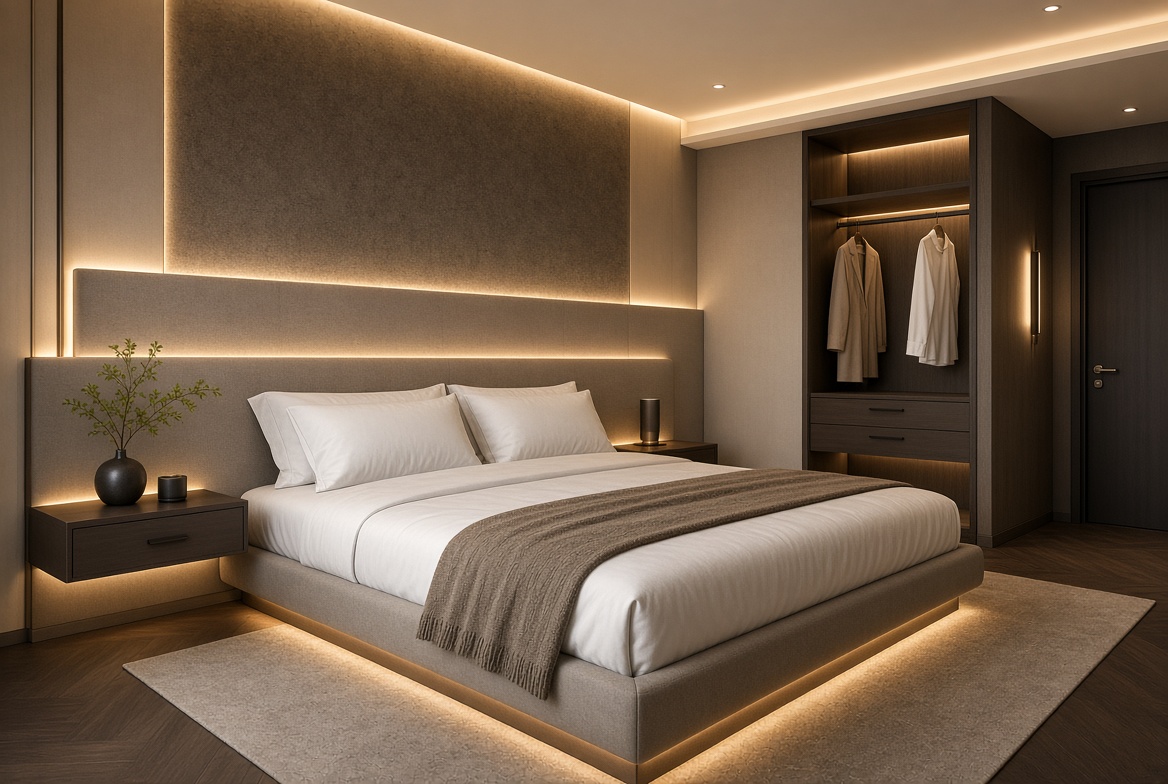
Before selecting hotel neon lighting or LED profile lighting, project teams should define the lighting task. The wrong approach often happens when decorative lighting is forced to perform a functional role—or when functional lighting is expected to create a dramatic brand statement.
Use this practical decision process.
Ask what the guest should feel in the space.
- Arrival and excitement: Consider neon-style decorative lighting
- Relaxation and privacy: Consider concealed LED profile lighting
- Luxury and visual detail: Combine both solutions in layers
- Clear navigation: Prioritize architectural profiles and indirect lines
- Social energy: Add flexible neon lighting around visual focal points
The installation surface directly affects product selection.
Choose flexible silicone neon lighting for:
- Curves
- Arches
- Organic shapes
- Decorative lettering
- Irregular architectural details
Choose LED profiles for:
- Long straight runs
- Cabinet edges
- Recessed grooves
- Ceiling slots
- Wall joints
- Shelf lighting
- Furniture panels
A lighting project is not only about selecting a strip or a profile. It is a complete system.
The project team should coordinate:
1. Lighting layout and zoning
2. Product type and installation method
3. Power supply placement
4. Dimming or control requirements
5. Cable routing and connection access
6. Heat management
7. Surface treatment and finish compatibility
8. Service and replacement access
This step is especially important for hotels because public areas and guestrooms are used continuously. A visually attractive installation that is difficult to maintain can create unnecessary operational cost later.
For custom hospitality lighting, a sample review is valuable. It allows the design team to check:
- Appearance during daytime
- Visual effect at night
- Light-line continuity
- Compatibility with wood, stone, metal, glass, or fabric finishes
- Installation position
- Driver and control access
- Guest viewing angles
A sample also helps avoid a common project mistake: approving lighting only from drawings without seeing the interaction between light and real materials.
The strongest hospitality projects often use both solutions strategically.
For example, a boutique hotel lobby could use an LED profile hidden in the ceiling cove to provide soft ambient light. A silicone neon strip could then create a curved line behind the reception desk, giving the space its signature visual identity.
This combination separates the two jobs:
- LED profile lighting provides the architecture.
- Hotel neon lighting provides the emotion.
In guestrooms, profile lighting can handle bedside, wardrobe, and cabinet illumination. Neon flex can be reserved for selected decorative features, such as a curved wall detail in a themed suite or a soft line behind a statement mirror.
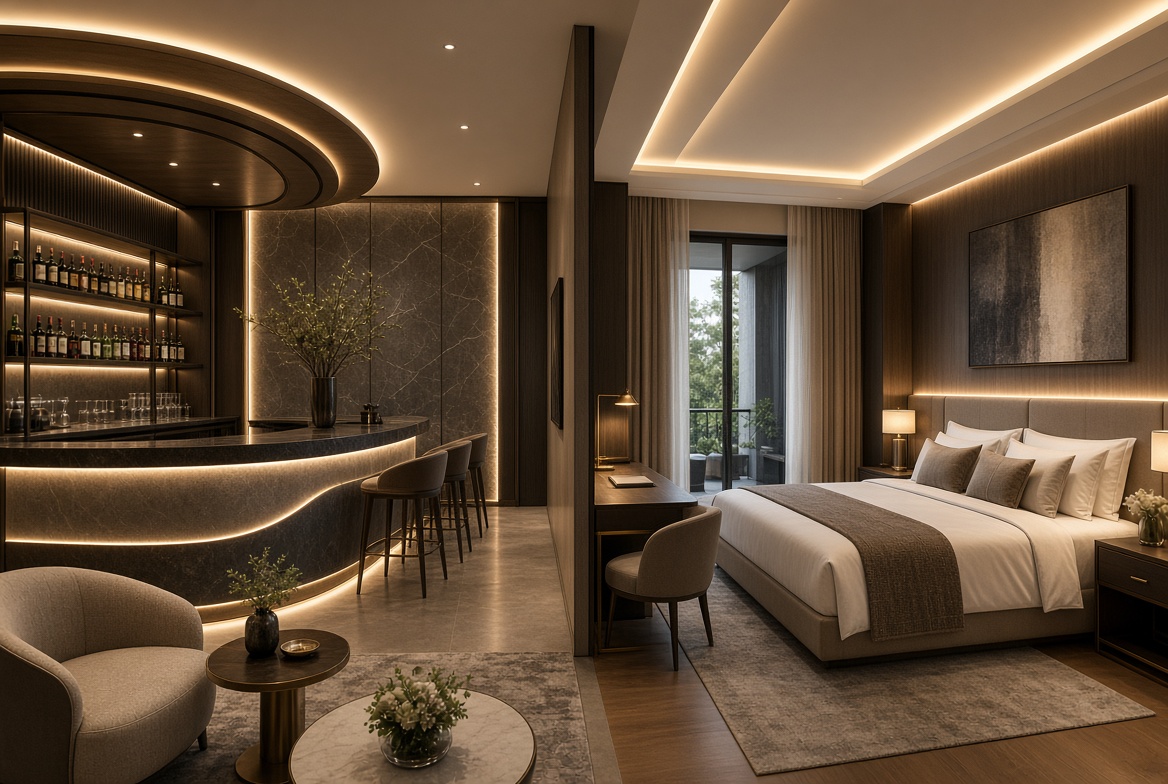
Neon-style lighting can look impressive, but it should not be expected to provide all functional illumination in a hotel room, bathroom, or corridor. Use it as part of a layered scheme.
Drivers, connectors, and control components should be accessible when maintenance is required. Hidden does not have to mean impossible to service.
A hotel lobby, guestroom, restaurant, bathroom, and spa have different lighting needs. A single product type rarely delivers the best result across every zone.
Too many exposed neon lines can make a premium hotel feel visually busy. Use focal lighting selectively, particularly in luxury and wellness-focused interiors.
For furniture lighting, dimensions, bend direction, mounting details, connection methods, and exterior finishes should be reviewed early. OEM and ODM support can help align the lighting solution with the project's furniture, design intent, and installation workflow.
Farwise Technology Co., Ltd. is a professional LED lighting manufacturer with 16 years of industry experience. We provide commercial and residential lighting solutions, including LED silicone strip lights and complete furniture lighting applications for cabinets, wardrobes, bathroom cabinets, bedrooms, and other interior spaces.
For hotel projects, our team can support customized solutions based on your specific application requirements, including size, function, lighting concept, and external appearance. Whether you are developing a hotel guestroom lighting package, a branded lobby feature, a customized furniture lighting system, or a multi-zone hospitality project, Farwise can help turn your design concept into a practical, scalable solution.
Contact Farwise Technology today to discuss your hotel neon lighting or LED profile lighting project and request a customized OEM/ODM solution.
Yes, but it is usually best used as a decorative accent rather than the primary source of room illumination. It works well for feature walls, mirrors, curved details, and themed suites. For bedside, wardrobe, and cabinet lighting, LED profile lighting is often more practical.
LED neon flex is flexible and designed for continuous decorative light lines, especially curves and custom shapes. LED profile lighting uses an aluminum channel to create straight, protected, architectural light lines in furniture, ceilings, walls, and cabinets.
Yes. OEM and ODM customization can include dimensions, function, appearance, lighting layout, and application-specific solution design. Customization is particularly useful when the light must fit hotel furniture, joinery, curved architectural details, or branded spaces.
LED profile lighting is generally the preferred option for wardrobes because it supports clean installation, protected strip placement, and consistent integration with furniture panels and shelves.
It can be used in appropriate bathroom areas when the complete system is selected and installed for the environment. The project should account for moisture exposure, sealing, protected connections, cable routing, and safe positioning of electrical components.
In many cases, yes. LED profiles can provide the practical base layer for guest rooms, wardrobes, ceilings, and corridors, while hotel neon lighting can add visual personality in lobbies, restaurants, bars, spas, and feature zones.
Prepare drawings or dimensions, installation location, intended visual effect, material finish, mounting method, control requirements, project quantity, and any special requirements for bends, connectors, or furniture integration. This information helps the manufacturer recommend a more suitable solution.
- [Flexi Neon — Neon Flex vs. Traditional Signage: The Benefits]
- [Ambience Lighting — Luxury Hotel Lighting Design & LED Solutions]
- [HLLED — The Ultimate Guide to Commercial Lighting Fixtures]
- [LED Technologies — LED Lighting for Interior Design & Architecture]
- [Vision Outdoor Lighting — How to Install LED Strip Lights Outdoors]
- [ColorsLED — 360 Neon Flex for Architectural and Commercial Lighting Projects]


