
Views: 233 Author: Farwise Lighting Publish Time: 2026-08-12 Origin: Site


Content Menu
● Quick Answer: Which Solution Fits Your Facade?
● What Outdoor LED Neon Flex Does Best
>> Flexible Lines for Curved Architecture
>> A Softer Appearance for Direct-View Lighting
● Where Aluminum Linear Lighting Leads
>> Clean Lines for Modern Facades
>> Better Control of Directional Effects
>> A Structured Choice for Long Runs
● Outdoor LED Neon Flex vs. Aluminum Linear Lighting
● Three Questions to Ask Before Choosing
>> 1. Is the Light Defining a Shape or Lighting a Surface?
>> 2. What Will People See at Their Viewing Distance?
>> 3. How Will the System Be Maintained?
● Design for Light, Not Just Brightness
● A Practical Selection Process
>> Step 1: Review the Architecture
>> Step 2: Define the Nighttime Objective
>> Step 3: Match the Form to the Lighting Medium
>> Step 4: Build a Sample Section
>> Step 5: Plan Installation and Service Access
>> Step 6: Create a Sensible Control Strategy
● Why Custom Development Matters
● Choose the Right Light for Your Facade
● FAQ
>> Is outdoor LED neon flex suitable for curved façades?
>> Can aluminum linear lighting be used for façade outlines?
>> Which option is better for a hotel entrance?
>> How can façade lighting avoid looking too bright?
>> Can both lighting solutions be used on the same building?
>> What should be checked before installation?
Outdoor façade lighting should do more than make a building brighter. It should reveal architectural character, guide people toward entrances, reinforce brand presence, and remain visually comfortable after dark. For this reason, choosing between outdoor LED neon flex and aluminum linear lighting is not simply a product decision—it is a decision about form, installation conditions, maintenance access, and the visual story a façade needs to tell.
At Farwise Technology Co., Ltd., we have spent 16 years developing LED lighting solutions for demanding residential and commercial applications. From flexible silicone light lines to structured linear systems, our team works with project owners, designers, contractors, and lighting brands that need practical OEM/ODM support—not just a fixture catalog. This guide explains where each façade-lighting solution performs best, where it can create problems, and how to build a reliable lighting plan before installation begins.

Choose outdoor LED neon flex when the building design includes curves, rounded corners, lettering, irregular outlines, or visible decorative light lines. Its main value is creative freedom: it can follow the architecture rather than forcing the architecture to follow the light.
Choose aluminum linear lighting when the design relies on clean geometry, crisp straight lines, wall grazing, concealed integration, or a more structured contemporary appearance. Its main value is precision: it creates disciplined lines that support the rhythm of modern façades.
In many successful projects, the best answer is not one or the other. A layered façade may use aluminum linear lighting to define long horizontal or vertical architectural elements, then use LED neon flex around curved entrances, canopies, logos, or special features.
Outdoor LED neon flex is a flexible, silicone-encapsulated lighting solution designed to produce a continuous, diffused line of light. Unlike conventional exposed strip lighting, it is intended to make the light source appear smooth and visually unified.
For façade projects, the product is especially useful when a design needs light to become part of the building's contour rather than a separate technical element.
The strongest reason to specify LED neon flex is its ability to follow shapes that rigid fixtures cannot easily handle. Curved façades, circular portals, arched windows, wave-like canopies, decorative screens, and branded outlines all benefit from a flexible lighting medium.
A straight fixture installed around a curve often creates visible joints, awkward transitions, and inconsistent spacing. Neon flex reduces that visual interruption by allowing the light line to move naturally with the architectural form.
Typical applications include:
- Curved hotel entrances and drop-off canopies
- Retail storefront outlines
- Rounded balconies and terrace edges
- Architectural lettering and illuminated logos
- Public-space wayfinding details
- Soft decorative accents around feature walls
- Organic façade patterns for hospitality and entertainment venues
The result is often more approachable and expressive than a rigid line. This makes neon flex particularly valuable for projects where the building must feel welcoming, premium, playful, or memorable.
When people can see the light source directly, visual comfort becomes critical. Outdoor LED neon flex is usually chosen for its diffused appearance, which helps create an uninterrupted band of light rather than a row of individual light points.
This characteristic matters at eye level. Hotel entrances, restaurant terraces, shopfronts, apartment lobbies, and pedestrian-facing façades are viewed from close range. A harsh or poorly diffused fixture can distract from the architecture and make the project look unfinished.
For these environments, the light line itself becomes a design feature. It should look clean from nearby, from across the street, and in photos.
A façade is often a brand touchpoint before a visitor reaches the door. Curved or custom-shaped neon flex can help transform a simple logo, wordmark, or signature architectural gesture into a recognizable nighttime element.
This is especially relevant for:
- Retail chains that need consistent storefront identity
- Hotels seeking a distinctive arrival experience
- Restaurants and cafés with evening-focused customer traffic
- Commercial developments that require recognizable zones
- Experience-driven venues and entertainment projects
The goal should not be to make every surface bright. The better approach is to identify the one or two elements people should remember, then use light to give those elements hierarchy.
Aluminum linear lighting is built around rigid profiles and straight runs. It is the preferred solution when a façade needs accuracy, visual order, and a sharp architectural finish.
Rather than bending around forms, aluminum linear lighting reinforces the building's existing geometry. It works especially well with contemporary buildings that rely on grids, strong edges, deep reveals, long canopies, vertical fins, and structured cladding systems.
Linear lighting can make an ordinary architectural line appear intentional after dark. Installed along a reveal, overhang, parapet, window rhythm, or façade joint, it creates a refined visual framework without overwhelming the building.
This approach is effective for:
- Office buildings
- Commercial complexes
- Apartment towers
- Showrooms
- Corporate headquarters
- Educational buildings
- Industrial facilities with a polished public-facing elevation
Aluminum linear lighting is best when the architecture is already disciplined. The fixture should support the lines designed by the architect, not add unnecessary visual noise.
A linear fixture can be used not only as a visible line but also as a concealed source. When placed in a recess, behind a façade fin, under a ledge, or within a cove, it can direct light across a surface to create depth without showing the fixture itself.
This enables several useful façade effects:
| Lighting effect | What it achieves | Best-suited solution |
|---|---|---|
| Outline lighting | Defines edges, rooflines, frames, and architectural rhythm | Aluminum linear lighting or neon flex |
| Grazing light | Reveals stone, brick, concrete, or textured cladding | Aluminum linear lighting |
| Cove lighting | Creates indirect light from concealed locations | Aluminum linear lighting |
| Curved contour lighting | Follows arches, waves, circles, and organic shapes | Outdoor LED neon flex |
| Logo and letter illumination | Builds identity at entrances or retail frontages | Outdoor LED neon flex |
| Feature accent lighting | Draws attention to selected façade zones | Both, depending on form |
Linear wall-grazing is particularly effective when material texture is part of the architectural concept. Light placed close to a surface can reveal depth, joints, relief, and material variation. However, this technique must be planned carefully. Poor placement can create uneven brightness, unwanted shadows, or glare for pedestrians and nearby occupants.
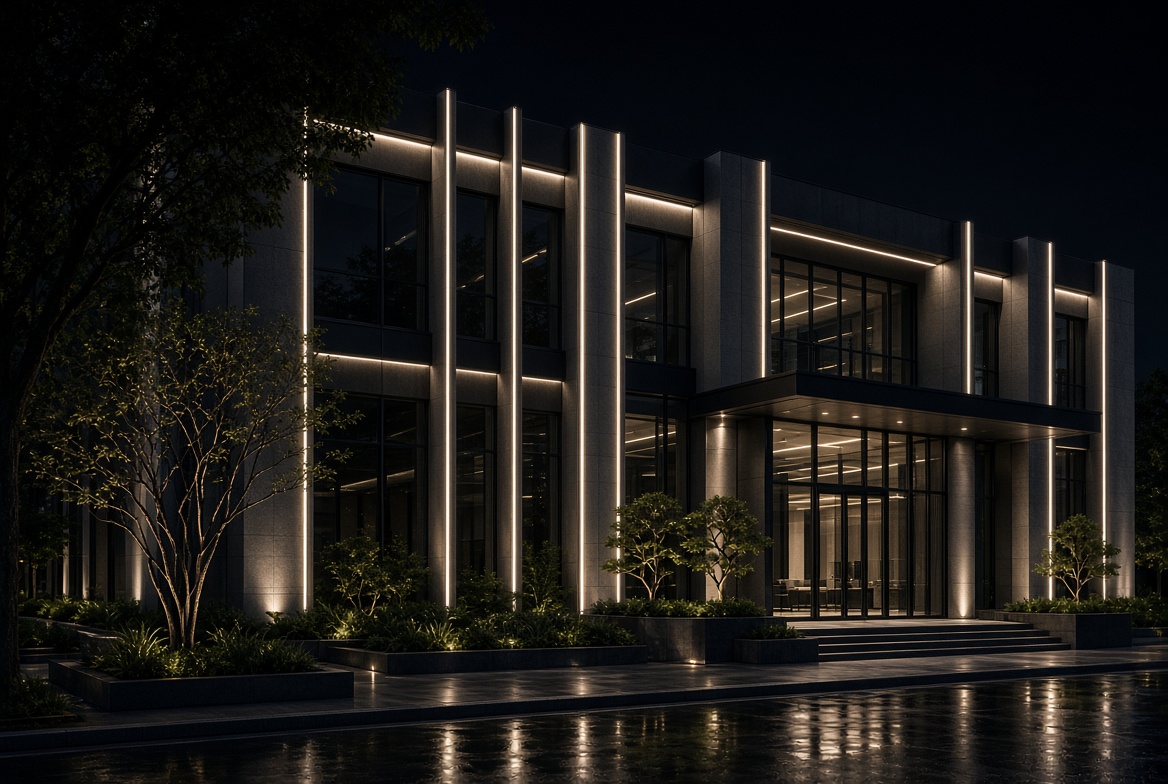
Long, uninterrupted straight runs generally favor aluminum linear lighting. A rigid profile provides a stable, orderly result across large elevations, especially where alignment with cladding joints or structural lines is important.
For example, an office façade with repeated horizontal bands may benefit from matching linear fixtures to those bands. The light then supports the façade's proportion and scale instead of competing with it.
This is one reason aluminum linear lighting is common in commercial architecture: it helps designers create consistency across repetition.
| Decision factor | Outdoor LED Neon Flex | Aluminum Linear Lighting |
|---|---|---|
| Best architectural form | Curves, arcs, irregular shapes, logos, decorative outlines | Straight lines, grids, reveals, fins, long architectural edges |
| Visual character | Soft, continuous, expressive, approachable | Crisp, minimal, structured, architectural |
| Direct-view use | Excellent for visible light lines | Suitable when the fixture design and diffuser support the intended appearance |
| Concealed installation | Possible in selected details | Highly suitable for coves, recesses, and integrated channels |
| Texture grazing | Less commonly selected for this purpose | Strong option when precise directional light is required |
| Installation planning | Requires careful bending, routing, and support layout | Requires accurate alignment, mounting, and joint coordination |
| Brand applications | Excellent for signage, letter forms, and custom contours | Best for restrained, architectural brand expression |
| Best project types | Hospitality, retail, leisure, residential features, creative façades | Offices, mixed-use developments, showrooms, public buildings, modern residences |
Neither solution is universally better. The correct choice depends on what the façade needs to communicate at night.
A product should never be selected from appearance alone. Before finalizing a façade-lighting concept, project teams should answer three practical questions.
If the purpose is to trace a visible architectural outline, neon flex may be the more natural choice—especially where curves are involved.
If the purpose is to reveal a wall, create a wash, emphasize texture, or deliver a clean concealed effect, aluminum linear lighting may be more suitable.
This distinction prevents a common project mistake: using a visible decorative light line where the architecture actually needs controlled surface illumination.
A façade should be assessed from multiple positions:
- Across the road
- From the pedestrian approach
- At the main entrance
- From adjacent buildings
- From upper-floor windows
- From vehicle arrival points
A bright effect that looks impressive from far away may feel uncomfortable at street level. Conversely, a subtle recessed line may disappear when viewed from a distance. Good façade lighting balances near-view comfort with long-view recognition.
Mock-ups are extremely valuable at this stage. Even a small on-site trial can reveal glare, mounting visibility, surface reflection, and color inconsistency before the full installation begins.
Lighting is not finished when it is installed. Outdoor projects must account for weather exposure, drainage, access for inspection, cable routing, mounting security, and replacement planning.
Ask early:
- Can technicians reach the fixtures safely?
- Will the mounting method remain stable over time?
- Is the system designed around real façade joints and drainage paths?
- Are connection points protected and organized?
- Can sections be serviced without dismantling large façade areas?
- Is the control method easy for the building operator to understand?
A visually beautiful project can become expensive if maintenance was treated as an afterthought. The most reliable designs consider service access from the beginning.
One of the most frequent issues in façade projects is over-lighting. Owners may assume that more brightness creates more impact. In reality, excessive brightness can flatten architectural depth, create glare, disturb occupants, and reduce the elegance of a building.
The better strategy is to create hierarchy.
Start by identifying the façade's key elements:
1. Primary focus: The main entrance, logo, upper crown, or defining architectural gesture
2. Secondary structure: Windows, columns, fins, canopies, or façade rhythms
3. Background surfaces: Areas that should remain quieter to create contrast
When every element is equally bright, nothing feels important. When lighting is layered, visitors understand where to look and where to go.
For commercial and hospitality projects, a welcoming entrance should generally receive more visual attention than remote façade areas. For residential projects, the emphasis should be softer and more privacy-conscious. For cultural buildings, the goal may be to reveal texture and heritage details without making the lighting itself the main subject.
A reliable façade-lighting project follows a clear sequence rather than starting with a fixture sample.
Study drawings, material finishes, curves, joints, window patterns, and access points. Identify where light can be integrated without disrupting the building envelope.
Decide whether the project needs identity, wayfinding, atmosphere, surface texture, commercial visibility, or programmable visual impact. This decision determines the right lighting effect.
Use flexible neon flex for changing geometry and direct-view contours. Use aluminum linear lighting for straight, structured, concealed, or directional applications.
Test the chosen effect on actual façade materials whenever possible. Surface color, reflectivity, texture, and mounting depth can change the final result dramatically.
Confirm support positions, power routes, connections, drainage, expansion considerations, and future access before mass production or site installation begins.
Use schedules, scene settings, dimming, or zoning to match the building's operating hours. A façade does not need the same visual intensity throughout the night.
Standard products can work for standard details. But many façade projects involve non-standard curves, special mounting conditions, unique finish requirements, branded visual effects, or specific control needs.
Farwise Technology Co., Ltd. provides OEM/ODM support for LED silicone strip lights and integrated lighting solutions. Our approach begins with the application: the façade geometry, required visual effect, installation environment, intended user experience, and project workflow.
Our team can support customization for:
- Light-line dimensions and shapes
- Functional requirements and control compatibility
- Installation-oriented structural solutions
- Exterior appearance and branding requirements
- Project-specific lighting concepts
- Coordinated solutions for furniture, residential, commercial, and architectural applications
The right façade lighting is not simply a line of light. It is a coordinated system that respects architecture, installation reality, long-term operation, and the visitor's experience.
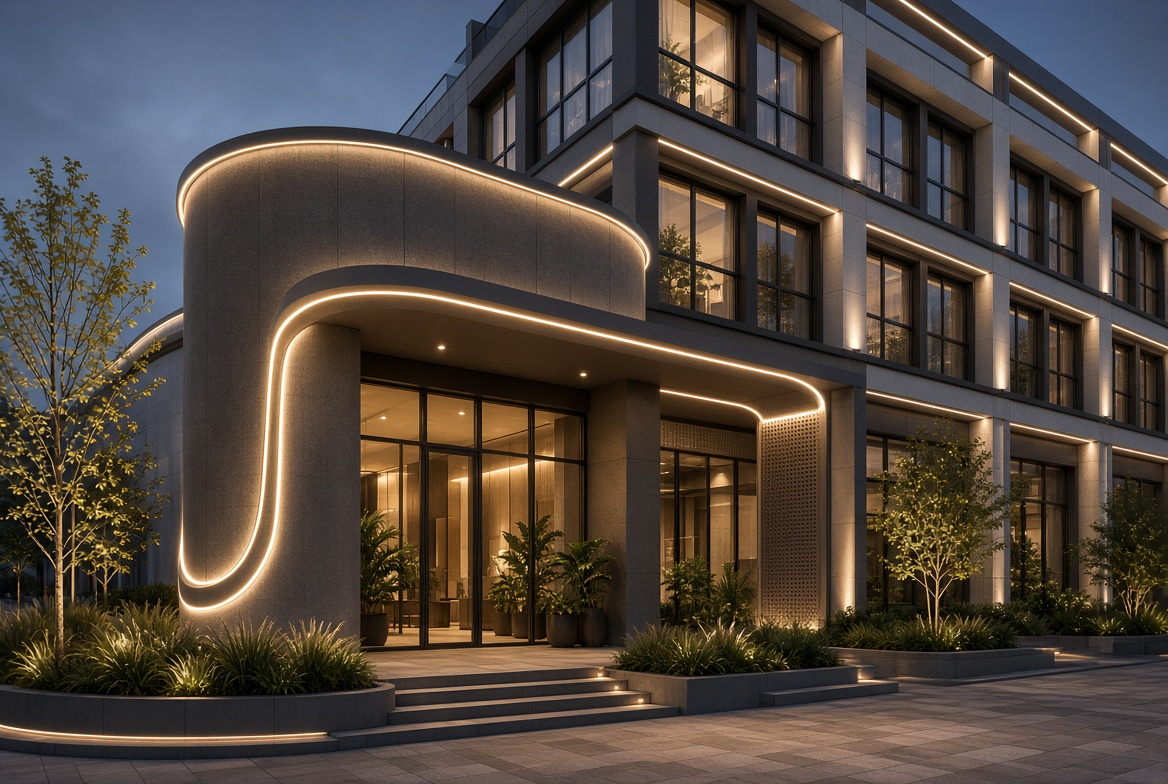
Outdoor LED neon flex brings freedom to curves, contours, and expressive visual identities. Aluminum linear lighting brings discipline to straight lines, concealed details, and precisely structured façades. The strongest projects choose based on the architecture—not on a one-size-fits-all product preference.
If you are developing a hotel, retail, commercial, residential, or custom architectural project, contact Farwise Technology Co., Ltd. to discuss your drawings, lighting concept, and customization requirements. Our team can help turn your façade idea into a practical, cohesive lighting solution built for real-world installation.
Yes. Outdoor LED neon flex is often selected for curved façades because it can follow arcs, rounded corners, circular features, and irregular contours more naturally than rigid fixtures.
Yes. Aluminum linear lighting is highly suitable for straight façade outlines, rooflines, window frames, vertical fins, and long horizontal architectural details.
It depends on the design. Neon flex is often effective for curved canopies, decorative contours, and welcoming direct-view details. Aluminum linear lighting is often better for recessed coves, straight canopy edges, and controlled indirect illumination.
Create a lighting hierarchy. Highlight the key architectural elements, keep secondary areas quieter, use controlled directional light, and apply schedules or dimming for late-night operation.
Yes. Many projects combine them. Aluminum linear lighting can define the main structural lines, while neon flex can accent curved architectural features, logos, signage, or special entrance details.
Review façade material, mounting points, cable routing, drainage, viewing distance, maintenance access, fixture alignment, and the intended control method before installation begins.
1. Signify. "[Façade Lighting]." Discusses architectural identity, zoned illumination, smart controls, energy management, and outdoor lighting applications. [signify]
2. ERCO. "[Facade Lighting: Displaying Buildings]." Covers light distribution, façade accenting, wall washing, and techniques for highlighting linear architectural elements. [erco]
3. LEDTEC. "[Facade Lighting—Professional LED Solutions for Architecture and Outdoor Areas]." Provides application guidance for flexible light contours, signage, weather-resistant architectural lighting, and integrated façade solutions. [ledtec]
4. COLORS Lighting. "[Building Facade Lighting: Techniques & LED Solutions]." Explores contour lighting, cove lighting, grazing, window-frame lighting, digital lighting, and façade application scenarios. [colorsled]
5. ArchDaily. "[LED: The Latest Architecture and News]." Provides architectural context on how lighting affects spatial perception, visual comfort, atmosphere, and contemporary linear design. [archdaily]


