
English
Views: 222 Author: Farwise Lighting Publish Time: 2026-10-12 Origin: Site


Content Menu
● Introduction: Why Source LED Neon Strip Products Through France?
>> France's Lighting Cluster Advantage
>> What Recent Industry Research Actually Shows
● Selection Criteria: How These Suppliers Were Evaluated
>> Manufacturing Identity and Supply-Chain Transparency
>> Development and Customization Capability
>> Quality-Control Accountability
>> Delivery and After-Sales Continuity
● Supplier Comparison: Manufacturing Role, Capacity, MOQ, and Certification
● The Shortlist: Five LED Neon Strip Sourcing Options
>> 1. Farwise Technology Co., Ltd. — Factory-Direct OEM/ODM Alternative
>>> Core Strengths
>>> Main Markets and Customization Scope
>> 2. ByLED — French Brand and Distributor for Local Project Supply
>>> Core Strengths
>>> Main Markets and Customization Scope
>> 3. LumiPop — Custom Neon Signage and Decorative Lighting Specialist
>>> Core Strengths
>>> Main Markets and Customization Scope
>> 4. Néon France — Retail Furniture and Display-Lighting Integrator
>>> Core Strengths
>>> Main Markets and Customization Scope
>> 5. COLORSLED France — Architectural Linear-Lighting Distribution
>>> Core Strengths
>>> Main Markets and Customization Scope
● Technical Buyer's Guide: Evaluate the Product Without Relying on Catalog Claims
>> Confirm the Material System
>> Separate Factory Certification From Product Conformity
>> Check the Regulatory Classification
● Common Procurement Pitfalls and How to Avoid Them
>> Pitfall: Buying a Finished Sign When You Need an OEM Component
>> Pitfall: Accepting a Brand-Wide Compliance Statement
>> Pitfall: Treating Local Stock as Manufacturing Capacity
>> Pitfall: Approving Appearance but Not Construction
● Internal Pitfall Guide: Approve the Termination, Not Just the Strip
● A Practical Sampling, Factory-Verification, and Logistics Workflow
>> Define the Application Before Requesting Prices
>> Verify the Supplier's Actual Role
>> Approve a Production-Representative Sample
>> Allocate Logistics Responsibilities
● Conclusion: Match the Supplier to the Purchasing Model
>> 1. How Can I Check Whether a Supplier's ISO Certificate Is Expired or Suspended?
>> 2. Does CE Marking Mean an Independent Laboratory Has Certified Every Product?
>> 3. Can I Advertise Products Purchased From a French Supplier as "Made in France"?
>> 4. How Should We Handle a Supplier's Proposed Material Substitution After Sample Approval?
>> 5. If We Sell an OEM Product Under Our Own Brand, Who Is Responsible for Compliance?
● External Industry and Official Links
France offers professional buyers a useful combination of lighting design expertise, local distribution, architectural project support, and specialist integration services. However, purchasing an LED Neon Strip from a French supplier does not automatically mean that the strip was manufactured in France. The market includes domestic integrators, importers, brand owners, and distributors representing overseas factories. Understanding these distinctions is essential before choosing a long-term partner.
The central purchasing principle is traceability: buyers should be able to connect the approved sample, manufacturing location, material specification, conformity documentation, and delivered batch. A persuasive catalog alone cannot establish that connection.

France's lighting industry extends beyond finished luminaires. It includes designers, technical consultants, control-system specialists, component suppliers, manufacturers, and installation partners. The Union de l'Industrie du Luminaire explicitly represents businesses involved in manufacturing, design, importing, commercialization, and lighting development—an important reminder that suppliers perform different roles within the same industry.
For professional buyers, a French sourcing partner can be particularly valuable when a project requires local communication, installation coordination, furniture integration, or ongoing replacement support. ByLED, LumiPop, Néon France, and COLORSLED France illustrate different approaches to these requirements rather than interchangeable versions of the same business.
Lyon provides a documented example of France's collaborative lighting ecosystem. Cluster Lumière brings together expertise across the lighting value chain, from design through implementation and operation. Its role is to connect technological innovation, training, and practical applications.
This is an advantage in application development and project collaboration. It should not be confused with evidence that France is a dominant silicone extrusion or mass-production center for LED neon flex.
For buyers, the useful distinction is between:
- A factory that manufactures the flexible lighting product.
- A brand owner that specifies products and commissions production.
- A distributor that supplies an established product range.
- An integrator that turns lighting components into a project-ready system.
A French government publication released in 2025 summarizes the Association française de l'éclairage's latest public-lighting survey. It reports increasing LED adoption and declining energy consumption across the surveyed lighting stock. However, the publication concerns public lighting, uses an earlier observation period, and does not measure the French LED Neon Strip market specifically.
The relevant commercial signal is continued attention to efficient lighting and modernization—not a verified market-size estimate for flexible neon products. Buyers should be cautious when broad lighting reports are presented as direct evidence of neon-strip demand.
This shortlist is based on publicly available company information, product relevance, and identifiable supply-chain roles. It is not a factory-audit ranking, and no undisclosed production capacity, minimum order quantity, or certification status has been assumed.
The companies were assessed against the following procurement criteria.
Can the supplier explain who designs, manufactures, assembles, and sells the product?
A French sales address is not sufficient evidence of French manufacturing. Likewise, local assembly of a sign does not establish domestic production of the flexible lighting component.
Does the business support the buyer's actual requirement?
Project adaptation, custom signage, and private-label manufacturing are different services. A supplier may be excellent at one without offering the others.
Buyers should request evidence showing how incoming materials, production changes, finished assemblies, and rejected batches are controlled.
Statements about quality are useful starting points, but purchasing approval should depend on records relevant to the proposed order.
The supplier should provide documentation tied to the specific product and responsible legal entity.
CE marking is a manufacturer's declaration of conformity with applicable legislation, supported by technical documentation and an EU Declaration of Conformity. It is not a universal quality certificate issued to an entire factory.
The comparison should address stock availability, custom-production scheduling, replacement components, warranty responsibilities, and repeat-order consistency.
Published capacity figures are not necessary for an initial shortlist. Written confirmation of available capacity for the buyer's intended purchasing schedule is more useful.

The table below avoids unsupported numerical claims. "Not verified" means that the reviewed public sources do not establish a current, product-specific certificate—not that the supplier lacks compliant products.
| Company | Location and supply role | Most relevant purchasing focus | Capacity visibility | MOQ position | Certification and compliance visibility |
|---|---|---|---|---|---|
| Farwise Technology Co., Ltd. | Dongguan, China; manufacturer | Silicone LED strips, furniture lighting, OEM/ODM development | Standardized production lines described; order-specific capacity requires confirmation | Custom-order MOQ not publicly disclosed | Current factory certificates and product documentation require verification. |
| ByLED / France LED Diffusion | Carros, France; designer, brand owner, importer, and distributor | Local sourcing, flexible neon products, project-ready purchasing | Local stock and direct factory relationships described; neon-specific capacity not disclosed | Standard purchasing available; custom-order conditions require confirmation | Company states that conformity evidence includes CE and RoHS; verify documents for the selected product. |
| LumiPop | Saint-Ay / Orléans area, France; custom-lighting and signage specialist | Bespoke signs, branded installations, decorative projects | Custom realization demonstrated; production capacity not disclosed | Project-based quotations; wholesale strip MOQ not established | Product-specific conformity and current management-system certificates not verified in reviewed sources. |
| Néon France | Île-de-France, France; lighting integrator with a factory location | Retail furniture, display lighting, project integration | Factory location and supply activity identified; neon-specific capacity not disclosed | Project and purchasing conditions require confirmation | Current certificates and selected-product conformity documentation require verification. |
| COLORSLED France | Toulouse, France; French distributor of COLORS products | Architectural linear lighting and neon-flex specification | Manufacturing belongs to the represented supply chain; French production capacity not established | Stock, project, and customization conditions require confirmation | Obtain model-specific documentation and clarify the respective responsibilities of distributor and manufacturer. |
Farwise Technology Co., Ltd. is based in Dongguan, Guangdong, China. Its company profile states that it was founded in 2009 and specializes in silicone LED strips and cabinet lighting. The published profile describes research and development, standardized production, quality control, and support for international customers.
Its product scope is relevant to furniture manufacturers and lighting brands developing coordinated solutions for cabinets, wardrobes, bathroom furniture, kitchens, and other interior applications.
Farwise's strongest shortlist rationale is the connection between silicone strip lighting and furniture-lighting development. Buyers can discuss the lighting component together with the surrounding application rather than treating the strip as an isolated commodity.
Its profile explicitly offers OEM and ODM customization. The company presents factory-direct pricing, production support, and professional service as parts of its business model. These are supplier statements that should be evaluated through quotations, samples, and development discussions.
Farwise describes a global customer base but does not identify a verified country-by-country sales distribution on the reviewed profile. Its published customization offer covers OEM/ODM work; the precise scope of engineering, tooling, packaging, and documentation should be agreed for each project.
For smaller lighting brands, flexibility should be tested through practical questions:
- Will the factory support a staged development process?
- Can it explain design trade-offs clearly?
- Will one accountable contact coordinate engineering and commercial decisions?
- Can repeat orders retain the approved material and assembly specification?
These questions assess communication efficiency and customization depth without assuming that either has already been independently verified.
Farwise is worth evaluating when the buyer wants direct manufacturing discussions, coordinated furniture-lighting development, and a potentially cost-conscious private-label supply route.
Before approval, request current conformity evidence, a production-representative sample, written MOQ conditions, and a clear allocation of import responsibilities.
ByLED operates through France LED Diffusion in Carros. Its website describes lighting specialization since 2010 and explicitly states that the business designs, commissions manufacture, imports, and distributes products under its brand.
That disclosure is commercially useful: buyers can recognize ByLED as a French sourcing and brand-management partner without incorrectly describing all its products as manufactured domestically.
ByLED offers flexible neon products alongside a broader lighting catalog. Its neon range includes silicone-based products and made-to-measure cutting services, making it relevant to architectural detailing and furniture-related applications.
The company also describes local stock, direct factory relationships, manufacturing-stage controls, and conformity review. These features support consideration for buyers seeking an established French purchasing channel.
ByLED identifies professionals, private customers, and public authorities as its customer groups, with applications across residential, commercial, office, industrial, and outdoor environments.
Its documented customization is strongest at the project-supply level, including made-to-measure cutting. Buyers should separately confirm whether it offers private-label packaging, exclusive product development, or customer-owned tooling. Those services should not be inferred from a custom-cutting offer.
ByLED is a practical candidate for contractors and purchasing teams that value local communication and a defined product range. It is less appropriate to assume full factory-level ODM support without obtaining a specific agreement.
LumiPop states that it has supported lighting projects since 2009. Its business developed from the earlier Néon Flexible identity into a broader custom-lighting and signage offer.
The company's public portfolio includes flexible LED neon installations and bespoke signs for professional and private customers.
LumiPop's relevance lies in translating visual concepts into finished installations. Its custom-sign service allows buyers to specify the appearance, mounting arrangement, backing, and control approach of a completed sign.
This is a different purchasing proposition from ordering bulk LED Neon Strip for resale or incorporating it into an independently designed product.
Its documented customer groups include businesses and individuals. Relevant applications include branded signage, decorative interiors, commercial spaces, and event-related lighting.
The published service supports bespoke fabrication. It does not, by itself, establish an unrestricted wholesale OEM/ODM program for raw flexible strips.
LumiPop suits buyers seeking a finished visual result and project-specific realization.
For repeated commercial rollouts, clarify artwork ownership, approval procedures, installation documentation, repair arrangements, and how later orders will match the original installation.
Néon France traces its history to 1938. Its company account describes a transition from traditional neon work to professional lighting and, subsequently, specialization in retail furniture, point-of-sale displays, and urban furniture integration.
The company identifies an Île-de-France headquarters and a factory location in Sartrouville. Its catalog includes neon-flex products.
Néon France is particularly relevant when lighting must function as part of a display, cabinet, or retail fixture rather than as a standalone decorative element.
Its documented background in furniture integration provides a useful basis for discussing installation access, visual presentation, component positioning, and maintenance requirements.
The company emphasizes French shops, commercial furniture, and point-of-sale applications. Its service positioning focuses on finding and integrating lighting solutions according to customer requirements.
Buyers should distinguish this project-engineering role from proof that every neon-flex component is manufactured in-house.
Néon France is a strong candidate for retail-fixture manufacturers, display specialists, and commercial fit-out teams.
The important procurement question is which parts of the final assembly are produced, modified, tested, or sourced externally—and who remains accountable for the completed system.
COLORSLED France represents the COLORS brand in the French market. France's official business directory records the French legal entity's creation in 2021. That date should not be confused with the earlier history of the represented brand.
An architectural-industry listing identifies COLORSLED France as the official French distributor of COLORS products.
The represented manufacturer specializes in linear lighting, including LED strips, neon strips, and luminaires. Its published neon range describes integrated silicone extrusion and products intended for interior and exterior decorative applications.
For buyers, this creates a route to a dedicated linear-lighting portfolio with a French commercial interface.
The French organization's stated role is developing the brand in France. The parent manufacturer describes international distribution and architectural lighting applications. [linkedin]
Project adaptation may involve the manufacturer, the distributor, or both. Buyers should confirm the exact scope of custom lengths, terminations, assemblies, branding, and engineering support before treating the relationship as an OEM/ODM arrangement.
COLORSLED France is relevant to architectural procurement teams seeking a specialized linear-lighting catalog and local commercial coordination.
For custom projects, identify the contractual party responsible for technical changes, documentation updates, warranty claims, and repeat-order consistency.
The word "silicone" is not a complete material specification.
Ask the supplier to identify the housing material, diffusion system, sealing materials, and intended installation environment. Request written controls preventing substitution after sample approval.
COLORS, for example, describes an integrated silicone extrusion process for its neon products. This illustrates why process information can be more useful than a generic "premium material" claim.
For other suppliers, obtain equivalent evidence rather than assuming that similar appearance means similar construction.
Management-system certification concerns the organization and its certified scope. Product conformity concerns the actual item placed on the market.
A factory certificate should therefore be reviewed alongside—not instead of—the selected product's technical documentation.
The European Commission states that manufacturers must assess conformity, prepare technical documentation, issue the EU Declaration of Conformity, and apply CE marking where required.
RoHS addresses restrictions on hazardous substances in electrical and electronic equipment. It should not be presented as a blanket guarantee of optical quality, outdoor durability, or manufacturing consistency.
Do not assume that all LED strips, finished neon signs, luminaires, and furniture-lighting assemblies have identical obligations.
The European Commission distinguishes light sources, separate control gears, and luminaires when explaining lighting requirements. Buyers should ask the supplier to document the classification of the proposed product and determine which obligations apply, including energy-labeling or registration requirements where relevant.
A signage specialist may deliver excellent finished work without offering bulk strip manufacturing or private-label component development.
Avoid the mismatch by describing the required deliverable in the first inquiry: raw strip, terminated assembly, furniture-lighting kit, or complete sign.
A conformity statement should identify the relevant product and responsible manufacturer. A document for an unrelated item does not establish compliance for the proposed purchase.
Ask for documentation before final approval, not after the shipment is ready.
Stock availability and production capability answer different questions.
Request separate confirmation of available inventory, custom-production scheduling, repeat-order planning, and the party responsible for manufacturing.
A visually acceptable sample may leave important purchasing conditions undefined.
Record the approved construction, materials, termination method, accessories, labeling, and packaging. Require written authorization before substitutions.
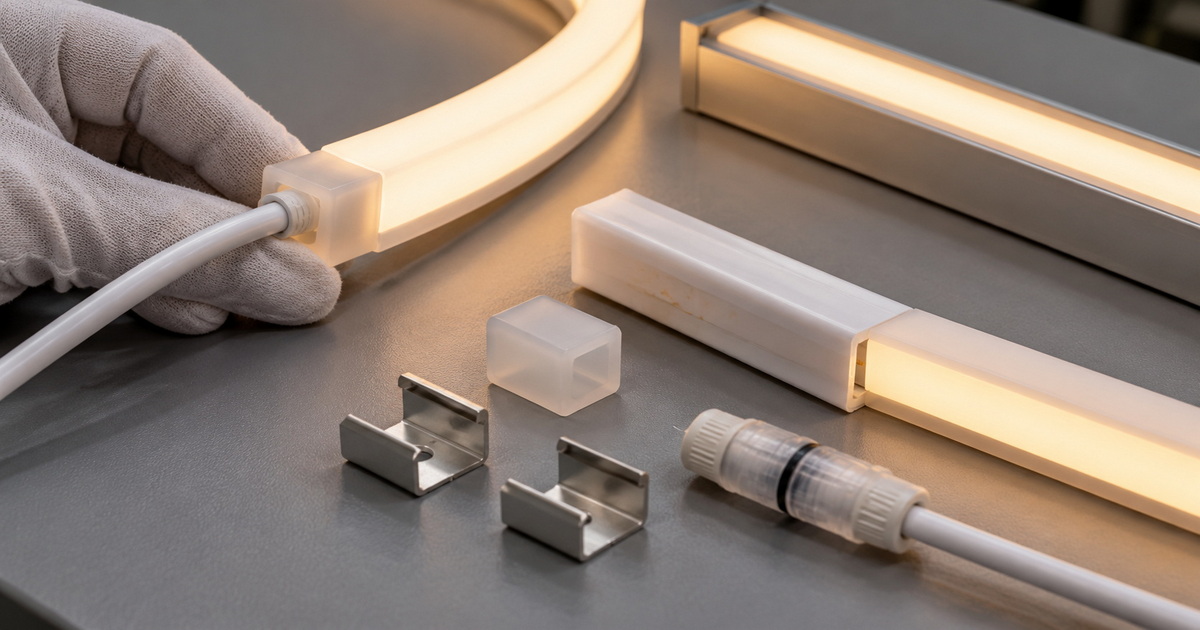
An easily overlooked purchasing issue is the gap between the flexible strip shown in a catalog and the assembly actually installed.
Cuts, cable entries, connectors, end closures, and mounting arrangements become part of the delivered system. Consequently, a prudent approval process should examine the finished configuration—not only an unmodified strip sample.
Ask the supplier:
- Who performs cutting and termination?
- Which materials and procedures are approved?
- What changes are permitted during installation?
- Which completed configuration is covered by the supporting documentation?
- Who accepts responsibility if field modifications differ from the approved assembly?
This recommendation follows the broader conformity principle that technical documentation must support the product being supplied. A catalog claim should not silently be extended to a modified assembly. [single-market-economy.ec.europa]
For repeat purchases, preserve an approved finished sample together with its assembly record. This gives both parties a practical reference when investigating later differences.
Describe the installation environment, visible-lighting objective, mounting method, control arrangement, service access, branding requirements, and desired supply format.
A useful brief helps suppliers explain limitations before development begins.
For a claimed manufacturer, request a live walkthrough of the relevant production and inspection processes.
For a distributor or integrator, request a clear explanation of the manufacturing partner, local modification work, and responsibility for conformity and warranty support.
Ask how the sample was made and whether the intended bulk-production process will be the same.
Evaluate the complete assembly in a representative installation. Record accepted appearance, construction, accessories, packaging, and documentation.
The purchase agreement should identify substitutions requiring buyer approval and explain how revised materials or assemblies will be evaluated.
This is particularly important when the purchasing objective is consistency across repeated installations.
For overseas sourcing, agree who handles import clearance, conformity documentation, transport protection, delivery exceptions, and claims.
For local sourcing, clarify whether the product is already stocked in France or will be imported specifically for the order. A French quotation does not necessarily mean immediate domestic availability.
Compare total purchasing cost, including development, installation, replacement handling, and administrative work—not only the unit quotation.
The most useful shortlist is not a collection of interchangeable names.
Farwise provides a China-based factory-direct route for silicone strip and furniture-lighting development. ByLED offers a French brand and distribution channel. LumiPop focuses on custom visual realization. Néon France brings retail-furniture integration experience. COLORSLED France connects French buyers with a specialized linear-lighting manufacturer's range. [byled]
For a long-term partnership, request the same evidence from every candidate: a clear manufacturing role, production-representative samples, selected-product documentation, written customization conditions, and an accountable repeat-order process.
To evaluate Farwise Technology Co., Ltd. for an OEM/ODM project, submit a concise application brief covering the furniture or installation type, required customization, branding approach, intended sales market, and purchasing schedule. Ask for a documented proposal that separates confirmed capabilities from items requiring development.
Verify the legal entity, manufacturing address, certificate number, scope, issuing body, and current status.
ISO recommends using IAF CertSearch or contacting the relevant certification or accreditation body. If the certificate cannot be found, request direct confirmation from the issuer rather than assuming that either a scanned document or a missing database result is conclusive.
Check whether the certified scope actually covers the activity and site supplying your order.
No. CE marking generally reflects the manufacturer's declaration that the product meets applicable legal requirements.
The manufacturer must prepare the supporting technical documentation and issue the EU Declaration of Conformity. Whether third-party involvement is required depends on the applicable legislation and conformity-assessment procedure.
Request the declaration and relevant supporting evidence rather than relying on a CE logo.
Not merely because the seller is based in France.
ByLED explicitly describes importing and commissioned manufacture, while COLORSLED France is identified as a distributor of the COLORS brand. These examples demonstrate why the seller's location and the product's manufacturing origin must be examined separately.
Request origin information and obtain appropriate customs or legal review before making an origin claim.
Require a written change request identifying the affected material, reason for substitution, and potential consequences for appearance, construction, conformity, and repeat-order consistency.
Do not approve the change solely because the substitute "looks equivalent." Ask which technical documents need updating and whether a revised sample is required. Manufacturers remain responsible for conformity of the product they place on the market.
Do not assume that buying from a factory transfers every legal obligation to that factory.
The European Commission's guidance describes manufacturer responsibilities in relation to products marketed under the manufacturer's name or trademark. Own-brand arrangements therefore require careful allocation of technical documentation, conformity assessment, declaration responsibilities, and ongoing change control.
Have the relevant legal entity and obligations established before launch, particularly when the buyer also imports the product into the European market.
1. - [Cluster Lumière — French lighting innovation and industry network]
2. - [Syndicat de l'Éclairage — industry representation and sector information]
3. - [Union de l'Industrie du Luminaire — French lighting-industry organization]
4. - [French government publication — 2025 AFE public-lighting survey summary]
5. - [European Commission — CE marking and manufacturer responsibilities]
6. - [European Commission — light-source requirements]
7. - [EUR-Lex — RoHS Directive]
8. - [ISO — certification and certificate-verification guidance]


