
Views: 222 Author: Farwise Lighting Publish Time: 2026-10-10 Origin: Site


Content Menu
● How Do LED Strip Lights Work Without a Plug?
● Best Ways to Power LED Strips Without Plugs
>> Hardwired LED Strip Lights for Permanent Furniture
>> Battery-Powered LED Strips for Flexible Installations
>> USB-Powered LED Strips Without a Wall Adapter
>> Solar-Powered LED Strips for Outdoor Applications
● Why Furniture Lighting Needs a System-Level Approach
● Installing LED Silicone Strip Lights Inside Furniture
>> Plan the Mounting and Bending Direction
>> Treat Every Cut and Connection as a Separate Detail
>> Provide Heat Management and Service Access
● A Practical Planning Checklist Before Installation
● Troubleshooting LED Strips Without Plugs
● Common Mistakes That Do Not Create a Better Plug-Free System
● How Farwise Supports Customized Furniture Lighting
● Frequently Asked Questions About LED Strips Without Plugs
>> 1.Can LED strips work without any power source?
>> 2.Can I remove the plug and connect the strip directly to building wiring?
>> 3.Are battery-powered LED strips suitable for wardrobes?
>> 4.Can any power bank run LED silicone strip lights?
>> 5.Are silicone-covered LED strips automatically safe for bathrooms?
>> 6.What is the best plug-free option for permanent cabinet lighting?
You can use LED strips without plugs. A compatible battery, a suitable USB source, or a professionally installed hardwired power supply can replace a conventional plug-in adapter. However, plug-free does not mean power-free: your LED strip still needs the correct electrical supply and a safe connection.
For cabinets, wardrobes, bathroom vanities, and bedroom furniture, the real question is not simply whether a plug can disappear. It is how to create reliable lighting without visible cables, inconvenient charging, or inaccessible components.
At Farwise Technology Co., Ltd., our approach to furniture lighting starts with the complete installation rather than the strip alone. Drawing on our company's stated 16 years in LED lighting manufacturing, we help customers consider the light source, power arrangement, controls, mounting method, and maintenance access together.

A plug connects a lighting system to an electrical source. It does not generate electricity or automatically make the supply suitable for the LEDs.
In a typical low-voltage strip installation, a power supply converts building electricity into the output required by the strip. A plug-in adapter combines that conversion with a convenient wall connection.
Removing the plug therefore requires another suitable arrangement—not removing essential power conversion.
There are two different goals:
- No visible plug: the lighting still uses building electricity, but the connection is concealed or hardwired.
- No wall outlet: the lighting uses stored energy or another independent source.
This distinction matters. A concealed cabinet installation and a portable display may look similar, but their charging, wiring, and maintenance needs are different.
Never connect a low-voltage LED strip directly to mains electricity. A hardwired system still needs the appropriate power supply and protective installation.
The best option depends on whether the furniture is permanent, movable, or used only occasionally.
| Power arrangement | Suitable application | Main consideration |
|---|---|---|
| Hardwired power supply | Permanent cabinetry and integrated furniture | Professional installation and service access |
| Compatible battery system | Furniture without convenient electrical access | Charging, protection, and replacement |
| Suitable USB source | Portable displays and compatible decorative lighting | Source capability and strip compatibility |
| Engineered solar system | Outdoor or remote lighting | Energy storage, regulation, and weather protection |
These are power arrangements. Connectors, ribbon cables, and soldered joints are connection methods, not independent sources of electricity.
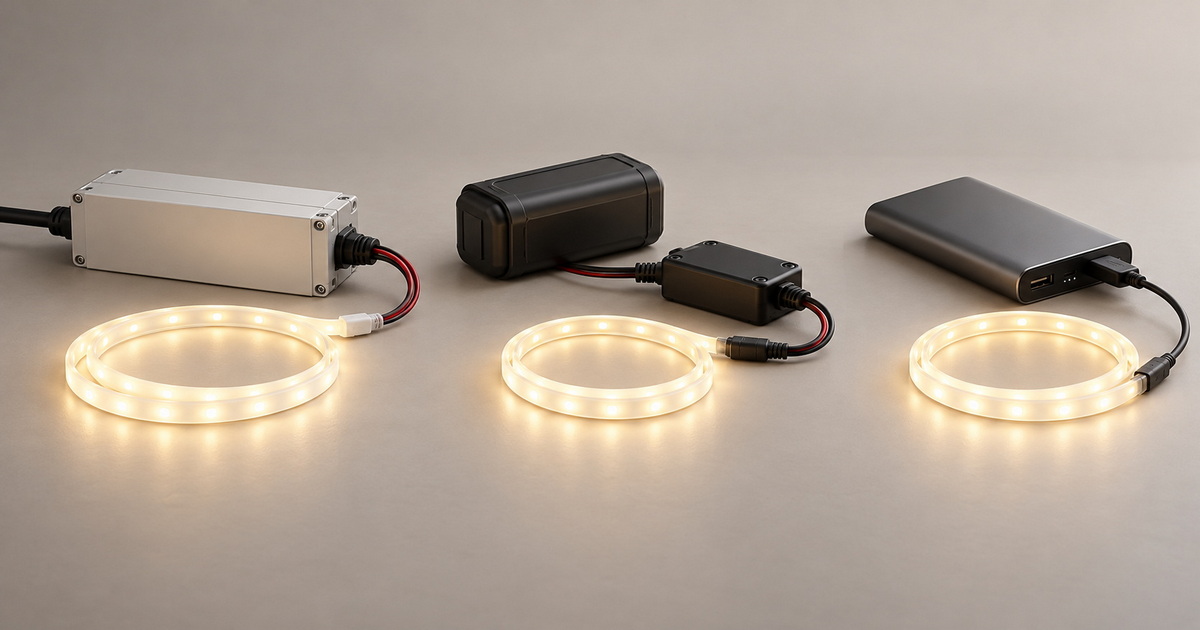
For permanent installations, a properly designed hardwired supply is often the most practical way to eliminate a visible wall plug.
The building circuit supplies an LED power supply, which then feeds the lighting system. Controls may sit between the supply and the strip, depending on the design.
This arrangement can suit kitchen cabinets, built-in wardrobes, and fitted bedroom furniture.
However, hiding the supply inside furniture creates responsibilities. It needs appropriate ventilation, secure mounting, protection against accidental contact, and access for future servicing.
Have a qualified electrician handle mains-side connections and confirm local installation requirements. Do not cut an adapter's plug off and assume that the remaining cable is ready for permanent wiring.
Battery power can be useful when running a cable would damage finished furniture or undermine portability.
Typical examples include removable displays, occasional wardrobe lighting, and movable decorative furniture.
The battery must be compatible with the lighting system throughout its usable operating range. A connector that fits physically does not establish electrical compatibility.
Choose an appropriate protected battery system and its specified charger. Avoid improvised charging arrangements or loose cells installed without suitable protection.
Plan access before mounting the strip. A battery hidden behind a fixed panel may produce a clean appearance initially but become frustrating when charging or replacement is needed.
Battery power is convenient, but it introduces a maintenance routine that permanent installations should not overlook.
A suitable USB source can power a strip designed for that connection. Possible sources include a compatible power bank or a device's designated USB output.
This can work well for temporary displays and compact decorative applications.
However, a USB connector does not make every LED strip compatible. The strip, cable, source, and any conversion electronics must work together.
Check the complete system rather than purchasing a generic USB cable and attaching it to an existing strip.
Also test the intended operating behavior. Device-controlled USB outputs may stop supplying power when the host device shuts down, while some power banks may switch off when the connected load is too small.
Solar lighting requires more planning than connecting a panel directly to a strip.
For dependable operation after sunset, an engineered system generally includes a panel, charge controller, battery, and compatible lighting circuit. Output regulation may also be necessary.
The controller manages charging, while suitable protection helps prevent excessive battery discharge.
The outdoor environment affects the whole assembly. Connections, controls, cable entries, batteries, and enclosures need protection appropriate to their locations.
A weather-resistant strip alone does not make the entire system suitable for outdoor use.
A strip can illuminate correctly on a workbench and still perform poorly inside finished furniture.
Furniture changes the installation conditions. Compartments can restrict ventilation. Doors can pull cables. Shelves can obstruct access. Reflective surfaces can reveal glare or uneven placement.
For that reason, start with the application:
- Cabinets need useful illumination on the working surface.
- Wardrobes need light where clothing blocks ambient illumination.
- Bathroom vanities need an installation suited to moisture exposure.
- Bed frames need comfortable placement without exposed wiring.
- Commercial displays need serviceable connections and consistent appearance.
Only then choose the power arrangement.
A tidy result comes from coordinating the strip, cable route, control position, and service location—not from hiding each component wherever space remains.
LED silicone strip lights offer useful design flexibility, but the silicone enclosure does not remove electrical or thermal requirements.
Confirm how the selected strip can bend before designing curved recesses.
Different constructions allow different bending directions. Forcing a strip around an unsuitable corner can stress its internal circuit or damage the enclosure.
Use the manufacturer's mounting guidance and suitable clips, channels, or other supports. Avoid locations where drawers, hinges, bedding, or stored objects can repeatedly press against the strip.
The mounting arrangement should support the light without distorting it.
If the strip is designed to be cut, use only its designated cutting locations and the specified termination method.
The connection must suit the strip's construction. A connector designed for an exposed strip may not fit a silicone-covered version correctly.
Where environmental sealing matters, a cut end or cable joint needs an appropriate sealing system. Ordinary tape is not a universal substitute for a purpose-designed termination.
Inspect the complete assembly rather than relying solely on the protection claimed for an unmodified strip.
LEDs still generate heat. A silicone covering should not be treated as a heat sink.
Follow the strip manufacturer's mounting instructions and provide an appropriate thermal path where required. Keep the power supply ventilated and avoid burying it beneath insulation or tightly packed belongings.
Service access is equally important. Arrange the installation so a technician can reach the supply and replace a failed section without dismantling major furniture components.

Use this sequence before ordering a plug-free furniture lighting system.
1. Define the lighting task. Decide whether the installation provides task lighting, ambient illumination, or decorative highlighting.
2. Identify the power source. Choose building power, battery power, or another engineered arrangement.
3. Map the cable route. Check hinges, drawer runners, removable shelves, and furniture joints.
4. Reserve service space. Keep the supply, battery, controls, and important connections accessible.
5. Confirm compatibility. Match the strip, supply, controller, connectors, and switching method.
6. Review the environment. Consider moisture, dust, ventilation, cleaning, and physical contact.
7. Test a representative assembly. Verify the intended appearance and operation before committing to final installation.
This process is especially useful for repeat furniture production. A successful sample should validate installation and servicing, not just demonstrate that the LEDs turn on.
Replacing a wall adapter can introduce new problems if the replacement source or wiring is unsuitable.
| Symptom | Possible cause | Recommended next step |
|---|---|---|
| Strip does not illuminate | Disconnected source, reversed polarity, or incompatibility | Isolate power and check the system connections |
| Light fades along the installation | Voltage drop or unsuitable power distribution | Have the cable route and supply arrangement reviewed |
| Lighting flickers | Loose joint, supply issue, or control incompatibility | Check connections and component compatibility |
| Battery lighting stops unexpectedly | Discharge protection or source shutdown | Review the battery system and operating behavior |
| Components become unusually hot | Overload, poor connection, or restricted ventilation | Switch off and obtain technical assistance |
Do not repeatedly energize a system that produces a burning smell, damaged insulation, or abnormal heating.
For extended installations, additional power-feed points may help address voltage drop. However, their placement and wiring need proper design. Do not join separate power-supply outputs unless the equipment explicitly supports that arrangement.
An extension cord can move a wall connection farther away, but it does not eliminate dependence on a plug. It should not become a substitute for properly planned permanent wiring.
Similarly, ribbon cable only carries power. Its suitability depends on the application, connections, and required electrical capacity.
Solderless breadboards and loose jumper wires are useful for some experiments, but they should not be presented as a default installation method for finished furniture.
Finally, avoid unnecessary conversions. If a battery-powered system can safely supply the required regulated output directly, adding an inverter and then converting the output again may introduce avoidable complexity and losses.
The goal is a coherent system, not the largest possible collection of adapters.
Farwise Technology Co., Ltd. provides LED silicone strip lights and related furniture lighting solutions for commercial and residential applications.
Our OEM/ODM services support customization of dimensions, functions, appearance, and overall lighting arrangements, based on the project brief.
For a meaningful discussion, share the furniture drawing, lighting locations, intended market, control preferences, and proposed power-source position. Include any restrictions on cable visibility, maintenance access, or installation sequencing.
These details help turn a general request for "lights without plugs" into a workable cabinet, wardrobe, vanity, or bed-lighting concept.
Send Farwise your project drawings and installation requirements to discuss a customized lighting system that integrates the light source, power arrangement, controls, and furniture design.
No. They can operate without a conventional wall plug, but they still require electrical energy. A battery, compatible USB source, or hardwired supply changes how power reaches the strip.
Not directly if the strip requires a low-voltage supply. Permanent installation must retain the appropriate power conversion and protection. Have a qualified electrician assess the mains-side arrangement.
They can be useful where electrical access is difficult, particularly for occasional lighting. Plan charging access, compatible controls, and battery replacement before installing them inside finished cabinetry.
No. Compatibility depends on the complete electrical system, not the silicone covering or connector shape. Confirm that the source and any conversion electronics are appropriate for the selected strip.
No. Bathroom suitability depends on the complete installation, including the strip, joints, controls, power supply, placement, and applicable local requirements. Silicone covering alone does not establish suitability.
A professionally designed hardwired supply is often practical for permanent cabinetry. However, accessible concealed plug-in systems may also suit some projects. The best choice depends on installation rules, furniture construction, and servicing needs.
1. - [SignliteLED — "Can I Use LED Strips Without Plugs?"]
2. Original article supplied for reconstruction. Used to identify the central question, existing coverage, and distinctions needing correction or clarification. Its brand-specific recommendations were not transferred to Farwise. [signliteled]
3. - [MEAN WELL — LED Power Supply Installation Manual]
4. Supports guidance on disconnecting power before installation, supply ventilation, suitable wiring, installation conditions, and secure waterproof connections. [meanwell]
5. - [MEAN WELL — Application Aspect: Power Supply Questions and Answers]
6. Supports the need to match the power-supply operating mode to the LED application, including constant-voltage supplies for typical resistor-based strips. [meanwell]
7. - [Adafruit — Battery Power for LED Pixels and Strips]
8. Provides application-specific examples of battery-powered LED systems. These examples do not establish universal compatibility for all LED strips. [cdn-learn.adafruit]
9. - [Adafruit — Powering NeoPixels]
10. Supports discussion of battery supplies, regulated conversion, power distribution, and avoiding indiscriminate connection of separate supply outputs. Its instructions concern the specified addressable products. [learn.adafruit]
11. - [Victron Energy — MPPT Solar Charger Manual]
12. Supports the distinction between solar generation, battery charging, load supply, and protection against excessive battery discharge. [victronenergy]
13. - [ENERGY STAR — Learn About LED Lighting]
14. Supports the explanation that heat management affects LED performance and useful life. [energystar]
15. - [National Fire Protection Association — Electrical Safety in the Home]
16. Supports qualified-electrician involvement, recognition of electrical warning signs, and the distinction between temporary extension-cord use and permanent installation. [nfpa]
17. - [Electrical Safety First — Electrical Safety Advice for the Bathroom]
18. Supports the elevated electrical risk associated with wet environments and the need for professional installation. Specific regulatory examples on this page apply to its jurisdiction rather than every export market. [electricalsafetyfirst.org]
19. - Farwise Technology Co., Ltd. — Company information supplied in the project brief.
20. Source for the stated 16-year manufacturing background, furniture-lighting applications, product scope, and OEM/ODM customization services. No public company-information URL or customer reviews were supplied; these details were not independently verified.


