
Views: 222 Author: Farwise Lighting Publish Time: 2026-09-25 Origin: Site


Content Menu
● What "Light Uniformity" Really Means
● How COB LED Strips Create Uniform Light
>> Why COB LED Strips Look Dot-Free
>> Where COB Delivers Its Best Uniformity
● How LED Neon Flex Creates Uniform Light
>> The Role of the Diffusing Housing
>> Where Neon Flex Delivers Its Best Uniformity
● COB LED Strip vs Neon Flex: Light Uniformity Compared
>> In Decorative Visible Installations
>> In Shallow Aluminum Profiles
>> On Curves and Complex Shapes
● The Hidden Factors That Affect Uniformity
>> 4. Driver and Dimming Compatibility
● A Practical Selection Process for Furniture Projects
>> Step 1: Define the Lighting Purpose
>> Step 2: Identify the Viewing Distance
>> Step 3: Check the Available Space
>> Step 5: Build a Sample Before Production
>> Choosing Based on Brightness Alone
>> Ignoring the Diffuser or Housing
>> Using Inconsistent Components
>> Forgetting About End Details
>> Treating Curves as an Afterthought
● Which Option Should You Choose?
● Why System-Level Customization Matters
● FAQ
>> Is COB LED strip more uniform than LED neon flex?
>> Can COB LED strips show light dots?
>> Is LED neon flex suitable for cabinet lighting?
>> Which is better for wardrobe lighting: COB LED strip or neon flex?
>> Does the diffuser affect light uniformity?
>> Can LED neon flex be used in bathroom cabinet lighting?
>> Why do some LED lighting lines look uneven after installation?
When buyers compare COB LED strip lights vs neon flex, the central question is usually not simply which product is brighter. It is whether the finished installation creates a smooth, continuous, professional-looking line of light—with no visible LED dots, dark gaps, uneven color, or distracting hot spots.
In our work with cabinet makers, furniture brands, interior contractors, and lighting distributors, we see the same pattern repeatedly: COB LED strips usually deliver the most direct and consistent light uniformity at close viewing distances, while LED neon flex can create a more visually forgiving, softly diffused, tube-like glow, especially when the light source needs protection, shaping, or exposure in visible decorative applications. The best choice depends on where the light is installed, how close people will see it, the required lighting effect, and the assembly method.
For Farwise Technology Co., Ltd., a manufacturer focused on furniture lighting systems for cabinets, wardrobes, bathroom cabinets, beds, and customized projects, this comparison is particularly relevant. Both solutions can create premium visual results. However, they solve light uniformity in different ways.
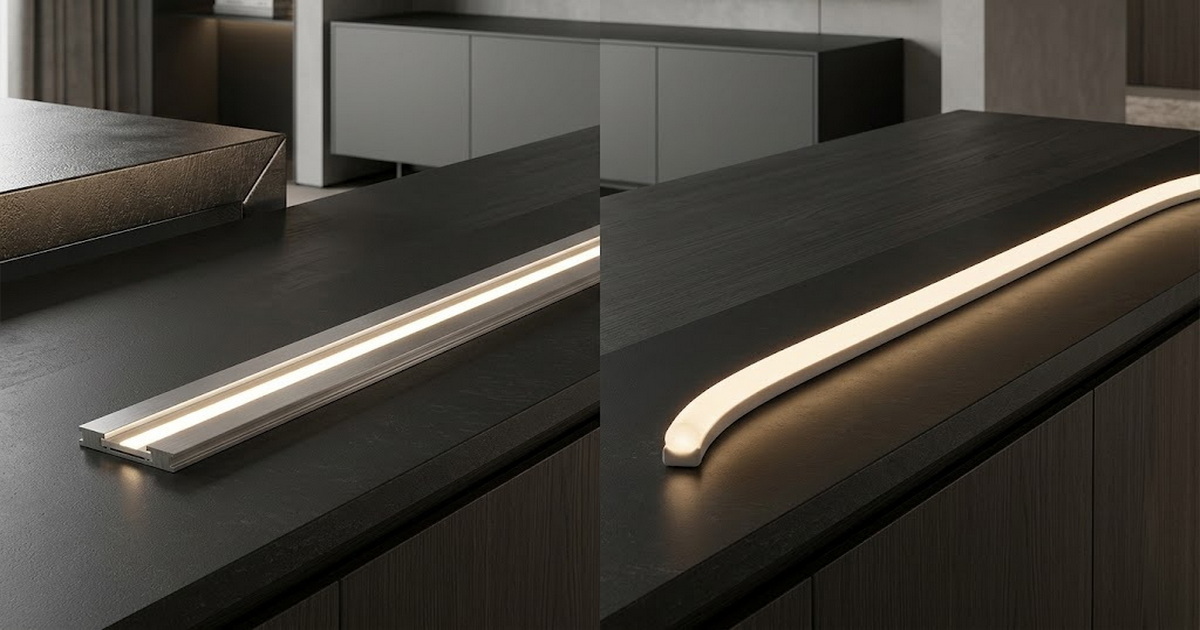
If your priority is a thin, seamless, direct lighting line inside a cabinet, wardrobe, shelf, drawer, aluminum profile, or under-cabinet application, a COB LED strip is generally the stronger choice.
If your priority is a soft, rounded, visible neon-like line with a protected outer body for contours, decorative edges, bathroom zones, display features, or shaped architectural details, LED neon flex may be the better option.
| Comparison Area | COB LED Strip | LED Neon Flex |
|---|---|---|
| Light-emitting appearance | Direct, flat, dot-free linear illumination | Soft, rounded, diffused neon-style glow |
| Uniformity at close range | Usually excellent when made with a high-quality continuous phosphor layer | Usually excellent on the visible emitting surface, depending on housing design |
| Installation profile | Slim and flexible | Larger outer profile because of its silicone or polymer housing |
| Best furniture-lighting use | Cabinets, wardrobes, shelves, drawers, under-cabinet lighting, channels | Decorative edges, visible contours, curves, exposed lighting features |
| Diffusion method | Integrated chip array and continuous surface coating | Internal LED strip plus external diffusing housing |
| Light direction control | Easier to pair with aluminum channels, lenses, and reflectors | Defined by the emitting surface and neon body orientation |
| Protection potential | Depends on the strip construction and installed channel | Often suited to applications needing a sealed outer body |
| Visual impression | Clean, minimal, precise | Soft, sculptural, decorative |
Neither technology is automatically superior in every project. A uniform lighting result depends on the full system: the light source, diffuser, mounting surface, channel geometry, installation distance, driver quality, wiring method, and final viewing angle.
Light uniformity describes how evenly light is distributed across a visible surface or task area. In practical furniture lighting, it means that the lighting line should appear consistent from one end to the other.
A poor result may include:
- Visible individual LED points
- Bright and dark sections along the strip
- Uneven color appearance
- Noticeable shadows beneath cabinet lips or shelves
- Light leakage at joints and end caps
- Bright spots caused by reflective cabinet materials
- Different brightness levels between connected sections
For homeowners, designers, and installers, uniformity is usually judged visually. A wardrobe rail, cabinet shelf, or bathroom mirror may look premium when the light line is smooth and calm. The same installation can look low-grade if individual light points are visible through a diffuser or reflected in glossy surfaces.
Lighting guidance commonly evaluates uniformity by comparing the brightest and dimmest points across an illuminated area. In real furniture projects, the practical lesson is straightforward: the more visible the fixture is, the more important it becomes to control hot spots, glare, shadows, and color inconsistency.
COB stands for Chip on Board. Instead of placing larger packaged LEDs at visible intervals, a COB LED strip uses many small LED chips mounted closely together on a flexible circuit board. A continuous phosphor coating covers the light-emitting surface.
This construction is why a well-made COB LED strip can create a nearly uninterrupted line of light even when viewed without a deep diffuser channel.
A conventional LED strip may show individual points because the LEDs are physically separated. If the strip is installed too close to a diffuser, reflective surface, shelf, or cabinet panel, those points can remain visible.
With COB technology, the light sources are much closer together, and the continuous coating helps blend their output. Instead of seeing a row of separate emitters, the viewer sees a smoother illuminated surface.
The main benefits are:
- Minimal visible spotting in shallow cabinet channels
- Better close-range appearance on open shelves and display units
- Cleaner reflections on glossy panels, glass, metal, and lacquered surfaces
- More consistent visual output in narrow aluminum profiles
- Simpler design integration where space is limited
A high-quality COB LED strip can look especially refined in furniture because it does not require a deep cavity to hide LED dots. This matters in slim cabinet frames, wardrobe systems, bedside panels, and concealed shelf lighting.
However, "dot-free" should not be treated as an unconditional promise. The perceived smoothness of COB lighting can vary according to the density and arrangement of the LED chips, phosphor layer quality, assembly consistency, mounting surface, color selection, and viewing angle. Industry guidance on COB strips similarly notes that the uniform effect depends on chip density and the quality of the continuous diffusion layer.

COB LED strips are usually the strongest option when the light source is close to the viewer or close to the reflecting surface.
Typical applications include:
- Under-cabinet task lighting
- Open kitchen shelving
- Wardrobe hanging areas
- Closet shelves and shoe cabinets
- Glass display cabinets
- Drawer interiors
- Bedside wall panels
- Mirror-side furniture lighting
- Recessed aluminum channels
- Furniture display edges
For example, imagine a high-gloss white kitchen cabinet with a slim under-cabinet channel. A conventional strip may create reflected points across the backsplash. A well-selected COB LED strip can produce a smoother line, reducing distracting visual repetition and making the overall cabinetry look more integrated.
LED neon flex uses LEDs inside a flexible outer body, commonly made from silicone or other polymer materials. The housing diffuses the internal light source and shapes it into a continuous line that resembles traditional neon lighting.
Unlike a bare COB strip, neon flex does not rely only on the LED surface for visual smoothness. Its outer body becomes part of the optical system.
The silicone or polymer body performs several functions at once:
- It helps conceal the individual internal LEDs
- It spreads light across the visible emitting face
- It creates a smooth, rounded or flat neon-like appearance
- It adds physical protection to the internal strip
- It supports certain bending directions and decorative shapes
- It helps create a more substantial visual presence
The quality of this housing has a major influence on uniformity. A well-designed housing balances light transmission and diffusion. If it diffuses too little, internal LED points may become visible. If it diffuses too much, the light can appear dull or unevenly bright along bends and connection points.
LED neon flex products are widely described as using an internal LED strip combined with PVC, silicone, or polyurethane casing to diffuse the light into a uniform visual effect. Silicone-based neon flex is also commonly used where a flexible, weather-resistant, protected light body is needed.
Neon flex is especially effective when the installation needs a visible, softened light line rather than a discreet furniture-lighting component.
Common applications include:
- Decorative furniture outlines
- Cabinet island accents
- Bathroom vanity contours
- Wall grooves and feature panels
- Curved ceiling details
- Retail display borders
- Hotel headboard accents
- Signage-style lighting
- Mirror perimeter features
- Architectural curves and irregular shapes
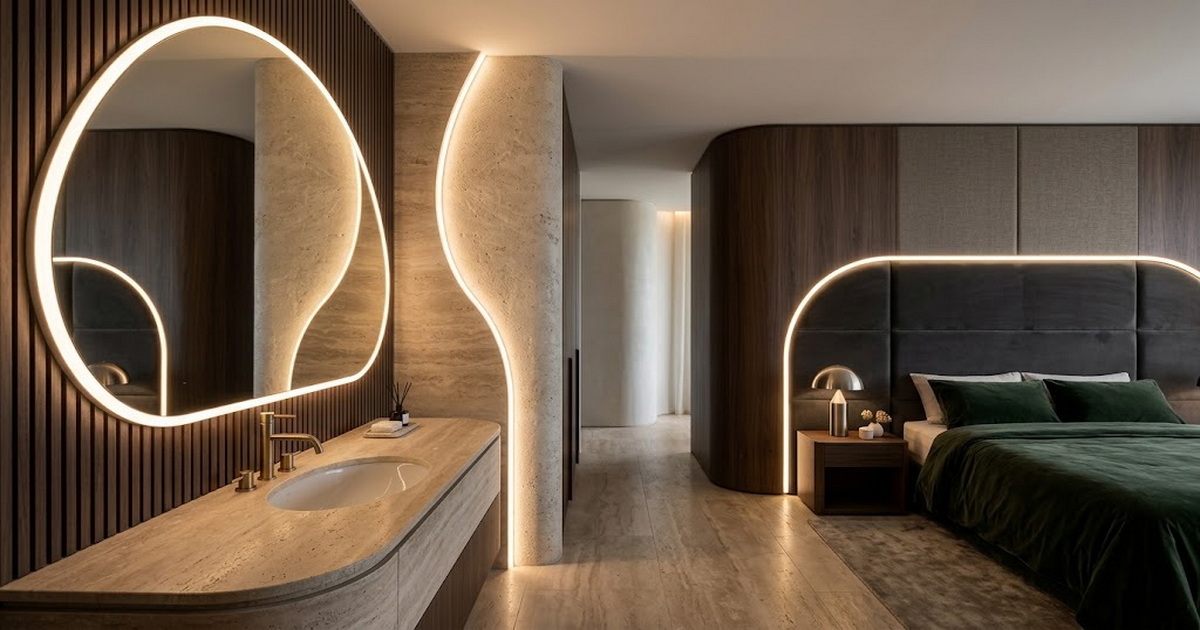
A neon flex line can feel more decorative than a COB LED strip because the illuminated body itself becomes part of the design. It can make an edge, curve, or contour visually stronger—even when the fixture remains visible.
The answer changes depending on how the product is viewed.
For a shallow cabinet recess, narrow shelf channel, or open wardrobe compartment, COB LED strips often provide better direct uniformity.
The light-emitting surface is thin, continuous, and close to the installation plane. When a quality COB strip is selected and properly mounted, it can maintain a smooth visual line with less bulk.
Neon flex can also look smooth at close range, but its visible body is larger. In a compact furniture detail, that extra volume may look less refined or may reduce usable space.
For exposed accent lighting, neon flex may produce a more forgiving appearance.
The larger diffuser body softens the visual output and can hide minor internal variations. It also creates a distinctive continuous tube effect that many designers want for decorative applications.
This is particularly useful for curved cabinet islands, vanity borders, feature walls, and bedroom headboards where the fixture is meant to be seen rather than concealed.
COB LED strips often have the advantage. Because the source itself is already visually blended, it can work effectively in shallower profiles than a point-source strip.
This can help manufacturers and cabinet makers maintain slim furniture dimensions while still delivering an elegant lighting result.
Neon flex often has an advantage when the project requires a defined luminous curve or a visible perimeter. Its outer body can support specific bending directions and protect the internal light source during installation.
That said, the bending direction must match the product design. A neon flex designed for one direction should not be forced into another, as this may distort the light line, damage internal circuitry, or create uneven illumination around corners.
The light source alone does not determine the final visual result. From a manufacturer's perspective, the following factors often decide whether a project looks premium or problematic.
The distance between the light source and the diffuser or illuminated surface has a major effect.
A shallow installation makes imperfections easier to see. COB LED strips are often preferred in these conditions because they begin with a more continuous emitting surface.
Neon flex already includes a diffusing body, but its total height and width should be considered early in the furniture design process.
Glossy lacquer, polished stone, glass, stainless steel, and mirrors make bright points and installation mistakes more obvious.
In these applications, use a light source that remains visually smooth from multiple viewing angles. COB LED strips are often effective under high-reflection conditions, while neon flex can work well when a visible, soft edge glow is the intended design effect.
A lighting line can appear uneven even if there are no visible dots. Slight color variation between sections can make one area look warmer, cooler, greener, or duller than another.
For long furniture runs and multi-cabinet systems, use consistently controlled production batches and verify the appearance of connected sections before final installation.
An unstable driver can cause flicker, inconsistent dimming, or differences in output between connected runs. These problems are often mistakenly blamed on the LED strip itself.
A complete lighting system should be planned as one solution:
- LED light source
- LED power supply
- Control method
- Connection accessories
- Mounting channel or housing
- Sensor or switch option
- Cable routing method
For cabinet, wardrobe, and bathroom furniture projects, coordinating the light source with a compatible LED power supply is essential to maintaining a stable, professional visual result.
Heat can affect both reliability and appearance over time. Poor thermal handling may contribute to inconsistent output, reduced lifetime, color shift, or premature failure.
COB strips installed inside aluminum profiles can benefit from improved heat transfer. Neon flex should be selected and installed according to its intended environment, bending requirements, and mounting method.
Instead of choosing based only on product appearance, use the following process.
Ask whether the lighting is intended for:
- Task illumination
- Ambient illumination
- Decorative outlining
- Display lighting
- Wayfinding
- Smart-home scene lighting
- Moisture-prone furniture zones
A cabinet worktop needs usable, stable light. A headboard feature may prioritize atmosphere. A bathroom cabinet may require both visual comfort and protected construction.
If people will see the light source from a short distance, prioritize a seamless appearance.
For shallow channels, glass shelves, open cabinet compartments, and mirror-facing surfaces, COB LED strips are usually a strong starting point.
For visible accent lines that are meant to look like a luminous tube, explore neon flex.
Measure the cabinet groove, profile, shelf edge, or installation cavity before selecting the light source.
COB LED strips are suited to space-sensitive designs. Neon flex needs sufficient room for its outer housing, mounting clips, bending radius, connectors, and end treatment.
For straight runs and discreet linear furniture lighting, COB strips are often easier to integrate.
For curves, circles, decorative edges, and exposed contours, choose neon flex designed for the required bending direction.
For OEM and ODM projects, a physical sample remains one of the most useful quality-control tools.
Evaluate the sample in the real installation condition:
- Turn the light on in daylight and at night
- View it from standing, seated, and close-up angles
- Check the reflection on adjacent surfaces
- Inspect corners, joints, connectors, and end caps
- Test dimming behavior
- Compare connected sections side by side
- Review the result after the furniture door or drawer is installed
This practical test often reveals issues that a product photo or isolated bench test cannot show.
More brightness does not automatically create better uniformity. A bright point-source strip may still look poor in a shallow channel.
Choose the lighting construction based on the desired visual effect first, then match the output to the application.
A COB strip, aluminum profile, diffuser cover, and reflective cabinet surface work together. The same strip can look different in a clear cover, frosted cover, deep profile, or shallow recess.
Likewise, the outer material and geometry of neon flex directly influence its smoothness, softness, and visual depth.
Mixing different batches, drivers, dimmers, connectors, or color appearances can create a visibly uneven project.
For large furniture programs, source a coordinated lighting system from a supplier able to support stable production, product matching, and customized assembly requirements.
End caps, connectors, cable exits, and corner transitions are highly visible in premium installations. A smooth main light line can still look unfinished if the end treatment is poorly planned.
Neon flex should be selected according to its intended bending method. Forcing a product around tight corners or unsupported curves can create irregular light appearance and damage the assembly.
Choose a COB LED strip when you need:
- A slim, direct, seamless lighting line
- Smooth light in shallow channels
- Clean cabinet, shelf, wardrobe, or drawer lighting
- Reduced visible spotting on reflective surfaces
- Flexible integration with aluminum profiles and sensors
- A discreet lighting component that supports the furniture design
Choose LED neon flex when you need:
- A visible neon-style light body
- Softly diffused decorative illumination
- Curved, shaped, or exposed lighting lines
- A more substantial visual lighting element
- Protected outer construction for selected environments
- A feature-lighting effect around edges, mirrors, panels, or contours
For many furniture projects, the answer is not either-or. A well-designed lighting program may use COB LED strips for functional cabinet interiors and under-cabinet lighting, then use neon flex for visible accents on vanity edges, display units, headboards, or feature panels.
For global furniture brands, cabinet manufacturers, lighting distributors, and project contractors, product selection should extend beyond choosing a strip or neon body from a catalog.
A dependable solution should consider:
- Furniture structure and mounting space
- Required lighting direction
- Sensor and switching method
- Dimming and smart-control needs
- Cable routing and connector accessibility
- Installation workflow
- Packaging requirements
- Brand appearance and private labeling
- Project-specific dimensions and assembly requirements
Farwise Technology Co., Ltd. supports OEM and ODM furniture lighting development across LED silicone strip lights, LED cabinet lights, LED wardrobe lights, LED bathroom cabinet lights, and LED power supplies. By coordinating the lighting source, driver, accessories, and application design, manufacturers can create more consistent results across whole-home furniture, commercial interiors, soft furnishing projects, and smart-home lighting systems.
Need a smoother, more reliable furniture-lighting solution? Share your application scenario, installation space, lighting direction, and customization requirements with Farwise Technology Co., Ltd. Our team can help evaluate whether a COB LED strip, LED neon flex solution, or a combined system is the better fit for your project.
In direct, close-range furniture applications, COB LED strips are often more uniform because their closely arranged chips and continuous phosphor surface create a thin, smooth light-emitting line. Neon flex can also be highly uniform, but it creates uniformity through a larger external diffusion body.
High-quality COB LED strips are designed to minimize or eliminate visible dots. However, perceived smoothness can still vary with product quality, chip arrangement, phosphor coating, viewing angle, reflective surfaces, and installation method.
Yes. LED neon flex can work well for visible cabinet edges, display furniture, vanity outlines, decorative shelving, curved islands, and feature panels. For concealed task lighting inside shallow cabinet channels, a COB LED strip is often the more compact option.
COB LED strips are usually better for wardrobe interiors, shelves, hanging zones, and drawer lighting because they provide a slim, direct, even lighting line. Neon flex is more suitable when the wardrobe design includes exposed decorative contours or a visible accent-lighting feature.
Yes. The diffuser, channel depth, material, and distance from the LED source can substantially affect the final appearance. A lighting system should always be evaluated as a complete assembly rather than as a strip alone.
It can be used in appropriate bathroom cabinet applications when the selected product, connections, power supply, mounting method, and protection level suit the installation environment. Product selection should account for moisture exposure, cleaning practices, ventilation, and local electrical requirements.
Common causes include visible LED spacing, shallow mounting depth, unsuitable diffusers, mismatched product batches, poor wiring, unstable drivers, reflective surfaces, overly tight bends, and inconsistent installation practices. A full sample test in the final furniture structure can prevent many of these issues.
1. - [Illuminating Engineering Society — Lighting Uniformity in Horticulture]
3. - [ENTTEC — Neon Flex LED Series Datasheet]
4. - [Voodoo Neon — What Is LED Neon Flex and How Can It Be Used?]
5. - [Super Lighting LED — The Ultimate Guide to COB LED Strips]
6. - [AspectLED — How to Connect Neon Flex LED Lights]
7. - [LEDYi Lighting — LED Neon Flex: Flexible and Efficient Linear Lighting]


