
English
Views: 222 Author: Farwise Lighting Publish Time: 2026-10-26 Origin: Site


Content Menu
● Warm White vs. Soft White LED Strip Lights: The Essential Difference
● What the Color Name Does Not Tell You
>> Warmth Is Not Color Accuracy
>> Warmth Is Not Glare Control
● Which LED Strip Light Works Best in Each Furniture Application?
>> Kitchen Cabinets: Balance Comfort and Visibility
>> Wardrobes: Judge Clothing, Not Just the Interior Finish
>> Bathroom Cabinets: Separate Decorative and Grooming Needs
>> Bedrooms: Favor Controlled, Indirect Illumination
>> Living Rooms and Commercial Interiors: Design the Whole View
● How Furniture Finishes Change the Result
>> Timber and Warm-Toned Materials
>> White Cabinetry and Pale Stone
>> Glossy Surfaces and Reflective Details
● LED Silicone Strip Lights: Evaluate the Finished Assembly
● A Practical Sample-Test Method Before Ordering
>> Step 1: Define the Lighting Job
>> Step 2: Reproduce the Real Materials
>> Step 3: Compare Under Similar Conditions
>> Step 4: Check Normal Use Positions
>> Step 5: Record the Approved Result
● OEM and ODM Purchasing: Prevent Color Mismatches Before Production
● Dimming and Smart Control: Specify the Behavior You Want
● Choosing Your Furniture Lighting With Farwise
>> 1.Are Warm White and Soft White LED Strip Lights the Same?
>> 2.Which Is Better for Under-Cabinet Lighting?
>> 3.Is Soft White Automatically Less Bright?
>> 4.Can I Mix Warm White and Soft White in One Room?
>> 5.Does Silicone Make an LED Strip Suitable for Bathrooms?
>> 6.Should I Choose Fixed White or Tunable White?
Choosing between warm white vs. soft white LED strip lights should begin with the atmosphere you want—not the wording on the packaging. Both labels can describe inviting white light, and suppliers sometimes use them interchangeably. For furniture lighting, the better choice depends on how the installed light works with your finishes, daily activities, and surrounding illumination.
At Farwise Technology Co., Ltd., our approach to furniture lighting starts with the application: what needs illuminating, how people will use it, and how the lighting integrates into the furniture. Drawing on our manufacturing focus, this guide explains the differences that matter when selecting LED silicone strip lights for cabinets, wardrobes, bathrooms, and bedrooms.
Terminology is the first issue to resolve. Warm white and soft white are commercial descriptions, not universally interchangeable specifications with fixed boundaries.
Some suppliers describe soft white as a gentler, more golden light and warm white as a slightly cleaner white. Others use warm white for the warmer-looking option or place both names within the same category.
Consequently, you should never assume that one supplier's soft white will match another supplier's warm white.
For this comparison, "softer-looking" means the more golden, intimate appearance, while "cleaner warm white" means a less golden white that still feels welcoming. These descriptions refer to the actual light, not a guaranteed difference between labels.
| Selection factor | Softer-looking white | Cleaner warm white |
|---|---|---|
| Visual impression | More golden and intimate | Less golden but still welcoming |
| Typical design priority | Decorative atmosphere | Everyday visibility with warmth |
| Furniture applications | Bed frames, display shelves, lounge cabinetry | Kitchen cabinets, wardrobes, mixed-use furniture |
| Main consideration | Can emphasize yellow or cream undertones | May feel less intimate in relaxation areas |
| Best selection method | Review an installed sample | Review an installed sample |
Neither category is automatically brighter, more efficient, or higher quality. Those characteristics require separate evaluation.

Light color describes whether illumination appears warmer or cooler. Brightness concerns the amount of light delivered and how it reaches the surface.
A golden-looking strip can provide effective task lighting. A cleaner-looking strip can produce a subdued decorative effect.
Before changing the light color because a cabinet feels dark, examine placement, shadows, diffusion, and surrounding illumination. The problem may be distribution rather than warmth.
Two strips with a similar white appearance can make wood, clothing, skin, and upholstery look different.
Color rendering describes how a light source reveals object colors. It is separate from whether the light itself looks golden or relatively neutral.
For furniture projects, inspect actual materials under the proposed lighting. A pleasant-looking light source does not automatically reproduce every finish convincingly.
"Soft white" does not guarantee soft illumination.
An exposed strip reflected in polished stone can feel uncomfortable regardless of its color name. Concealed positioning, appropriate diffusion, and careful aiming are often more important than choosing a warmer label.
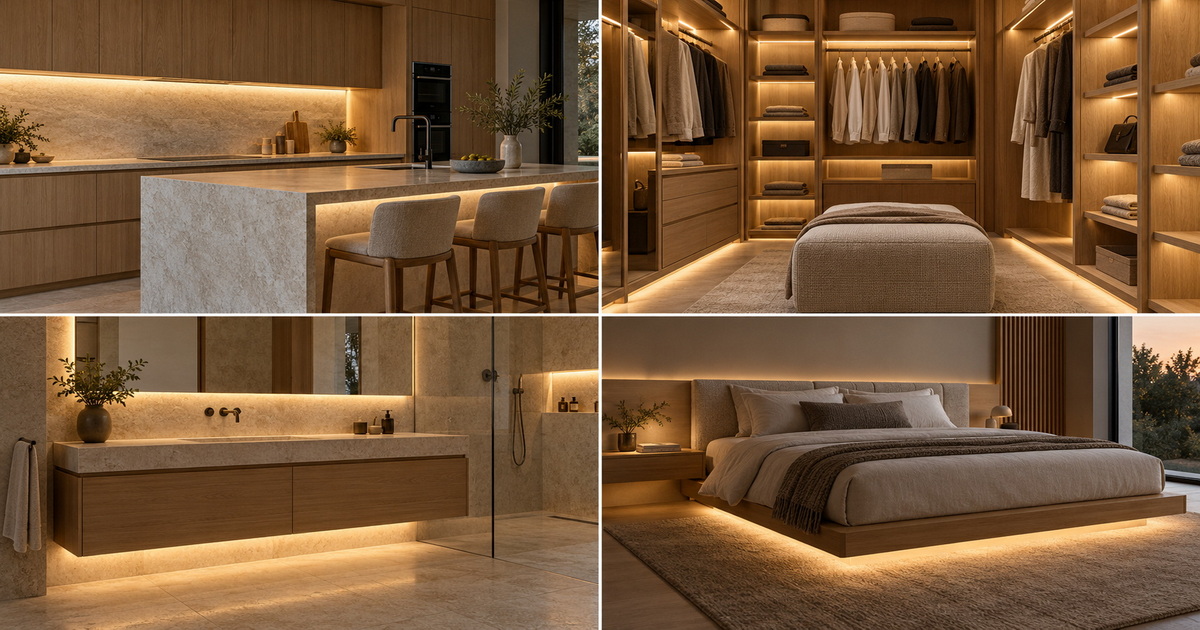
For kitchen under-cabinet lighting, I would prioritize comfortable visibility across the working surface before choosing the warmer-looking option.
A cleaner warm white can suit kitchens where preparation, cleaning, and entertaining share the same space. A more golden appearance may complement timber cabinetry and evening dining.
However, cabinet color alone should not decide the outcome. Test the light against the countertop, backsplash, and nearby ceiling lighting.
Positioning matters too. A poorly located strip may leave the working area shadowed or create distracting reflections, even when its white tone looks attractive.
The best LED strip lights for wardrobes should help users distinguish clothing colors while making the interior inviting.
A golden glow may enhance timber shelves but change how white shirts, pale fabrics, or similar dark garments appear.
My preferred evaluation is simple: place representative clothing inside the sample wardrobe and compare it under each lighting option.
Also check the view from outside the wardrobe. Lighting that looks comfortable when facing the shelves can become distracting when visible through open doors.
Bathroom furniture often combines different lighting functions.
A concealed strip beneath a vanity can create a welcoming decorative effect. Lighting used for grooming needs to reveal facial features without strong shadows or misleading color changes.
Do not expect an attractive under-vanity glow to replace suitable mirror lighting.
For bathroom installations, assess the complete lighting assembly for its intended location and applicable electrical requirements. Silicone encapsulation alone does not establish that an installation is suitable for exposure to moisture.
For bed frames, headboards, and bedside cabinetry, a softer-looking white is often a practical starting point when the goal is a quiet evening atmosphere.
The installation should keep the light source out of normal sightlines, particularly when someone is lying down.
Reading requires separate consideration. Decorative light beneath a bed may provide orientation without delivering useful illumination onto a page.
Avoid treating warm lighting as a guaranteed sleep solution. The amount of light, timing, duration, and individual sensitivity also matter.
Display shelves, hospitality furniture, and reception cabinetry benefit from coordinated lighting.
Select the white appearance alongside upholstery, artwork, adjacent luminaires, and the intended atmosphere.
Consistency is especially important where several illuminated furniture pieces appear together. Small differences can become obvious when light falls across the same wall or finish.
Golden-looking illumination can reinforce the character of oak, walnut, leather, and warm fabrics. However, it may also push already-yellow finishes further in that direction.
Cleaner warm white can provide a useful alternative when a space needs warmth without strongly emphasizing golden undertones.
The right balance depends on the entire palette, not simply whether the furniture contains wood.
White finishes are particularly revealing because nearby lighting differences become easy to notice.
A golden strip may make one cabinet appear cream-colored beside another illuminated by a cleaner white source.
Review painted samples, stone, and wall finishes together. Looking at each material separately can hide clashes that become obvious after installation.
Polished countertops, glass shelves, and metal fittings can reveal the light source through reflections.
In these applications, changing the white tone may do little to solve visual discomfort.
Adjust concealment, placement, or diffusion before concluding that the color selection is wrong.
LED silicone strip lights should be assessed as part of the installed furniture system, not as an isolated glowing strip.
The visible result depends on the LED source, covering, mounting arrangement, surrounding materials, and viewing position.
Optical materials can influence light transmission and appearance. Therefore, approve the version that will actually enter production, including its intended covering and accessories.
Mechanical integration also matters. A flexible lighting format still needs a suitable installation route, secure mounting, accessible connections, and appropriate heat management.
For OEM and ODM projects, define the installation method early. This helps avoid choosing an attractive sample that becomes difficult to assemble, service, or reproduce consistently.
A controlled mock-up provides more useful information than comparing product photographs.
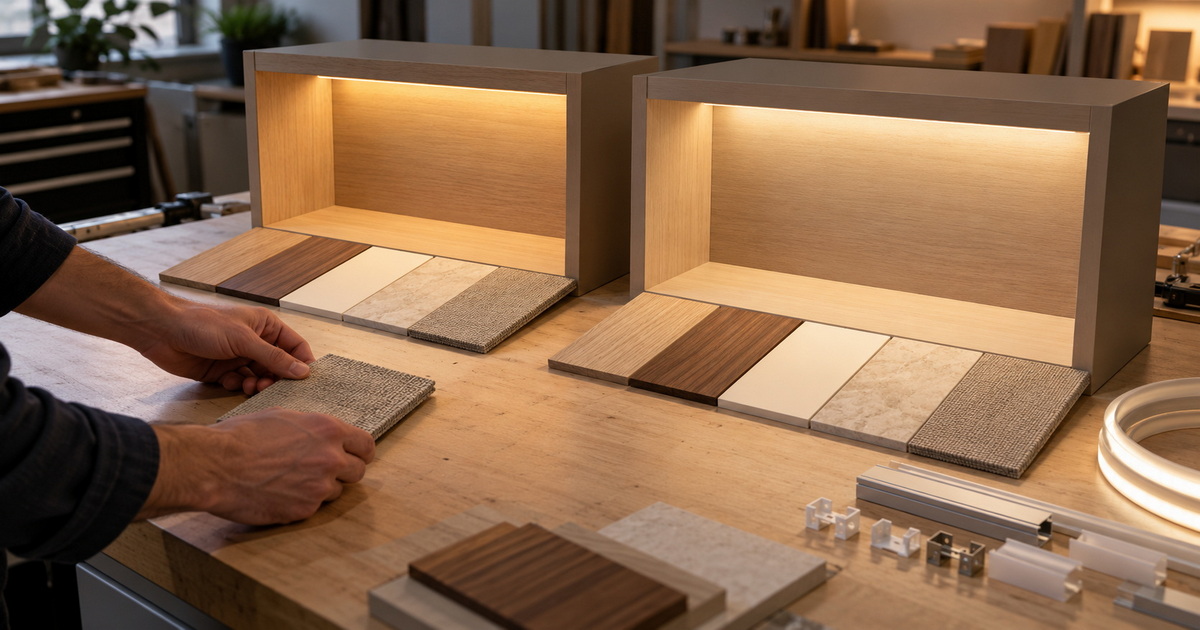
Write a short application brief.
Is the strip intended for food preparation, clothing selection, decorative display, nighttime orientation, or several functions?
Agree on the primary purpose before discussing appearance.
Use the intended cabinet finish, countertop, upholstery, or representative samples.
Include the planned mounting arrangement. Holding a bare strip above a material does not reproduce the finished installation.
Use the same viewing position and comparable illumination when judging the alternatives.
Otherwise, the brighter sample may appear more appealing simply because it delivers more light.
Review the samples with nearby lighting both switched on and switched off.
Look while standing, sitting, opening doors, and reaching into storage areas.
For bedroom furniture, check from a lying position. For wardrobes, inspect both the clothing and the light visible around the door opening.
Keep an approved physical sample and document the complete assembly.
Photographs can support communication, but camera processing and screen settings can alter the apparent white tone. They should not replace the physical reference.
For manufacturers, distributors, and project buyers, the most useful question is not "Which label sounds better?" It is "How will the approved appearance be reproduced?"
A clear purchasing brief should address:
- The intended furniture application.
- The approved appearance and material samples.
- Matching requirements across adjacent lighting sections.
- The complete mounting and control arrangement.
- Production inspection and replacement expectations.
Color consistency and color stability are related but different concerns.
Consistency describes how closely units match each other. Stability concerns how appearance changes during use. Both deserve attention when lighting extends across several furniture modules.
Retain a reference sample for repeat orders. This creates a more reliable approval basis than relying on a familiar product name.
Dimming, warm-dimming, and tunable-white lighting are different functions.
Conventional dimming reduces light output without necessarily creating a deliberate change in white appearance. Warm-dimming systems are designed to become warmer-looking as they dim. Tunable-white systems allow adjustment between different white appearances.
For mixed-use furniture, adjustable lighting may help accommodate different activities. However, controls introduce additional compatibility and commissioning considerations.
Ask the supplier to demonstrate the complete lighting system through its intended operating range. Check transitions, low-level behavior, and any visible instability.
Do not assume that every strip works with every dimmer or smart-home controller.
Farwise Technology Co., Ltd. brings 16 years of LED lighting manufacturing experience to furniture applications, including cabinets, wardrobes, bathroom cabinets, and bedroom furniture.
Our OEM and ODM services support customization of dimensions, functions, appearance, and integrated lighting solutions.
For your next project, send Farwise your furniture drawings, finish references, installation details, and intended lighting effect. Request a sample evaluation before confirming the production order, so the selected lighting can be reviewed in the context that matters: the finished furniture.
They can overlap. Suppliers do not always use these names consistently. Compare the actual light appearance and confirm the approved sample rather than relying on the label alone.
Neither name guarantees the better result. Prioritize useful visibility, comfortable reflections, suitable color rendering, and coordination with surrounding lighting. Then select the white appearance that complements the materials.
No. "Soft white" describes a marketed color appearance, not a guaranteed brightness level. Output, placement, diffusion, and the illuminated surface all influence how bright an installation feels.
Yes, when the difference serves a clear purpose. However, visibly adjacent strips or lights illuminating the same surface generally benefit from close matching to avoid an unintended patchwork effect.
Not by itself. Suitability depends on the complete assembly, installation location, connections, and applicable requirements. Confirm the intended use with the supplier and a qualified installer.
Fixed white suits projects with a clearly defined appearance. Tunable white offers flexibility for changing activities or preferences, but requires a compatible control system and careful evaluation of the finished installation.
1. ENERGY STAR — "Light Bulb Purchasing Checklist." Consumer guidance grouping warm white and soft white terminology and explaining the distinction between light color and brightness. [energystar]
2. U.S. Department of Energy — "LED Basics." Technical background on white-light production, color appearance, color fidelity, and lighting controls. [energy]
3. U.S. Department of Energy — "LED Color Characteristics." Technical fact sheet covering color appearance, consistency, stability, and the interaction between lighting and object colors. [energy]
4. U.S. Department of Energy — "Understanding LED Color-Tunable Products." Explanation of warm-dimming and tunable-white systems, including the importance of evaluating installed mock-ups. [energy]
5. U.S. Department of Energy — "Purchasing Energy-Efficient Light Bulbs." Guidance on light appearance, color rendering, and compatibility between lamps and dimming systems. [energy]
6. U.S. Department of Energy — "Color Stability of LEDs: Understanding the Basics." Technical presentation distinguishing consistency from stability and discussing the influence of operating conditions and optical materials. [www1.eere.energy]
7. SignliteLED — "Warm White vs. Soft White LED Strip Lights: Which One Is Best for You?" Original comparison reviewed for topic coverage. This article independently addresses terminology overlap, furniture integration, sample approval, and purchasing considerations rather than adopting its category boundaries. [signliteled]


