
Views: 222 Author: Farwise Lighting Publish Time: 2026-10-18 Origin: Site


Content Menu
● Can You Throw LED Strip Lights in the Trash?
● Check Whether Your LED Strip Lights Really Need Disposal
>> Separate Replacement Decisions From Disposal Decisions
>> Reuse Only When the Product Is Suitable
● How to Dispose of LED Strip Lights Safely: Step by Step
>> Step 1: Disconnect the Electrical Supply
>> Step 2: Record the Installation
>> Step 3: Remove Accessible Components Carefully
>> Step 4: Separate Removable Batteries
>> Step 5: Package for the Confirmed Collection Route
● Where to Recycle LED Strip Lights
>> Look Beyond a Generic "Electronics Accepted" Label
● How to Dispose of LED Silicone Strip Lights
>> Do Not Assume the Silicone Belongs in Plastics Recycling
>> Avoid Unnecessary DIY Material Separation
● Furniture Lighting Disposal: Sort the System, Not Just the Strip
● A Better Disposal Workflow for Commercial Refurbishments
>> Plan Collection Before Dismantling
>> Separate Reusable Stock From Failed Products
● Reduce Future Waste Through Better Lighting Planning
>> 1.Can LED strip lights go in the household recycling bin?
>> 2.Are LED strip lights accepted wherever LED bulbs are collected?
>> 3.Should I remove silicone before recycling LED strip lights?
>> 4.Can I donate used LED strip lights?
>> 5.Do drivers and controllers need separate disposal?
>> 6.What should I do with batteries from a lighting system?
>> 7.Can businesses use household lighting collection programs?
Knowing how to dispose of LED strip lights starts with one important distinction: an unwanted lighting strip is not necessarily a failed product, and a failed product should not automatically go into household waste. Check whether it can be reused, identify its separate components, and confirm which local collection service accepts it.
For silicone-encased strips, cabinet lighting, wardrobe lighting, and integrated furniture systems, disposal involves more than removing a light source. Drivers, controllers, wiring, mounting channels, and batteries may need different handling.
At Farwise Technology Co., Ltd., our perspective comes from 16 years in LED lighting manufacturing. We believe responsible lighting planning should consider installation, maintenance, replacement, and eventual disposal—not simply the initial purchase.

Recycling through an appropriate collection service is the preferred route for unwanted LED strip lights. However, disposal requirements and accepted products vary by location. Contact your municipal waste authority or a suitable recycler before choosing a disposal method.
Do not confuse ordinary rubbish collection with household recycling. An electrical product does not belong in a packaging-recycling bin simply because it contains metal or plastic.
Also, do not assume that a collection point accepting LED bulbs will accept flexible strips. Local programs distinguish between product categories, and some restrict their services to household waste rather than business waste. San Francisco's LED-bulb guidance, for example, identifies household-only restrictions at retail take-back locations.
The practical rule is simple: describe the actual product before making the trip.
Before removing an entire installation, establish whether replacement is necessary.
A dark section, intermittent operation, or an unresponsive lighting system does not, by itself, identify which component has failed. Avoid discarding a complete furniture-lighting assembly without first checking the installation information or consulting the supplier.
Consider these questions:
- Is the strip damaged, or is the problem elsewhere in the system?
- Is the lighting being removed only because the furniture is being redesigned?
- Can an accessible component be replaced without disturbing the complete installation?
- Is the product still covered by its supplier's support arrangements?
- Would inspection by a qualified installer prevent unnecessary replacement?
Do not conduct electrical testing unless you have the necessary competence. Stop using equipment with visible burning, exposed wiring, or other signs of unsafe damage.
Working strips may be suitable for reuse or donation when their condition, compatible components, and installation requirements are clear.
Keep useful identification labels and instructions with the product. Do not donate damaged equipment or present an untested assembly as ready for installation. The US Environmental Protection Agency recommends considering donation and reuse before recycling unwanted electronics.
A careful removal process makes subsequent sorting and collection easier.
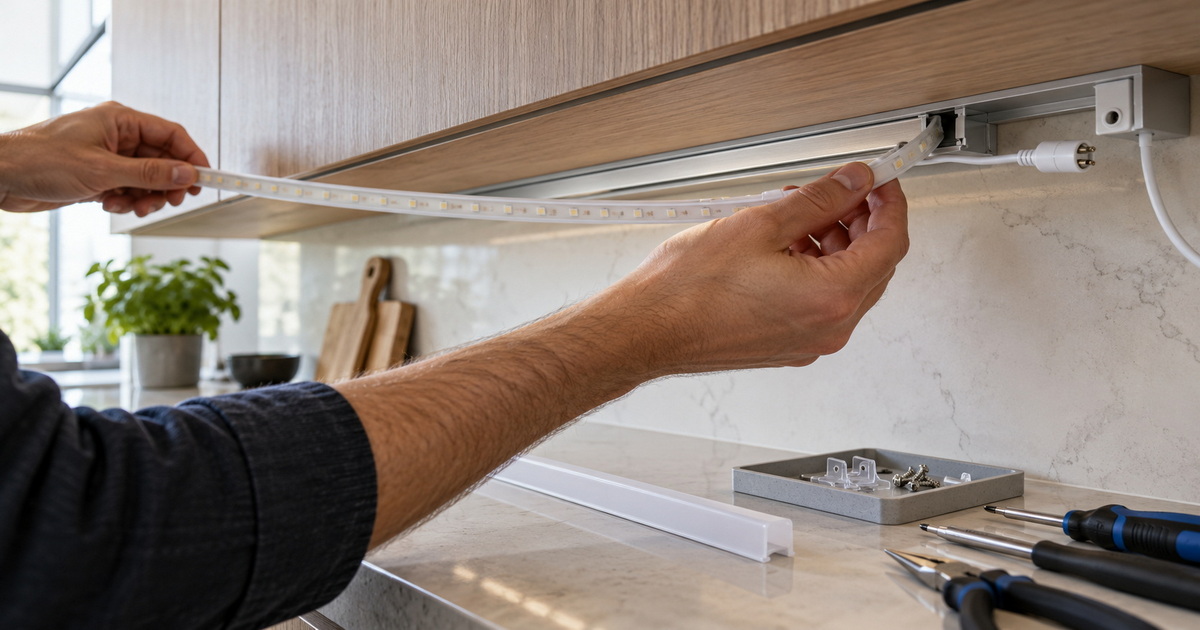
Switch off and unplug an accessible plug-in system before removal.
For hardwired cabinet, bathroom, or commercial lighting, arrange safe isolation and removal by a qualified electrician. A wall switch alone should not be treated as confirmation that equipment is safe to disconnect.
Do not open a driver or power supply to recover internal parts.
Before disconnecting accessible components, photograph the arrangement and retain readable labels.
For furniture projects, record which strips, drivers, sensors, and controllers belong together. This helps preserve working assemblies for assessment or reuse and gives the recycler a clearer description of the waste.
Follow the installation instructions where available.
Release accessible clips or covers without forcing concealed wiring. Avoid unnecessary cutting: chopping a strip into fragments does not establish a recycling route and can make handling more difficult.
For silicone-encased products, keep the assembly intact unless the receiving recycler specifically requests otherwise.
Some lighting systems include battery packs or battery-powered remote controls.
Remove batteries only where they are designed for straightforward user removal. If a battery is swollen, leaking, damaged, or inaccessible, ask the collection service how to handle the complete device.
Lithium-ion batteries must not go into household rubbish or ordinary recycling bins. The EPA recommends specialist collection and protecting exposed terminals with nonconductive tape or individually bagging batteries to prevent contact.
Keep strips, accessories, and batteries separated as instructed by the receiving service.
Contain loose pieces, protect exposed sharp edges, and avoid mixing lighting waste into construction debris. Label reusable assemblies separately from failed equipment so their condition remains clear.
The best destination depends on the product, your location, and whether the waste comes from a household or business.
| Collection option | What to confirm before using it |
|---|---|
| Municipal electronics collection | Whether flexible LED strips and their accessories are accepted |
| Specialist electronics recycler | Whether silicone-encased strips are within its accepted categories |
| Retailer take-back service | Whether it accepts strips rather than bulbs alone |
| Manufacturer collection program | Whether a program actually exists for your product and location |
| Household collection event | Whether the event accepts lighting electronics and separate batteries |
| Commercial waste contractor | Whether it can handle project quantities and provide documentation |
A recycler's general description is not a guarantee that every lighting product is accepted.
In the United States, the EPA recommends certified electronics recyclers and identifies R2 and e-Stewards as accredited certification standards. Certification is a useful screening factor, but you should still confirm product acceptance, collection arrangements, and business-waste conditions.
Silicone-encased lighting deserves a separate conversation with the recycler because the strip is a combined assembly rather than a clean piece of packaging material.
For collection purposes, describe the item as a silicone-encased electrical lighting product.
Do not place it in household plastics recycling based on its flexible appearance. Equally, do not assume that a service collecting uncoated strip lighting will accept the encapsulated version.
The useful question is not simply, "Is silicone recyclable?" It is, "Can your facility process this silicone-encased lighting assembly?"
Do not burn, melt, or chemically strip the casing.
Manual peeling should not become a prerequisite you invent yourself. It may damage the assembly, create loose fragments, and provide no benefit if the recycler requires intact products.
Ask the receiving facility what preparation supports its actual process.
Where available, provide the product name, packaging description, or a photograph.
This is particularly helpful when waste staff need to distinguish a flexible furniture-lighting strip from a bulb, decorative light string, or complete luminaire.
Cabinets, wardrobes, bathroom furniture, and illuminated beds can contain several separate lighting components.
A planned strip replacement should therefore include a component review rather than treating everything as one disposable bundle.
| Component | Practical handling approach |
|---|---|
| LED strip | Confirm acceptance as flexible lighting electronics |
| Driver or power supply | Keep closed and ask about electronics collection |
| Controller or sensor | Retain identification and confirm the accepted category |
| Removable battery | Use the appropriate battery collection route |
| Mounting channel | Ask whether a clean, separated channel can enter metal recovery |
| Covers and adhesive backing | Follow the local service's material-specific instructions |
Furniture manufacturers, installers, retailers, and refurbishment contractors need a repeatable process.
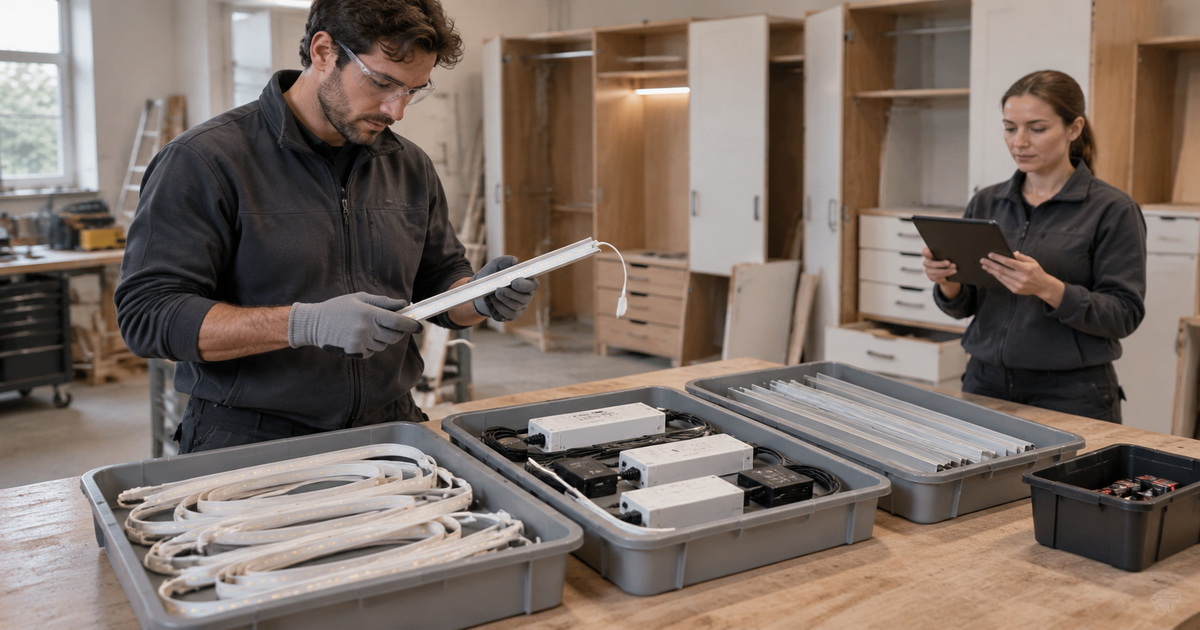
Contact the waste contractor before work starts.
Confirm accepted categories, packaging requirements, collection access, charges, and any restrictions on mixed materials. Do not assume a household drop-off program accepts business-generated waste.
This avoids removing an entire installation and discovering that the selected destination cannot receive it.
Create clearly labelled groups:
- Working assemblies awaiting assessment.
- Failed or damaged lighting electronics.
- Separate batteries.
- Accessible, clean mounting materials.
- Other dismantled furniture materials.
This is a proposed project workflow, not a claim that every component can be recovered. The receiving facility must confirm the final route.
Retain collection receipts, contractor details, and a description of the materials transferred.
Ask what documentation the service provides and what happens to the accepted equipment. Avoid describing a project as completely recycled unless the available evidence supports that statement.
End-of-life decisions become easier when replacement access is considered during product development.
For furniture-lighting projects, discuss:
- Access to strips, drivers, and controllers.
- Clearly identified components.
- Replaceable sections where appropriate.
- Installation instructions and maintenance information.
- Support for identifying compatible replacements.
- Removal methods that avoid unnecessary furniture damage.
These are design and procurement considerations, not promises that every installation will be repairable.
Farwise Technology Co., Ltd. provides LED silicone strip lights and a broader range of furniture-lighting solutions for cabinets, wardrobes, bathroom cabinets, and beds. Our OEM/ODM services support customization of dimensions, functions, lighting solutions, and appearance.
When planning a new project, share the furniture application, installation arrangement, and maintenance expectations with our team. Ask us to discuss component access and replacement planning alongside your lighting design requirements.
Do not put them in a standard packaging-recycling bin unless your local authority explicitly instructs you to do so. Ask about a collection route for electrical lighting products.
Not necessarily. A bulb collection program may have different acceptance rules from an electronics recycler. Describe the strip, its casing, and its accessories before visiting.
Not unless the receiving recycler requests it. Keep the product intact and ask how the facility wants silicone-encased lighting prepared.
Potentially, if they are safe, functional, and supplied with enough information for appropriate reuse. Do not donate damaged strips or unidentified assemblies as ready-to-use equipment.
They may need separate sorting, depending on the collection service. Ask whether the facility accepts the complete lighting system and whether accessories should be packaged separately.
Use the correct battery collection route. Lithium-ion batteries must not enter household rubbish or ordinary recycling, and exposed terminals should be protected against contact.
Do not assume so. Confirm eligibility before delivery. Commercial refurbishment waste may require a business collection service even when similar household products are accepted locally.
1. LEDYi Lighting. "How To Dispose Of LED Strip Light?" Original article reviewed for topic coverage and editorial reconstruction. Its disposal recommendations should not replace local authority instructions. [ledyilighting]
2. United States Environmental Protection Agency. "Electronics Donation and Recycling." Guidance on reuse, donation, battery removal, and finding collection services. [epa]
3. United States Environmental Protection Agency. "Certified Electronics Recyclers." Guidance on certification and responsible electronics management. [epa]
4. United States Environmental Protection Agency. "Used Lithium-Ion Batteries." Collection guidance and terminal-protection precautions. [epa]
5. San Francisco Environment Department. "Light Bulbs (LED)." An example of product-specific collection guidance and household-only take-back restrictions. [sfenvironment]
6. CalRecycle. "Electronic Waste Management." Information on reuse, repair, recycling, and locating electronics collectors in California. [calrecycle.ca]


