
English
Views: 222 Author: Farwise Lighting Publish Time: 2026-10-14 Origin: Site


Content Menu
● Understanding Router-In Micro Channels and Metal U-Clips
>> What Are Solid Wood Router-In Micro Channels?
● Solid Wood Router-In Micro Channels vs. Metal U-Clips: Comparison
● Preservation Comes Before Concealment
>> Original Finishes Are Part of the Object
>> Removability Is Not the Same as Reversibility
● When Router-In Micro Channels Make Sense
>> Use Routing in New or Clearly Replaceable Components
>> Avoid Treating "Solid Wood" as Proof of Safety
● When Metal U-Clips Are the Better Choice
>> Put Clips on a Removable Carrier Where Possible
>> Check Contact, Restraint, and Access
● LED Silicone Strip Lights: Look Beyond the Mount
>> Concealment and Glare Need Separate Decisions
>> Reduced Light Exposure Still Matters
>> Neither Wood Grooves nor Clips Prove Thermal Suitability
● A Practical Preservation-First Installation Workflow
>> Step 1: Establish What Is Original
>> Step 2: Define the Viewing Requirement
>> Step 3: Compare Non-Invasive Alternatives
>> Step 4: Build an Off-Object Mock-Up
>> Step 5: Approve and Record the Installation
● Two Illustrative Design Scenarios
>> An Antique Vitrine with an Original Interior
>> A Reproduction Cabinet for Commercial Display
● Working with Farwise on a Preservation-Conscious Lighting Brief
>> Are Metal U-Clips Always Safer Than Routed Channels?
>> Can LED Silicone Strip Lights Go Directly into a Wooden Groove?
>> Is Adhesive Mounting a Damage-Free Alternative?
>> Should Existing Screw Holes Be Reused?
>> Which Method Is Best for a Valuable Antique Vitrine?
>> Can Farwise Help with a Removable Lighting Assembly?
When comparing solid wood router-in micro channels vs. metal U-clips for antique timber vitrine preservation, the decisive question is not which installation looks cleaner. It is which approach provides useful illumination while protecting original timber, historic finishes, and future repair options.
For an authentic antique display cabinet, my recommendation is to avoid routing original wood. Metal U-clips can offer a less invasive alternative, but only when their attachment avoids unacceptable damage. Often, the strongest solution is neither method applied directly to the antique: it is a removable lighting support carrying the installation.
The guiding principle is reversibility—although removing a lighting component does not automatically reverse the damage caused by installing it. Conservation guidance emphasizes preserving original materials, evaluating treatment risks, and documenting alterations.

Here, "router-in micro channels" means narrow grooves machined into timber to accommodate an LED silicone strip light or a separate lighting profile. It describes an installation approach, not a standardized conservation treatment.
The appeal is straightforward. Recessing the light can conceal its body, simplify the visible interior, and place illumination behind an existing sightline.
However, routing removes wood. If the groove cuts into an original cabinet rail, shelf, or frame, removing the light later will not restore the missing material.
A routed groove in a newly fabricated, removable insert is therefore fundamentally different from a groove cut into antique timber.
Metal U-clips are shaped retainers that hold a compatible lighting body or mounting profile. Their attachment may involve screws or another mounting arrangement.
Their main practical advantage is component access: the installer may be able to release the lighting without dismantling the surrounding joinery.
Nevertheless, the complete attachment matters more than the clip itself. A removable clip screwed into an original surface still leaves a permanent hole.
For preservation-focused projects, compare the entire installation assembly—not simply "wood versus metal."
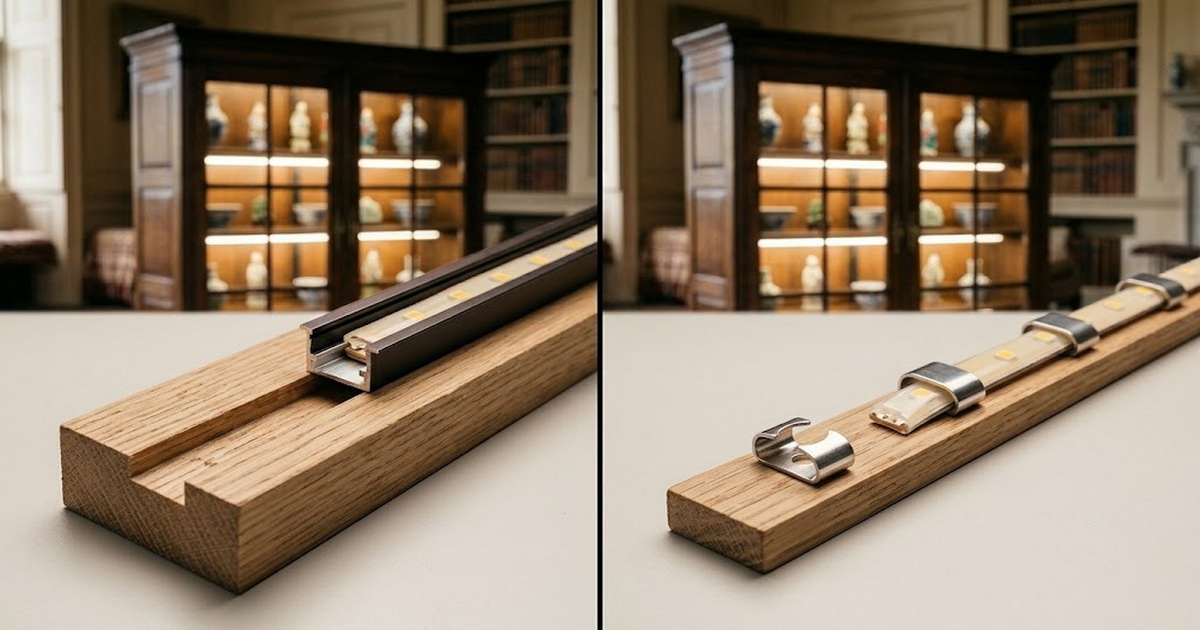
The following table provides a design assessment rather than results from comparative laboratory testing.
| Decision factor | Router-in micro channels | Metal U-clips |
|---|---|---|
| Original material | Routing removes timber wherever the groove is cut | Attachment may require holes or create contact marks |
| Visual integration | Can conceal much of the lighting body | Hardware may remain visible unless carefully positioned |
| Removal | Lighting may lift out, but the groove remains | Lighting and clips may detach, but attachment damage can remain |
| Maintenance | Depends on access to the groove and wiring | Can support accessible component replacement |
| Finish protection | Machining can disturb finishes around the groove | Contact and fastening can affect fragile surfaces |
| Thermal planning | A timber groove is not automatically a suitable thermal solution | Small clips are not automatically a suitable thermal solution |
| Preferred application | New furniture or removable replacement inserts | Removable supports or conservator-approved attachment locations |
| Main preservation concern | Irreversible loss of original material | Mistaking detachable hardware for a damage-free installation |
The most useful distinction is therefore not recessed versus surface-mounted. It is original fabric versus replaceable support.
An antique vitrine is more than its timber structure. Its finish, wear patterns, tool marks, and earlier repairs may contribute to its historical character.
The Canadian Conservation Institute advises that original finishes form part of a furniture piece's historical value and cannot simply be put back once removed. That makes seemingly minor preparation work potentially consequential.
From a lighting-design perspective, I would treat sanding, scraping, drilling, and adhesive application as proposed alterations—not routine installation preparation.
A visually hidden modification can still damage significant material.
Consider two installations:
- A light strip releases cleanly from a routed groove, but the original timber remains cut.
- A metal clip unscrews easily, but its hole remains in the cabinet.
Both lighting assemblies are removable. Neither restores the cabinet automatically to its previous condition.
A stronger preservation proposal asks what remains after removal, whether the finish has changed, and whether future treatment becomes more difficult.
This distinction is especially important when a supplier describes hardware as "non-permanent."
Routing is more defensible when the work happens in a newly made component that can be removed without altering historic material.
Possible examples include:
- A separate lighting rail.
- An independently supported interior frame.
- A removable shelf insert.
- A reproduction cabinet designed for integrated lighting.
These approaches retain the visual benefit of recessed lighting while moving the machining away from the antique.
They still require assessment. An insert must not abrade finishes, obstruct doors, overload shelves, or rely on damaging pressure against fragile joinery.
Solid wood may be appropriate for a newly fabricated support, but the label does not establish conservation suitability.
The relevant questions concern the support's finish, contact surfaces, stability, attachment, and interaction with the cabinet.
Likewise, an extremely narrow groove is still a removal of material. "Micro" describes scale, not preservation performance.
For an authentic vitrine, a discreet routed installation can be the wrong choice precisely because it makes an irreversible intervention easy to overlook.
Metal U-clips become more attractive when attached to a separate carrier rather than directly to original timber.
This arrangement can separate two functions:
1. The carrier provides the approved interface with the display arrangement.
2. The clips retain the lighting and allow future replacement.
It also gives the lighting manufacturer a defined assembly to review before installation.
Existing holes should not automatically be reused. Their condition, historical significance, and ability to support the proposed assembly require examination.
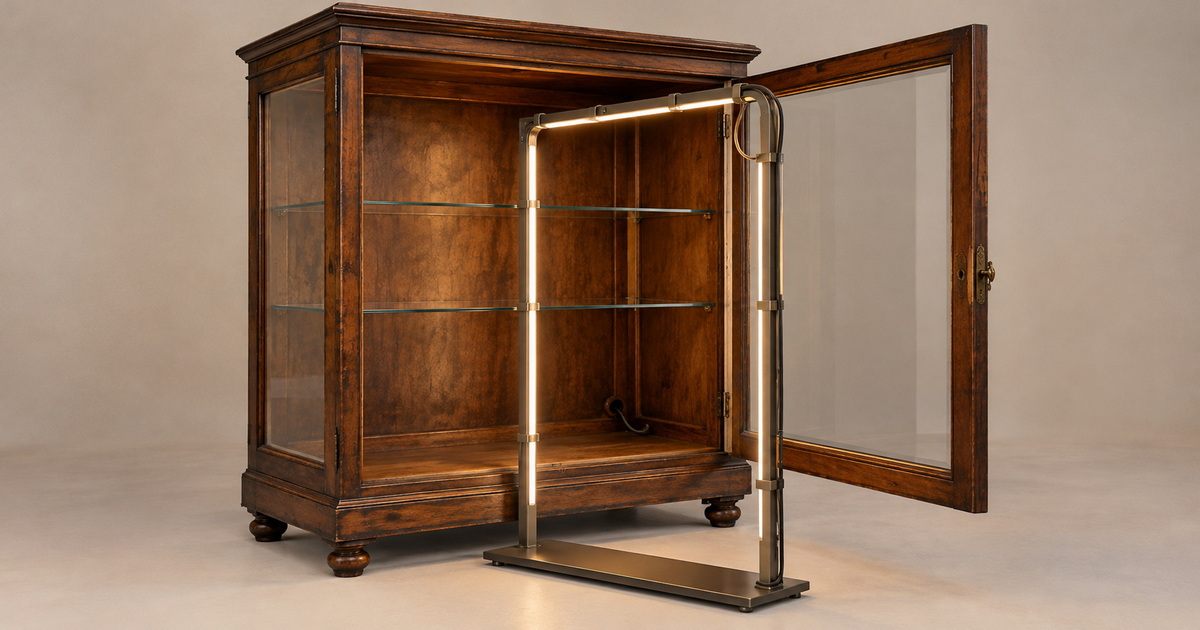
A clip installation should hold the lighting securely without pinching its silicone body or forcing it into an unsuitable bend.
The installer should also consider:
- Whether clip edges can contact vulnerable finishes.
- Whether cables pull against the lighting.
- Whether release requires levering tools near the antique.
- Whether cleaning can occur without disturbing the assembly.
- Whether the light can be replaced without moving displayed objects unnecessarily.
These are practical acceptance checks, not universal guarantees about all U-clips. Compatibility depends on the actual lighting body and retention design.
A concealed light is not necessarily a comfortable light.
Glass can reflect the source toward viewers, while polished objects may produce distracting highlights. Test the arrangement from normal viewing positions before approving the mounting method.
The Canadian Conservation Institute identifies shielding and cutoff as effective ways to reduce glare. In a vitrine, the design implication is to position and screen the source rather than relying only on recess depth.
A removable mock-up can reveal reflections before any permanent work begins.
LED lighting does not eliminate the possibility of fading. Visible light can damage sensitive materials, and exposure depends on both illumination and operating time.
The cabinet and its contents may have different vulnerabilities. Painted surfaces, textiles, documents, and other sensitive objects should influence the lighting plan.
Use controlled operating periods and switch lighting off when viewing is unnecessary. These measures address preservation more directly than choosing clips instead of grooves.
Do not assume a silicone enclosure makes a strip suitable for every enclosed installation.
Similarly, small metal retainers should not be treated as equivalent to a purpose-designed heat-dissipating assembly. Some strip-light installation instructions specifically call for additional aluminum profiles on poorly heat-dissipating surfaces such as wood. That requirement is product-specific, not a universal rule for every silicone light. [m.media-amazon]
Request installation guidance for the proposed assembly and evaluate it under its intended operating conditions.
Before designing the mount, identify original timber, later replacements, fragile finishes, loose veneer, previous repairs, and existing cable openings.
Where significance or condition is uncertain, involve a furniture conservator before proceeding.
Clarify whether the purpose is to illuminate objects, reveal cabinet details, or create ambient decoration.
An installation designed around the objects may need a different position from one intended to outline the cabinet.
Assess external lighting, a separately supported interior frame, or a removable carrier before considering alterations to historic wood.
Routing and direct screw attachment should not become the default merely because they are familiar workshop methods.
Test the proposed strip, carrier, clips, shielding, and cable route away from the antique.
Review reflections, service access, component restraint, and operating behavior before bringing the assembly into contact with the cabinet.
Document the condition before work, the selected materials, attachment locations, cable route, and removal procedure.
Professional conservation guidance calls for examination records, treatment planning, and documentation of alterations. For lighting projects, this creates a useful record for the next owner, installer, or conservator. [culturalheritage]
Consider a cabinet with intact historic rails and a delicate finish.
Routing the rails would sacrifice original material. Screwing clips directly into them would also introduce damage.
The preferred design direction is a separately supported lighting assembly, or external illumination if an internal support cannot be introduced safely.
This is an illustrative decision scenario, not a documented Farwise installation.
Now consider a newly manufactured, antique-style cabinet.
Routing can be planned before finishing, and service access can be incorporated into the construction. Clips may still be preferable where frequent lighting replacement is expected.
Here, the decision centers on appearance, maintenance, and manufacturing practicality rather than preservation of an original artifact.
The same mounting method can therefore be appropriate in one cabinet and inappropriate in another.
Farwise Technology Co., Ltd. describes its background as sixteen years in LED lighting manufacturing, with furniture-lighting products and OEM/ODM customization services.
For an antique-vitrine project, that manufacturing role should complement—not replace—conservation assessment.
A useful enquiry should include:
- Photographs of the cabinet and proposed lighting location.
- Identification of original and replacement components.
- Areas where contact or alteration is prohibited.
- The intended removable support.
- Viewing and glare concerns.
- Cable access and future maintenance expectations.
Ask Farwise to review LED silicone strip light integration around the approved support arrangement, including lighting-body compatibility, retention, cable routing, and customization feasibility.
The right brief is not simply "hide the light." It is "provide maintainable illumination without unnecessary alteration to the antique."
No. Clips fixed into original wood can leave holes or affect finishes. Their preservation advantage depends on where and how they attach. A routed groove in a removable new insert may be preferable to clips screwed into historic timber.
Do not assume so. Follow the selected product's installation guidance and assess the complete assembly. A groove provides a location, but it does not independently establish suitable thermal behavior, cable protection, or service access.
Not automatically. Application and removal may affect fragile finishes or leave residues. For an antique cabinet, avoid treating ordinary mounting tape as a conservation-approved substitute for mechanical fixing.
Only after assessment. Existing holes may be damaged, historically significant, or unsuitable for the proposed attachment. Their presence does not establish permission or structural adequacy for new lighting.
Start with an approach that avoids altering original material: external lighting or a suitably assessed removable support. If neither is feasible, seek conservation advice before choosing direct clips or routing.
Farwise's stated OEM/ODM services provide a basis for discussing a customized lighting arrangement. Submit the approved preservation constraints first, then request confirmation of manufacturing and integration feasibility.
1. Canadian Conservation Institute. "Basic Care—Furniture and Objects Made of Wood." Guidance on original finishes, handling, and preventive care. [canada]
2. American Institute for Conservation. "Code of Ethics and Guidelines for Practice." Principles covering examination, treatment planning, documentation, and protection of cultural property. [culturalheritage]
3. Canadian Conservation Institute. "LED Lighting in Museums and Art Galleries." Technical guidance on LED selection, light damage, and glare control. [canada]
4. Canadian Conservation Institute. "Light, Ultraviolet and Infrared." Guidance on exposure management and preventive lighting measures. [canada]
5. Canadian Conservation Institute. "Care of Furniture Finishes." Guidance on vulnerable finishes and limiting damaging exposure. [canada]
6. Dephen. "LED Strip/Tape." Product-specific installation instructions illustrating the need to verify mounting and heat-dissipation requirements. Not evidence of Farwise product performance. [m.media-amazon]
7. Company background: Farwise Technology Co., Ltd., supplied in the commissioning brief. No independent product testing or completed conservation project is claimed in this article.


