
Views: 222 Author: Farwise Lighting Publish Time: 2026-10-18 Origin: Site


Content Menu
● Start With the Purpose of Your LED Shelf Lighting
● Where to Place LED Strip Lights on Shelves
>> Under the Front Edge for Object Visibility
>> Near the Back for a Decorative Glow
>> Along the Sides for Tall Compartments
● Choosing LED Silicone Strip Lights for Furniture
>> Check the Complete Assembly
>> Respect the Intended Bending Direction
>> Compare Enclosed Strips With Profile-Based Lighting
● Choose Light Appearance With Real Materials
>> Separate Light Appearance From Color Rendering
>> Check Glare and Reflections
● Plan Power, Controls, and Maintenance Before Installation
>> Choose Controls Around Daily Use
>> Keep Serviceable Components Accessible
● How to Install LED Strip Lights on Shelves
>> Step 1: Map the Complete Layout
>> Step 2: Test the System Before Mounting
>> Step 3: Prepare the Mounting Surface
>> Step 4: Cut and Connect Correctly
>> Step 5: Secure the Strip and Cables
>> Step 6: Inspect the Finished Installation
● A Better Method: Approve a Real Furniture Mock-Up
● Troubleshooting Common LED Shelf Lighting Problems
● Planning Custom Shelf Lighting With Farwise
>> 1.Can I install LED strip lights on existing shelves?
>> 2.What is the best position for LED bookshelf lighting?
>> 3.Are LED silicone strip lights automatically waterproof?
>> 4.Do LED strips need an aluminum channel?
>> 5.Can shelf lighting work with motion sensors?
>> 6.Why does my shelf lighting look different from the sample photograph?
Learning how to light shelves with LED strips starts with a simple design decision: what should the light help people see? Bookshelves, kitchen shelves, wardrobe compartments, and retail displays need different approaches. A strip that creates an attractive background glow may not illuminate the objects in front of it.
My recommended starting point is to design around the furniture, not around the lighting reel. Consider shelf depth, viewing angles, surface finishes, cable routes, and maintenance access before choosing components.

Shelf lighting usually serves one of three purposes:
- Task lighting helps people identify clothing, read labels, or find stored items.
- Accent lighting draws attention to books, decorative objects, or merchandise.
- Ambient lighting adds a softer layer of illumination to the room.
These functions can overlap, but the priority should be clear.
For example, a wardrobe shelf needs useful visibility across its contents. A floating shelf above a sofa may primarily need a discreet glow. A commercial display needs lighting that presents products consistently without distracting reflections.
Write a short brief describing the intended result. "Make labels readable without visible light points" is more useful than "make the shelf brighter."
Position affects both appearance and usefulness. Test placement with the actual shelf and its contents before making permanent changes.
Mounting the light beneath the shelf, toward its front edge, can illuminate the faces of objects below.
This arrangement is worth testing for bookshelves, wardrobe compartments, and display cabinets. A concealing lip or suitable angled profile can help keep the light source outside normal sightlines.
Avoid placing the strip where seated users can look directly into it.
Rear placement emphasizes the backing panel and creates a layered appearance.
It can work well for floating shelves and decorative niches. However, tall objects may block the light, leaving their fronts relatively dark.
Choose this arrangement when the background effect matters more than detailed visibility.
Vertical lighting can help illuminate tall cabinet compartments where horizontal shelves would otherwise interrupt the light.
Check how adjustable shelves, hinges, and stored items affect the light path. Keep the strip protected from objects being inserted or removed.
| Shelf application | Placement to test | Main concern |
|---|---|---|
| Bookshelf | Concealed beneath the shelf front | Readable spines without glare |
| Decorative floating shelf | Rear-facing concealed position | Background glow and visible shadows |
| Wardrobe compartment | Front underside or protected side | Clothing blocking the light |
| Glass display cabinet | Shielded front or side position | Reflections from normal viewing angles |
| Kitchen shelf | Underside directed toward the working area | Shadows and countertop reflections |
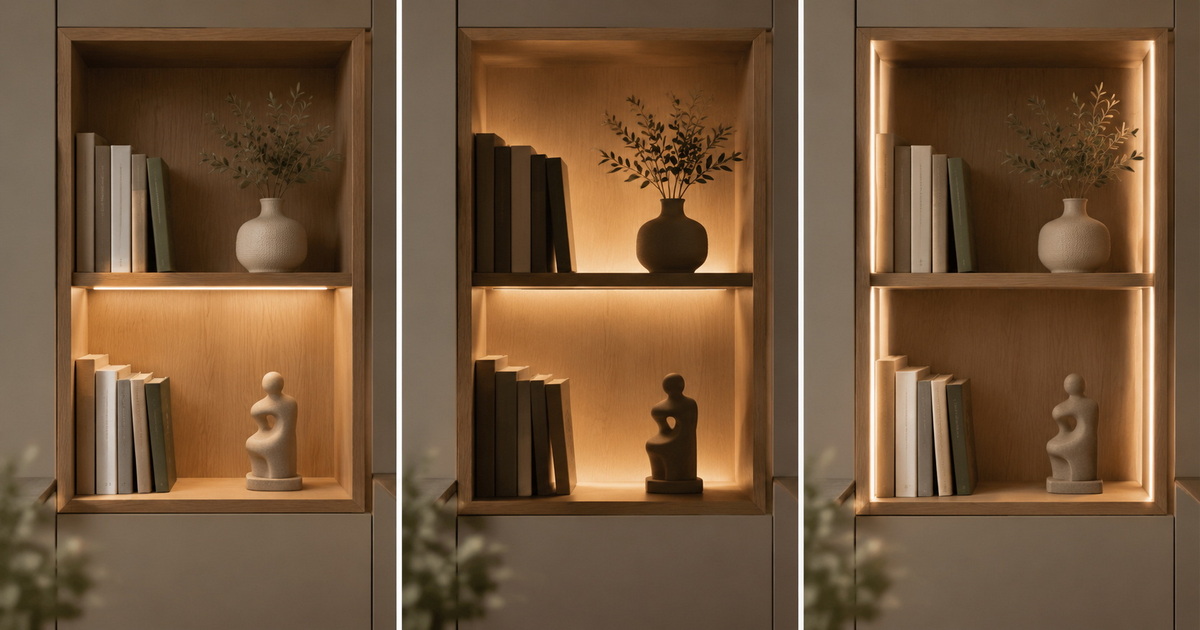
LED silicone strip lights can suit furniture projects where a flexible, enclosed lighting format is useful. However, silicone construction alone does not establish suitability for every installation.
An enclosed strip, its cut ends, connectors, cable entries, and power supply must all suit the installation environment.
A protected strip connected to an unsuitable exposed joint does not create a moisture-resistant system. For bathroom shelves, identify the expected exposure and have the installer confirm applicable local requirements.
Avoid treating every bathroom location as equivalent.
Flexible does not mean foldable in every direction.
Some silicone lighting products bend sideways; others bend vertically. Follow the manufacturer's instructions and avoid twisting, creasing, or forcing corners.
Where the furniture changes direction sharply, an approved connector or separate lighting section may be more appropriate.
A silicone-enclosed strip and an LED tape installed inside an aluminum profile are different construction approaches.
Compare them against the furniture design, mounting method, desired appearance, and service requirements. Confirm any thermal-management requirements with the supplier.
Neither approach automatically guarantees invisible light points. The complete optical arrangement needs testing.
Selecting the appearance of LED shelf lighting involves more than choosing between warm and cool white.
Warm-looking light may complement timber and a relaxed interior. A more neutral appearance may suit a display where the priority is a balanced presentation of varied materials.
These are starting points, not fixed rules.
Two lighting products can look similarly white while rendering fabrics, packaging, or finishes differently.
Compare samples using objects that matter to the project:
- Timber and laminate finishes.
- Clothing and upholstery fabrics.
- Printed packaging and labels.
- Painted panels and decorative objects.
Do not choose shelf lighting from an empty cabinet alone.
Glossy stone, mirrors, polished fittings, and glass can reveal light points that remain hidden on matte surfaces.
A diffuser may soften the appearance, but its result depends on the strip, profile, and viewing distance.
Inspect the shelf while standing, sitting, and approaching from the side. These viewpoints often reveal problems that a straight-on photograph misses.
Treat the strip, driver, controller, sensor, and wiring as one coordinated system.
The power supply must match the strip's electrical requirements and support the connected load. Ask the supplier or qualified installer to verify component compatibility and cable layout.
Do not connect a low-voltage strip directly to a household electrical outlet.
Different furniture applications benefit from different controls:
- A door-operated switch can suit enclosed wardrobe compartments.
- A motion sensor can support hands-free access.
- A manual switch offers straightforward operation.
- A compatible dimming system allows adjustment for different activities.
Confirm what triggers the sensor and what switches the light off. Door operation, motion detection, and presence detection are not interchangeable functions.
Hide equipment without making it unreachable.
Allow access to the driver, controller, and connections. Follow required ventilation and clearance instructions rather than enclosing components tightly inside furniture.
For adjustable shelves, plan how cables move and disconnect. Repositioning a shelf should not strain its wiring.
A compatible plug-in kit may be suitable for straightforward installation. Fixed wiring, unfamiliar electrical work, and moisture-exposed installations should be handled by a qualified professional where required.
Mark strip positions, cable routes, connection points, control locations, and driver access.
Check that drilling or routing will not damage concealed wiring or weaken the furniture. Confirm the approved layout before modifying finished panels.
Connect the intended components according to their instructions and check operation before permanent installation.
Test switching, sensing, and dimming where included. Do not operate the strip while tightly coiled if the manufacturer prohibits it.
Disconnect power before cutting, connecting, or adjusting components.
The surface should be clean, dry, stable, and suitable for the selected attachment method.
Follow adhesive preparation and curing instructions. On surfaces where adhesive attachment is unsuitable, use an approved mechanical mounting method.
Cut only at designated locations and only when the product permits cutting.
Use compatible connectors or the manufacturer's approved termination method. Ordinary household transparent tape is not a substitute for a properly designed electrical connection.
Where sealing is required, follow the instructions for the complete termination assembly.
Fit profiles, clips, or mounting channels as specified.
Keep cables away from sharp edges, moving hinges, drawer runners, and pinch points. Provide appropriate support so connections do not carry cable tension.
Do not force a strip into a groove that compresses its enclosure.
Check light distribution, reflections, mounting security, and control response.
Repeat the inspection after placing normal contents on the shelves. A well-lit empty compartment may perform differently when filled.
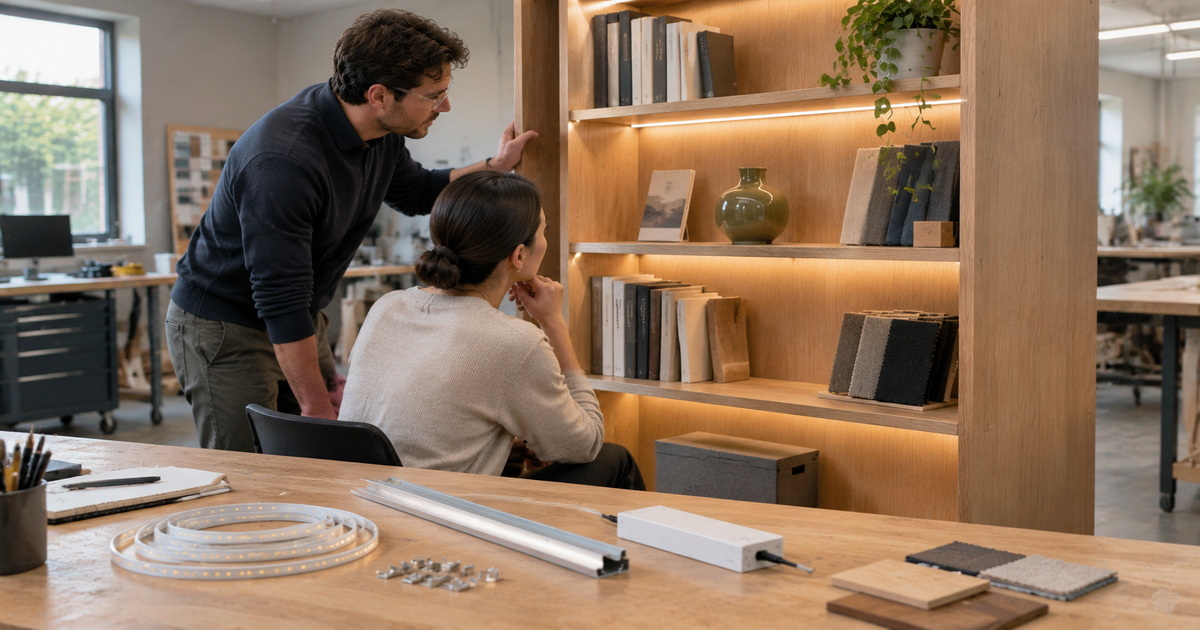
For furniture manufacturers and fit-out contractors, validation should happen before production, not after delivery.
Build a representative sample using the intended shelf finish, mounting arrangement, lighting components, and typical contents.
Review it from actual user positions and ask:
1. Are the important objects clearly visible?
2. Can users see distracting light points?
3. Do glass or polished surfaces create reflections?
4. Does stored material block the light?
5. Can the lighting be serviced without damaging the furniture?
Test the full dimming range and the intended sensor behavior.
Record the approved arrangement with drawings and photographs. This turns a subjective preference into a repeatable production reference.
This is a recommended project workflow, not a claim about a completed customer installation.
| Problem | Possible cause | What to check |
|---|---|---|
| Objects look dark despite a bright background | Placement emphasizes the backing panel | Test a more forward or angled position |
| Light points appear in glass | Direct reflections or inadequate shielding | Review sightlines and the optical arrangement |
| One section appears dimmer | Connection, cable, or supply-layout issue | Have the complete circuit checked |
| Strip detaches from the shelf | Surface or attachment incompatibility | Review preparation and approved mounting |
| Lighting flickers when dimmed | Incompatible components or connection issues | Test the exact strip, driver, and dimmer combination |
| Sensor operation feels unpredictable | Sensor type or location does not match use | Review detection behavior in the installed furniture |
Disconnect power before inspecting connections. Stop using equipment that shows damage, unusual odor, or abnormal heating and seek qualified assistance.
Farwise Technology Co., Ltd. is a source manufacturer with 16 years of experience in LED lighting, according to the company information supplied for this article.
Its furniture-lighting range includes LED silicone strip lights and solutions for cabinets, wardrobes, bathroom cabinets, and bedroom furniture. Farwise supports OEM/ODM development covering dimensions, functions, system arrangements, and appearance.
For a productive project discussion, prepare:
- Furniture drawings and installation locations.
- Surface finishes and typical shelf contents.
- Desired lighting effects and control behavior.
- Cable-routing and maintenance-access requirements.
- Destination-market documentation requirements.
- Prototype approval and production-inspection expectations.
Ask for project-specific evidence rather than assuming every configuration carries the same approvals.
Contact Farwise with your drawings and application brief to discuss a coordinated shelf-lighting solution before finalizing furniture construction.
Yes, suitable retrofit systems can be added to existing furniture. First confirm mounting compatibility, cable routing, power access, and visibility of the light source. Avoid modifying structural components without checking the furniture design.
A concealed position beneath the shelf front is a useful starting point for illuminating book spines. Test it with books in place, because shelf depth and viewing angles affect the result.
No. Suitability depends on the specific product and the completed installation, including ends, joints, and cable entries. Confirm the intended environmental exposure with the supplier.
Not universally. Some systems require or recommend a particular mounting arrangement for thermal management or mechanical support. Others use a different approved construction. Follow the instructions for the selected product.
Yes, when the sensor, driver, controller, and lighting are compatible. Choose the detection method around the furniture's use and test it with doors, nearby movement, and stored contents.
Photographs may use different exposure, surroundings, shelf finishes, or mounting positions. Judge the result with an actual sample in representative furniture rather than relying on an image alone.
1. LEDYi Lighting — "How to Light Shelves With LED Strips?" By Martin Wan; updated January 6, 2024. Original article reviewed for topic coverage, installation guidance, and areas requiring clarification. [ledyilighting]
2. U.S. Department of Energy / Building America — "Strategy Guideline: High Performance Residential Lighting." Technical background on layered residential lighting, under-cabinet task illumination, color quality, and dimming compatibility. [www1.eere.energy]
3. U.S. Department of Energy / Better Buildings Solution Center — LED lighting upgrade fact sheet. Supports evaluating distribution, glare, color appearance, and the exact LED-driver-dimmer combination through sample testing; its primary application is troffer lighting, not shelf-specific installation. [betterbuildingssolutioncenter.energy]
4. Häfele — "The LED Lighting System for Furniture and Rooms." Furniture-system planning guidance covering lighting purpose, concealed cable routing, driver selection, and component compatibility. [hafele]
5. Häfele — "Loox LED Lighting Illuminates Furniture, Cabinetry & More." Industry examples of integrated furniture lighting, profiles, drivers, and switching options. [hafele]
6. Flexfire LEDs — "LED Strip Light Installation Guide." Practical installation guidance on disconnecting power, preparing mounting surfaces, matching power supplies, and sealing applicable terminations. Instructions remain product-specific. [flexfireleds]
7. Häfele — "Aluminum Profile, Häfele Lighting Profile 1190." A product-specific example demonstrating that using a profile and diffuser does not automatically eliminate visible light points. [hafele]
8. Farwise Technology Co., Ltd. — Company information supplied in the project brief. Source for the stated manufacturing experience, product scope, applications, and OEM/ODM services. No public company source or customer-review material was supplied for independent verification.


