


Tel / WhatsApp
+86-13790241903

Views: 202 Author: Farwise Lighting Publish Time: 2026-07-18 Origin: Site


Content Menu
● Understanding Flush-Fit Quartzite Countertop Illumination
● What Is a Flanged Recessed Aluminum Profile?
● What Is a Flangeless Recessed Aluminum Profile?
● Visual Impact on Quartzite Countertops
● Light Quality, Glare Control and Shadow Management
● Installation Practicalities for Cabinetmakers and Furniture Factories
● Durability, Thermal Management and Safety
● Design Scenarios Where Flanged Profiles Excel
● Design Scenarios Where Flangeless Profiles Shine
● Choosing Between Flanged and Flangeless Profiles: A Practical Checklist
>> 1. Define the Primary Lighting Role
>> 2. Assess the Design Language of Cabinets and Countertops
>> 3. Confirm Fabrication Capabilities and Tolerances
>> 4. Plan for Maintenance and Lifecycle
>> 5. Align with Safety and Control Strategies
● Flanged vs. Flangeless: Side-by-Side Comparison
● Industry Insights from Cabinet Lighting Projects
● Conclusion: Making Confident Profile Choices for Quartzite Projects
● FAQs
>> 1. Are flangeless recessed profiles suitable for every quartzite kitchen?
>> 2. Do flanged profiles always look more industrial than flangeless options?
>> 3. Can the same LED cabinet strip be used in both profile types?
>> 4. How important is routing accuracy for flangeless recessed installations?
>> 5. Does the profile choice influence overall maintenance complexity?
Choosing between flanged and flangeless recessed aluminum profiles is one of the most impactful design decisions when planning flush-fit illumination for quartzite countertops and high-end cabinet lighting. For manufacturers and project teams, the profile geometry affects not only the visual language of the kitchen or furniture system, but also installation complexity, durability, and long-term lighting performance. This article approaches the topic from a practical project perspective, blending hands-on experience with industry insight to help you navigate both options with confidence.
Quartzite countertops are prized for their hardness, rich veining and natural color depth. When light grazes or washes across these surfaces, every choice in the lighting system becomes visible: color temperature, uniformity, glare, and the way the light source is integrated into the cabinetry. Recessed aluminum profiles are a critical interface between LED cabinet lights and the furniture structure. They host the LED strip, control diffusion through a dedicated cover, and protect the electronics from mechanical impact and everyday use.
In a flush-fit configuration, the profile sits within the cabinet or furniture substrate so that the diffuser surface is level with the surrounding material. This allows the countertop and cabinet planes to remain visually uninterrupted while still delivering bright, usable light into task or accent areas. For quartzite applications, flush-fit lighting is particularly valuable near prep zones, around the perimeter of islands, and in display cabinets where the stone surface becomes part of the visual story.
A flanged recessed profile features a projecting lip, or flange, around the visible opening. Once the installer routes a groove or cavity in the cabinet panel, the profile drops into place and the flange overlays the edges of the cut-out. This simple detail has several important consequences. First, the flange hides small routing imperfections, chips and tolerance variations. Second, it visually frames the light aperture, creating a defined border between the illuminated zone and the surrounding material. Third, it provides extra bearing surface, helping the profile sit firmly against the panel and improving mechanical stability.
In practice, flanged recessed profiles are widely used in under-cabinet lighting, furniture compartments, wardrobe systems and bathroom cabinets. They handle everyday bumps, cleaning, and minor panel movement without exposing bare edges. From a design standpoint, the flange reads as a subtle trim that can support more technical or industrial interior styles. It can also be matched to handle finishes or other hardware elements, creating a coherent detailing language across the entire cabinet program.
A flangeless recessed profile eliminates the trim lip entirely. The outer walls of the profile align with the walls of the routed groove, and the diffuser surface sits level with the panel face. Viewed from normal standing height, the light appears as a pure slit or band, almost as if it were carved into the material itself. This creates a highly integrated, minimal aesthetic where visible hardware is reduced to an absolute minimum.
Flangeless recessed profiles are popular in handleless kitchens, contemporary wardrobes, and premium furniture where continuous surfaces and crisp shadow lines are part of the design intent. Because there is no flange to disguise rout defects, fabrication tolerances need to be tight. Panel thickness, routing depth, groove width and straightness all matter. When these conditions are met, flangeless profiles deliver a seamless look that keeps the visual focus on materials such as quartzite, timber veneers, lacquer and glass.
When lighting is integrated into cabinets surrounding quartzite countertops, the difference between flanged and flangeless profiles is immediately noticeable. A flanged profile introduces a defined border that helps separate the light aperture from the complexity of the stone. This border can improve visual comfort by framing bright task lighting against strong veining, making it easier for the eye to distinguish working zones from background texture.
Flangeless profiles, by contrast, emphasize material continuity. The light seems to emerge from the furniture plane without any visual interruption. In a kitchen with a bold quartzite island and minimal cabinet detailing, this can be extremely powerful. The lighting supports the architecture without drawing too much attention to its mechanical components. For low-level ambient or decorative lighting, the flangeless option often feels more subtle and refined, especially in evening use when the room is lit predominantly by cabinet and under-counter sources.

Light quality over quartzite surfaces depends on uniformity, glare management and shadow behavior. Recessed aluminum profiles create a controlled optical chamber where the LED strip, diffuser and surrounding structure interact. Properly sized cavities and high-quality diffusers help convert point-source LED light into smooth, continuous illumination bands. This is important for quartzite, where inconsistent lighting can exaggerate veins or create uneven patches across the stone.
Flanged profiles are often designed with slightly deeper recesses. This extra depth can provide better shielding from direct view, which is useful for bright task lighting under wall cabinets or along tall panels. Flangeless profiles, particularly ultra-slim variants, may position the LED closer to the surface plane. In such designs, the choice of diffuser (frosted vs. clear) and the spacing of LED chips becomes critical. Well-specified systems will balance output and shielding so that users experience comfortable brightness without harsh spots or distracting reflections on polished quartzite.
The profile decision also has strong implications for fabrication and installation. Flanged profiles are more forgiving. Routing can tolerate small variations in width and edge quality, and the flange will still cover the interface cleanly. This is particularly appealing in factories working with a variety of board materials, thicknesses and panel sizes, as well as in projects that combine standard elements with some bespoke components.
Flangeless profiles demand more precision. Panels typically need CNC routing, and the groove dimensions must closely match the profile. Any misalignment or chipping will remain visible after installation. For manufacturers, this means a defined workflow: stable substrates, accurate machinery, calibrated tools and clear quality control checkpoints. Planning these steps in advance—especially for international projects with multiple production sites—helps ensure that the finished furniture delivers the intended seamless effect.
Long-term durability for cabinet lighting depends on mechanical robustness and thermal behavior. Aluminum profiles act as compact heat sinks for LED strips. By transferring heat away from the LEDs, they help maintain stable output and reduce the risk of premature failure. Deeper, heavier profiles often provide more thermal mass. Many flanged designs fall into this category, offering comfortable headroom for higher-output runs along busy quartzite work surfaces.
Flangeless profiles can be slimmer and lighter, but with careful pairing of LED power density, operating hours and ambient conditions, they can still deliver reliable performance. Regardless of profile type, low-voltage systems are typically preferred inside cabinets and near countertops. They improve safety, simplify wiring, and allow integration with accessories such as motion sensors, hand-wave controls and dimmers. Good design practice will also consider cable routing, connector placement and strain relief inside the furniture to prevent mechanical stress on wiring harnesses.
Certain applications consistently benefit from flanged recessed aluminum profiles. Busy family kitchens often require lighting that can withstand heavy use, frequent cleaning and occasional impacts from pots, trays or small appliances. In these contexts, the extra mechanical support and trim coverage of flanged profiles add practical value. The trim makes it easier to keep edges neat even after minor panel movements or adjustments over time.
Commercial and hospitality projects also tend to favor flanged profiles in working zones. Food prep areas, bar counters and service stations demand bright, stable lighting that remains visually composed under intense use. The framed aperture of flanged designs supports this more technical aesthetic, aligning well with engineered quartzite and durable cabinet finishes. When project teams are dealing with mixed material thicknesses or multiple suppliers, the forgiving nature of flanged trims reduces integration risk.
Flangeless recessed profiles come into their own in premium, design-led environments. Handleless kitchens that rely on continuous grooves and shadow lines are an obvious example. Here, any visible trim would interrupt the linear composition and undermine the intended minimalism. A flush, trimless light slot instead reinforces the same language of clean cuts and integrated functions.
Display cabinets, wardrobes and bathroom furniture also provide ideal use cases. In these spaces, lighting is often more about atmosphere and presentation than pure task performance. Flangeless profiles allow the light to feel embedded in the material, supporting an impression of precision and luxury. When paired with quartzite countertops or quartzite-clad furniture, the combined effect can be striking: the stone remains the visual hero, while the light provides a quiet but sophisticated supporting role.
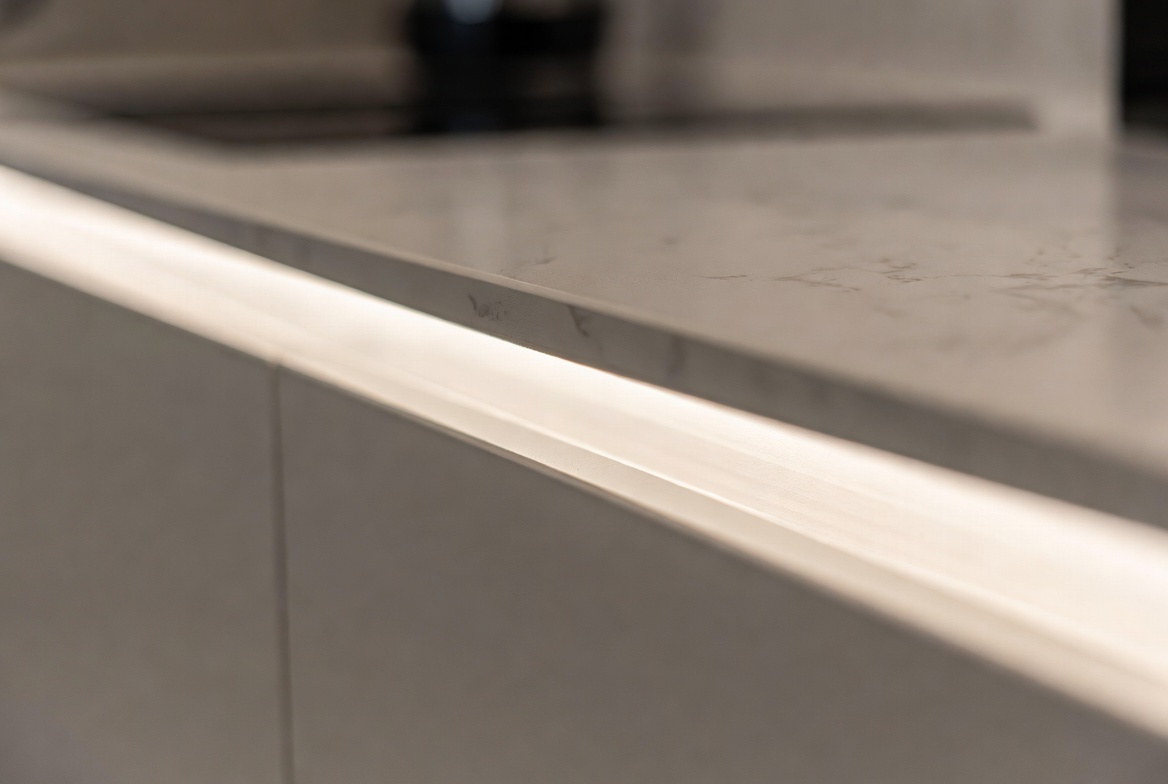
Project teams can simplify the decision by working through a structured checklist that focuses on functional and aesthetic priorities. This process avoids purely decorative judgments and keeps the choice grounded in how the kitchen or furniture system will be used over time.
Start by clarifying whether the profiles are mainly for task lighting over quartzite work surfaces or for low-level ambient and decorative effects. Higher-output task runs often benefit from flanged profiles because the additional recess can help control glare and perceived brightness. Softer ambient applications may reward the minimal appearance of flangeless designs.
Consider how the cabinet system is styled. If strong, visible frame lines and hardware are part of the look, flanged profiles integrate naturally. If the aesthetic favors continuous, unbroken planes with concealed mechanisms, flangeless profiles are more aligned. Quartzite with pronounced veining may pair well with the framing effect of flanged trims in some interiors, while subtle or light-toned quartzite might benefit from the quiet simplicity of trimless apertures.
Evaluate the production environment. Factories with advanced CNC capabilities and a culture of tight dimensional control are well positioned to deliver seamless flangeless installations. Workshops or supply chains with more variability may see better consistency and fewer on-site adjustments when flanged profiles are used. This consideration becomes critical when projects involve cross-border manufacturing, multiple subcontractors or complex material mixes.
Think about how the lighting system will be serviced over its life. Inspecting and replacing LED strips, diffusers or drivers is easier when profiles are accessible and installation details are forgiving. Flanged designs can provide smoother access and help keep exposed edges tidy after interventions. Flangeless installations can still be maintainable, but they rely on careful design of fasteners, clips and access points.
Finally, align profile choices with the broader electrical and control strategy. Low-voltage systems with organized cable routing are safer and simpler to integrate into cabinet carcasses near heavy quartzite slabs. Recessed profiles, whether flanged or flangeless, should support safe cable paths, appropriate strain relief and clear separation from hot appliances. Thoughtful integration of sensors, dimming, and switching will further enhance user comfort and extend system lifetime.
| Aspect | Flanged recessed profile | Flangeless recessed profile |
|---|---|---|
| Visible hardware | Framed aperture with a trim lip that outlines the light slot. | Trimless, flush diffuser with minimal visible hardware. |
| Installation tolerance | More forgiving routing; flange hides small edge defects. | Requires precise routing and tight dimensional control. |
| Glare management | Typically offers deeper recess; better shielding for bright task runs. | Relies heavily on diffuser design and LED spacing to control glare. |
| Design character | Technical and framed, suited to robust kitchens and furniture systems. | Minimal and integrated, suited to handleless and premium programs. |
| Thermal behavior | Often more mass and surface contact for comfortable heat distribution. | Slimmer, but can perform well at appropriate power levels. |
| Best use cases | Family kitchens, commercial prep zones, engineered-board furniture. | Display cabinets, wardrobes, monolithic quartzite islands. |
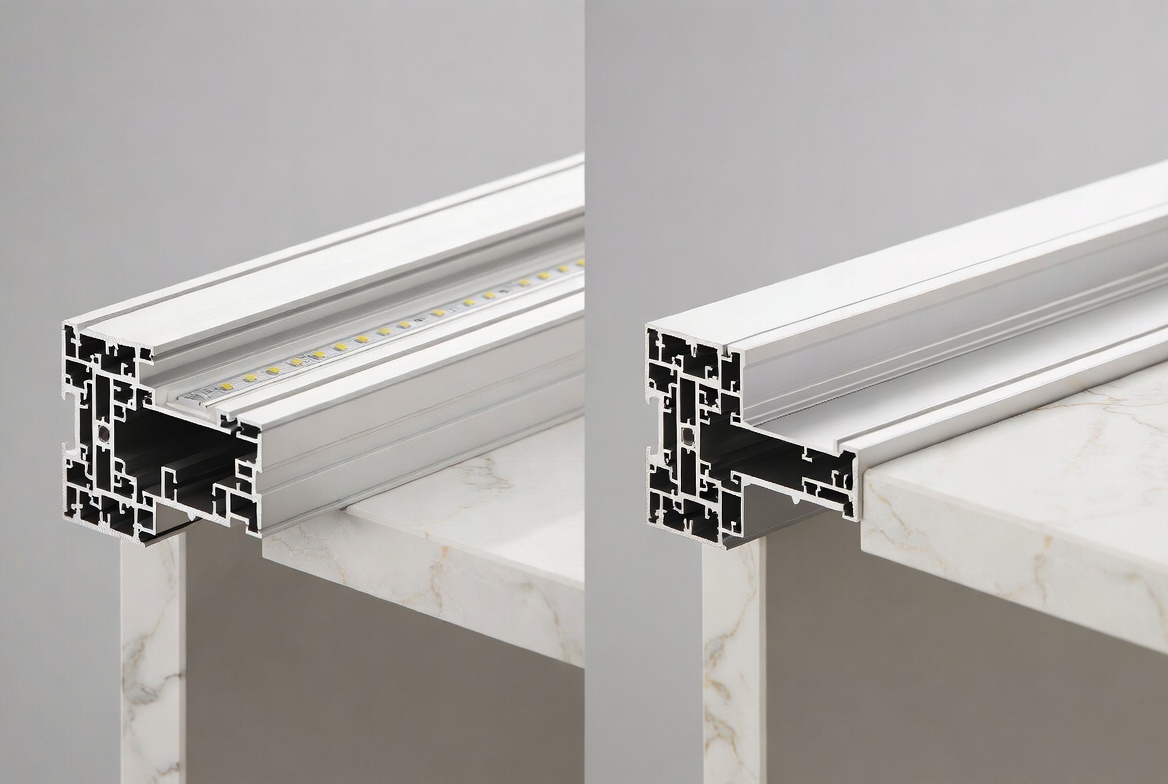
In recent years, many furniture and cabinet lighting manufacturers have expanded their profile ranges to include both flanged and flangeless recessed options. Flexible product platforms allow the same underlying LED engines and drivers to be used with different trim geometries. This modular approach simplifies inventory and engineering, while giving designers the freedom to tailor the visible interface to each project.
Project teams working on international kitchens, wardrobes and bathroom programs increasingly request customization in length, color temperature, lumen output and mounting accessories. Within these tailored systems, the profile family often becomes a key differentiator. For example, a single under-cabinet lighting engine might be paired with a flanged profile in a practical, mid-market kitchen collection and with a flangeless profile in a flagship, high-end line. This strategy supports brand coherence while respecting different user expectations and budget levels.
Flanged and flangeless recessed aluminum profiles each bring distinct strengths to quartzite countertop illumination and cabinet lighting. Flanged designs emphasize framed apertures, forgiving installation and robust mechanical support, making them a solid choice for busy kitchens and demanding commercial environments. Flangeless versions prioritize seamless integration and visual subtlety, aligning with modern, premium interiors that celebrate continuous surfaces and carefully curated materials.
By examining functional needs, design language, fabrication capabilities, maintenance plans and safety strategies, project teams can make profile decisions that stand up to everyday use while maintaining a refined aesthetic. When lighting feels natural, reliable and comfortably balanced against the character of quartzite countertops, the entire furniture system gains a sense of quiet confidence and long-term value.
Flangeless profiles can work in many quartzite kitchens, but they are most successful where cabinet fabrication tolerances are high and the design intent prioritizes seamless surfaces and minimal hardware.
Flanged profiles do have a more defined frame line, but their character depends heavily on finish, proportion and surrounding materials. With careful detailing, they can support both technical and refined interiors.
Many systems are designed so that one LED strip family can be paired with multiple profiles. Adjustments in diffuser type, output and control settings help tune the visual effect to each profile geometry.
Routing accuracy is critical for flangeless designs. Groove width, straightness and edge quality directly affect visual results, because there is no trim lip to conceal defects or misalignment.
Profile choice can influence maintenance. Flanged designs tend to mask minor edge changes after servicing and may simplify access, while flangeless designs reward precise assembly and clearly planned access paths.
1. AspectLED – Under Cabinet LED Lightinghttps://www.aspectled.com/collections/under-cabinet-led-lighting
2. Visual Comfort – Recessed Lighting Guidehttps://www.visualcomfort.com/inspiration/tips/recessed-lighting-guide/
3. Houzz – Backlight Translucent Quartzite Counters Discussionhttps://www.houzz.com/discussions/5774532/best-led-for-backlight-translucent-counters-quartzite
4. Star LED Profile – LED Profile Buying Guidehttps://www.starledprofile.com/which-led-profile-is-best/
5. LiBO Lighting – Professional LED Cabinet Lighting Manufacturerhttp://www.libo-lighting.com/news/professional-led-cabinet-lighting-manufacturer
6. Weihui Cabinet LED. "LED Cabinet Lighting Solutions Provider – OEM Design."https://www.wh-cabinetled.com/handleless-wardrobe-led-profile-light-wardrobe-cabinet-lighting/
7. Boray Light. "China Top Custom Kitchen Cabinet Lights Manufacturers."https://www.boraylight.com/catalog/top-10-kitchen-cabinet-lights-manufacturer-exporters/
8. SMOG Lights Technology. "LED Cabinet Lights Manufacturer & Factory."https://www.smoglights.com/led-cabinet-lights-manufacturer-factory/
9. SMALUX. "LED Cabinet Light Manufacturer and Supplier in China."https://www.smalux.com/led-cabinet-lights/
10. Lightology. "How to Light a Kitchen."https://www.lightology.com/index.php?module=how_to&sub=kitchen-lighting