
Views: 220 Author: Farwise Lighting Publish Time: 2026-08-27 Origin: Site


Content Menu
● What Does LED Neon Strip Yellowing Mean?
>> UV Exposure and Photo-Oxidation
>> Heat Build-Up and Thermal Aging
>> Material Quality and Formulation
>> Chemical Contact and Cleaning Damage
>> Moisture, Contamination, and Surface Deposits
● Why Yellowing Changes Light Quality
● How to Prevent LED Neon Strip Yellowing
>> Choose Material for the Environment
>> Design for Heat Dissipation
>> Use Compatible Cleaning Methods
● Inspection Checklist for Buyers
● When Should You Replace a Yellowed Strip?
● Work With a Custom Lighting Partner
● FAQ
>> 1. Is yellowing normal for LED neon strip lights?
>> 2. Do silicone LED neon strips turn yellow?
>> 3. Why is my LED neon strip yellow only in certain areas?
>> 4. Can I clean yellowing off an LED neon strip?
>> 5. Does heat cause LED silicone strip lights to yellow?
>> 6. Is PVC or silicone better for sunlight-exposed LED neon lighting?
>> 7. How can OEM/ODM buyers reduce yellowing complaints?
LED neon strip yellowing is usually caused by material aging, not by the LED chips alone. In most cases, ultraviolet exposure, heat accumulation, oxygen, unsuitable chemicals, and low-grade encapsulation materials gradually change the appearance and light-transmission performance of the neon jacket.
For furniture lighting, cabinet lighting, wardrobe lighting, bathroom vanity lighting, and architectural interiors, yellowing can turn a clean white light effect into a warmer, duller, or uneven-looking installation. Understanding why LED silicone neon strip lights yellow over time helps buyers, designers, installers, and OEM/ODM partners make better material and installation decisions before a project begins.

LED neon strip yellowing is the gradual change of a clear, milky white, or white silicone/PVC outer jacket toward yellow, amber, or brown. The issue can appear across the entire strip, only near heat-intensive areas, or mainly on sections exposed to sunlight.
This discoloration is more than a cosmetic concern. As the diffuser or encapsulation layer yellows, it may reduce light transmission, alter the perceived color temperature, and make white illumination look creamier than intended. In severe cases, yellowing may occur alongside surface hardening, stickiness, cracking, or reduced flexibility.
For example, a white LED neon strip installed under a sunlit display cabinet may initially produce a crisp, neutral lighting effect. After prolonged exposure to daylight and heat, the outer jacket can begin to look yellow. Even if the LEDs still work, the visual quality of the furniture lighting system may no longer match the original design intent.
Direct sunlight is one of the most common causes of LED neon strip yellowing. Ultraviolet radiation can break down polymer chains in the outer jacket. This process is often called photo-oxidation: UV energy initiates chemical reactions, while oxygen in the air accelerates the material's deterioration.
Yellowing is especially visible on:
- Clear or milky-white neon strip jackets
- White cabinet lighting channels near windows
- Retail displays facing storefront glass
- Outdoor or semi-outdoor architectural applications
- Glass-door wardrobes and sunrooms
PVC-based neon products are generally more vulnerable to sunlight-related discoloration than properly formulated silicone neon products. Under UV exposure, PVC can undergo dehydrochlorination, a reaction that creates structures that absorb visible light and make the material appear yellow or brown.
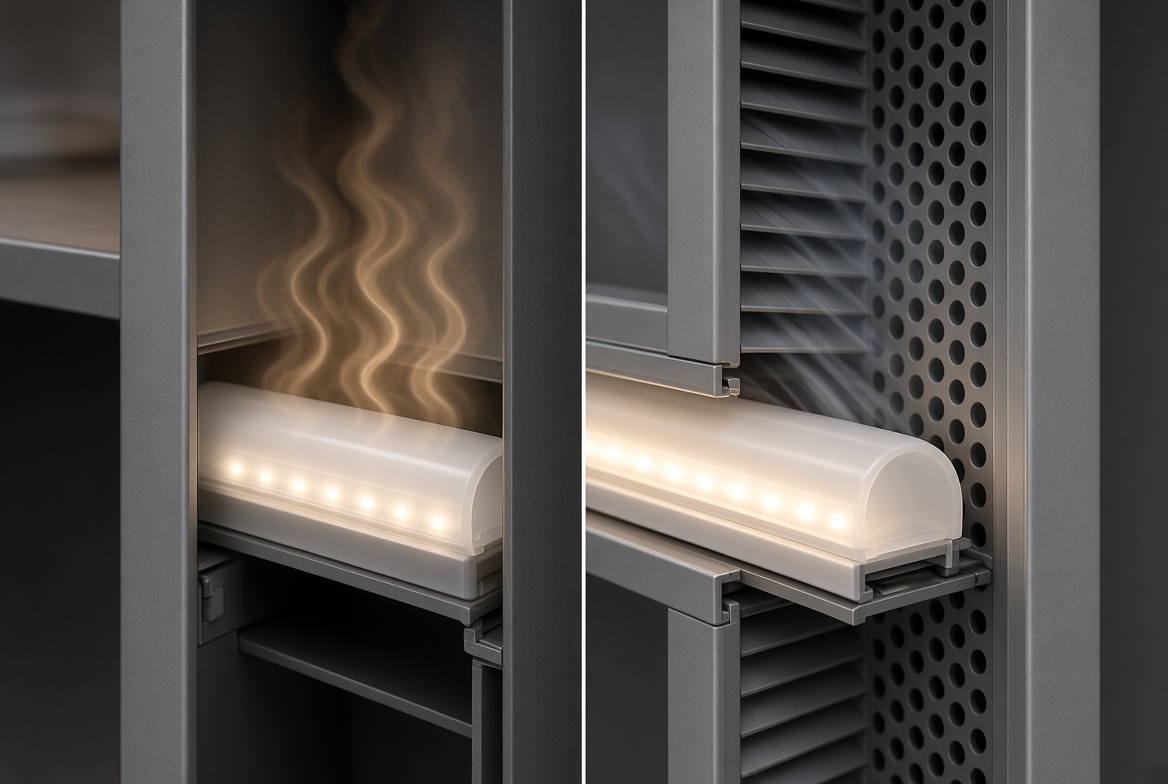
LEDs generate heat during operation. Although LED lighting is energy efficient, poor heat management can still shorten the useful appearance life of an LED neon strip.
When heat cannot dissipate effectively, the encapsulation material may gradually oxidize and discolor. Thermal aging becomes more likely when strips are installed in enclosed spaces, tightly packed grooves, unventilated cabinets, dark-colored channels, or locations near other heat-producing equipment.
Common warning signs include:
- Yellowing concentrated near brighter sections
- Uneven color changes around bends or connection points
- A warmer-looking light output over time
- A jacket that becomes harder, less flexible, or slightly sticky
- Faster discoloration in enclosed furniture cavities
Heat accelerates oxidation and polymer-chain breakdown. This means that even an indoor installation without direct sunlight can develop yellowing if thermal design is overlooked.
Not all LED neon strip lights use the same encapsulation material, curing process, stabilizer package, or production controls. Two products may look similar when new but perform very differently after extended use.
The long-term appearance of an LED silicone neon strip depends on factors such as:
- The base polymer quality
- UV-resistant additives
- Thermal stabilizers
- Curing consistency
- Purity of raw materials
- Compatibility between the outer jacket, adhesive, PCB, and electronic components
- Production process control
A low-cost outer jacket may contain insufficient stabilizers, recycled materials, or incompatible additives. These factors can increase the risk of early discoloration. High-quality formulations are designed to better resist UV exposure, oxidation, and thermal stress, although no polymer material is completely immune to aging under extreme conditions.
For project buyers, the real comparison is not simply "silicone versus PVC." It is well-formulated silicone versus poorly controlled material selection and production.
Silicone and PVC are both used in flexible LED lighting, but they behave differently under light, heat, and environmental exposure.
| Factor | LED Silicone Neon Strip | PVC LED Neon Strip |
|---|---|---|
| UV resistance | Generally stronger when properly formulated | More prone to UV-driven discoloration |
| Heat stability | Better suited to higher-temperature environments | Can degrade faster under sustained heat |
| Flexibility over time | Typically retains softness more effectively | May harden or become brittle as it ages |
| Yellowing risk | Lower in well-made products, but still possible | Often higher, especially under direct sunlight |
| Suitable applications | Furniture, architectural, indoor, outdoor, and custom lighting projects | Primarily controlled indoor applications |
| Long-term appearance | Usually more stable with appropriate material formulation | Can show visible yellowing more quickly in demanding environments |
Silicone is widely selected for demanding LED neon applications because it generally provides better resistance to temperature change, UV exposure, and weathering. PVC can remain a practical material for controlled indoor projects, but it needs careful evaluation when exposed to sunlight, heat, or aggressive environments.
Yellowing is not always caused by time or sunlight. Some cleaning products, solvents, adhesive residues, oils, and household chemicals can react with the neon jacket or damage its protective surface.
Potential risks include:
- Strong alcohol-based cleaners
- Solvent-containing degreasers
- Acidic or alkaline cleaners
- Unverified adhesive tapes
- Plasticizers migrating from nearby materials
- Paint fumes and renovation chemicals
- Oils from repeated handling
A chemical reaction may first appear as dullness, patchy color change, cloudiness, or surface stickiness. Over time, those affected areas can become visibly yellow.
For finished furniture and custom cabinetry, installers should test any cleaning method on a hidden section first. A soft cloth and a manufacturer-approved mild cleaner are usually safer than aggressive chemical products.
Dust alone does not always mean permanent material yellowing. In kitchens, wardrobes, display cabinets, and commercial interiors, airborne grease, smoke, dust, and cleaning residues can build up on the surface of LED neon strips.
This contamination may make the strip look yellow even when the silicone or diffuser material has not degraded internally. Before deciding that a strip has failed, inspect whether the discoloration is removable.
A practical distinction is simple:
- Surface dirt: Often uneven, wipeable, and concentrated near cooking, smoking, or airflow areas
- Material yellowing: Usually remains after careful cleaning and may be accompanied by hardening, haze, or reduced transparency
- Heat-related degradation: Often stronger near LED-dense zones, power connections, or poorly ventilated cavities
- UV-related degradation: Often strongest on window-facing or sun-exposed sections
The outer jacket of an LED neon strip does more than protect internal components. It also diffuses light, reduces visible LED dots, and helps create a continuous neon-like lighting line.
When the jacket yellows, it absorbs and filters part of the blue spectrum in white LED light. The result may be a warmer perceived output, lower brightness, and inconsistent illumination between new and aged sections.
This becomes highly noticeable in applications such as:
- White kitchen cabinet lighting
- Bathroom mirror and vanity lighting
- High-end wardrobe lighting
- Retail shelves and glass displays
- Hotel guestroom joinery
- Interior projects using multiple continuous lighting lines
For design-led projects, appearance consistency is often as important as basic illumination. A strip that still turns on but has visibly yellowed may still require replacement to protect the finished space.
Preventing yellowing begins before purchasing. The material, installation method, electrical design, and cleaning routine all affect long-term results.
First, match the neon strip material to the actual application. Do not select a product based only on initial appearance or price.
For projects near windows, balconies, skylights, storefronts, or outdoor areas, prioritize a high-quality silicone neon strip with UV-resistant formulation. For enclosed cabinet lighting, focus on both material stability and heat management.
Ask a manufacturer about:
- Intended indoor or outdoor use
- UV-resistance approach
- Material type and curing process
- Heat-management recommendations
- Cleaning compatibility
- Customization options for application-specific environments
An experienced OEM/ODM supplier should be able to discuss the intended installation scenario rather than offer one generic product for every project.
Good thermal design protects both the LEDs and the outer jacket. Avoid trapping a high-output LED neon strip in a sealed, narrow cavity without a path for heat to escape.
Use these installation practices:
1. Select a suitable mounting channel or structure.
2. Avoid compressing the strip inside an undersized groove.
3. Keep drivers and power connections away from heat-sensitive enclosed areas.
4. Avoid excessive bending or stretching near heat-generating sections.
5. Confirm that the lighting layout allows practical ventilation.
6. Use an appropriate power solution to reduce electrical stress and uneven loading.
Heat management is especially important in kitchen cabinets, enclosed wardrobes, vanity units, headboards, and custom joinery where the strip may operate for long periods.
If direct sunlight is unavoidable, reduce the intensity reaching the lighting installation. Glass films, blinds, architectural shading, recessed placement, and UV-conscious layout planning can all help.
For example, a display cabinet placed beside a south-facing window may need its LED neon strip installed deeper inside the frame rather than directly behind exposed glass. This small design change can reduce UV exposure while maintaining the desired visual effect.
Clean the strip regularly to prevent grime from being mistaken for aging. However, use a gentle method.
- Turn off the power before cleaning
- Remove loose dust with a soft, dry cloth
- Use a lightly dampened lint-free cloth when necessary
- Avoid strong solvents and abrasive pads
- Do not spray cleaner directly onto the strip
- Follow the supplier's cleaning guidance for the specific material
If yellowing appears suddenly after renovation, cleaning, or adhesive application, investigate chemical contact before assuming natural aging.
Before approving a large furniture lighting or commercial lighting order, buyers should evaluate more than brightness and flexibility.
Use this checklist:
- Confirm whether the installation is indoor, outdoor, or near strong daylight.
- Ask which encapsulation material is used.
- Check whether the material is designed for UV and thermal stability.
- Review the proposed mounting method and available heat dissipation.
- Verify the compatibility of adhesives, channels, end caps, and cleaners.
- Request application-specific samples for high-visibility projects.
- Inspect samples after realistic handling, bending, and cleaning.
- Confirm that the supplier can support consistent batches for future replacement or expansion.
For long-term projects, batch consistency matters. If an extension is added later, a stable supplier should help minimize visible differences between older and newer lighting sections.
Cleaning may be enough if discoloration is only surface contamination. Replacement is usually the safer option when yellowing is permanent, affects light appearance, or occurs with cracking, hardening, flickering, water ingress, or declining brightness.
Replace the LED neon strip when:
- The yellowing cannot be removed safely
- White light has become noticeably warm or uneven
- The jacket is brittle, sticky, cracked, or cloudy
- The strip no longer matches adjacent lighting
- Moisture may have entered through damaged areas
- The application is in a high-visibility residential or commercial space
Do not treat severe yellowing as only a visual issue. If it is accompanied by cracking or loss of material integrity, the protection of internal components may also be compromised.
At Farwise Technology Co., Ltd., we understand that furniture lighting must perform beyond the first installation. Our focus is on system-oriented LED lighting solutions for cabinets, wardrobes, bathroom cabinets, bed frames, soft furnishing projects, whole-house customization, and smart-home applications.
With 16 years of experience in LED lighting manufacturing, we support OEM/ODM partners with customized LED silicone strip light solutions, including tailored dimensions, functions, lighting concepts, and exterior designs. Our team helps customers consider the real installation environment, material choice, thermal conditions, visual expectations, and long-term project consistency.
If you are sourcing LED silicone neon strip lights for a furniture lighting project, contact Farwise Technology to discuss your application requirements and develop a more stable, project-ready lighting solution.
Some gradual aging can occur in polymer materials over time, but fast or severe yellowing is not ideal. It often indicates excessive UV exposure, heat accumulation, chemical contact, or insufficient material stability.
Silicone LED neon strips can eventually age, but high-quality silicone generally offers better resistance to UV exposure, heat, and weathering than PVC. Product formulation, curing quality, and installation conditions remain important.
Localized yellowing often points to local heat build-up, direct sunlight, chemical contact, contamination, or stress near a bend, connector, power point, or enclosed cavity.
If the yellow appearance comes from dust, grease, or surface contamination, careful cleaning may improve it. If the material itself has degraded, cleaning will not restore its original clarity or color.
Yes. Sustained heat can accelerate oxidation and thermal aging in polymers. Poor ventilation and inadequate heat dissipation can increase the chance of discoloration over time.
For sunlight-exposed applications, properly formulated silicone is generally the better choice because it has stronger resistance to UV-related aging and retains flexibility more effectively than conventional PVC.
Specify the installation environment early, select suitable materials, evaluate samples under realistic conditions, plan heat dissipation, use compatible accessories, and work with a manufacturer that can provide stable production quality across batches.
1. [Colors LED — 4 Major Challenges in Outdoor Neon Flex and How We Solve Them]
2. [Chitec — Six Causes of Plastic Yellowing Part 2: Thermal Oxidation]
3. [SuperLightingLED — Why LED Neon Sign Lights Use Silicone Material to Diffuse Light]
4. [Top LED Profile — Why Is the Diffuser Cover on My LED Profile Discoloring or Yellowing?]
5. [Clear Lighting — PU vs Silicone LED Neon Flex Lights: Which Is Better?]
6. [SignliteLED — Why Outdoor LED Neon Signs Turn Yellow Over Time]


