


Tel / WhatsApp
+86-13790241903

Views: 231 Author: Farwise Lighting Publish Time: 2026-07-21 Origin: Site


Content Menu
● Best LED Neon Flex Solutions for Building Outline Lighting Projects
● What "Best LED Neon Flex Solutions" Really Mean in Practice
>> Key Performance Metrics for LED Neon Flex
● From Strip‑Based Neon Flex to Systemized Building Outline Lighting
>> Neon Flex vs Integrated Outline Systems
● Why Building Outline Lighting Is Growing
● Design Considerations for Building Outline Projects
>> When LED Neon Flex Is the Best Fit
>> When a Full Outline Lighting System Is Better
● Material, Optic and Bending Profiles – A Technical Comparison
>> Silicone Housing and Optics
>> Bending Geometry and Application Fit
● Practical Project Steps for Selecting LED Outline Solutions
>> Step‑by‑Step Outline Lighting Planning
● Balancing Energy, Longevity and Visual Identity
● FAQs on LED Neon Flex and Building Outline Lighting
Best LED neon flex has become a go‑to choice for modern building outline lighting projects, especially where aesthetics, durability and energy efficiency must work together in real‑world architectural and commercial environments. At the same time, integrated LED outline lighting systems offer broader control, scalability and project‑level consistency that many large façades and complex structures require. This article compares these two core concepts in depth, drawing on both hands‑on project experience and current industry data, with Farwise Technology's 16‑year manufacturing background as a practical reference point.
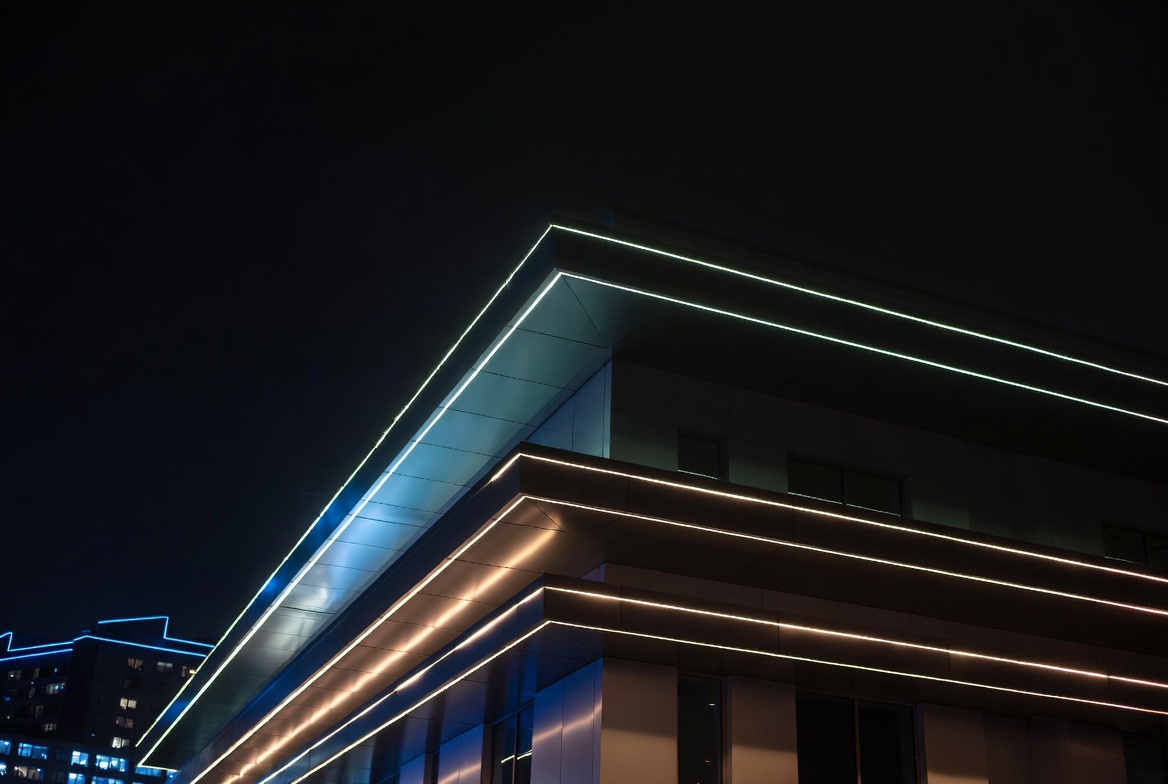
Building outlines are no longer just decorative borders; they have become part of a wider visual and functional strategy for wayfinding, brand identity and urban night‑time landscapes. LED neon flex sits at the heart of this transformation, bringing the classic continuous glow of traditional neon into a safer, more robust and more controllable form factor. In parallel, holistic outline lighting solutions combine linear fixtures, controllers, profiles, and accessories into systemized packages designed to meet complex architectural and engineering requirements.
From an industry practitioner's perspective, "best" LED neon flex solutions are defined less by marketing claims and more by how they perform over years of outdoor exposure and frequent on‑off cycles. For building outlines, this typically involves harsh UV, temperature swings, occasional mechanical stress and constantly shifting visual needs during events or seasonal campaigns.
Professionals usually evaluate LED neon flex against a consistent set of metrics:
- Optical uniformity over long runs with minimal dotting or brightness drop.
- Bending profile appropriate to the building geometry.
- Ingress protection level and resistance to UV, salt and moisture.
- Output per meter and high LED density.
- Compatibility with low‑voltage drivers for safety and simplified maintenance.
In Farwise's case, long‑term work with silicone‑encapsulated LED strip technologies for furniture, cabinetry and residential projects translates directly into better material choices and sealing processes for façade outlines. Silicone profiles give neon flex products high resilience, color stability and a soft yet precise visual edge that many designers prefer for premium building exteriors.
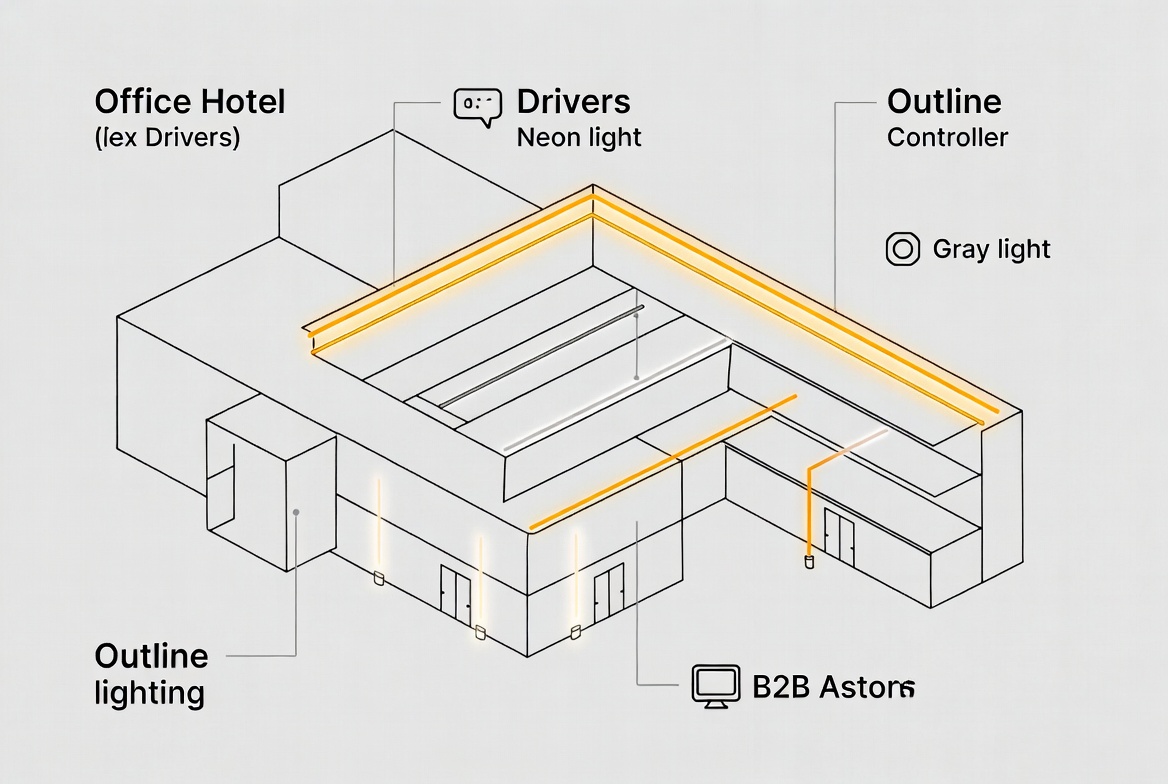
It is useful to distinguish between LED neon flex as a product, and building outline lighting as a system that combines multiple product families, control components and mounting methods. Neon flex units are frequently integrated into larger frameworks that also include aluminum profiles, digital controllers, sensors, smart‑home or building automation gateways, and standardized installation hardware. [openpr]
Below is a practical comparison frequently used in project consulting sessions:
| Aspect | LED Neon Flex Solutions | Integrated Outline Lighting Systems |
|---|---|---|
| Visual effect | Continuous, dot‑free glow with strong color consistency. | Mix of linear, grazing and accent effects tailored zone‑by‑zone. |
| Flexibility | High bending flexibility; ideal for curves, logos, complex outlines. | High system flexibility; combines multiple fixture types and optics. |
| Installation | Relatively straightforward; clip‑based or channel‑based mounting. | More complex; involves profiles, drivers, control wiring, commissioning. |
| Control | Basic dimming to advanced color control depending on driver choice. | Deep integration with smart building platforms and automation scenes. |
| Lifecycle cost | Lower entry cost; strong value for simple façades and retrofits. | Higher initial cost, but optimized energy use and centralized maintenance. |
Architects often start with neon flex to define the main outline, then layer additional systems such as wall washers or cove lighting for key façades, entrances and signage. This hybrid approach aligns visual impact with budget and technical constraints while keeping future upgrades open as new lighting control technologies mature.
Architectural LED lighting is expanding rapidly in both commercial and residential segments, with global market valuation rising from around US$ 6.78 billion in 2024 and projected to almost double by 2032 at close to 7.9% compound annual growth. Separate market reviews forecast architectural and façade lighting to contribute a significant portion of this growth, supported by urbanization, smart‑city initiatives and stricter energy‑efficiency standards.
For building outlines specifically, three macro trends are particularly relevant:
- Urban branding and tourism: city skylines and waterfronts use illuminated outlines to create memorable night‑time identities.
- Smart infrastructure upgrades: municipal and commercial projects prioritize low‑energy, controllable lighting replacing legacy discharge and neon systems.
- Human‑centric and health‑oriented lighting: façade and perimeter lighting schemes are gradually being tuned to reduce glare and visual fatigue for nearby residents.
These trends favor high‑performance neon flex and outline systems that deliver energy savings and tunable effects without compromising durability or maintenance simplicity.
From an expert's perspective, the most successful outline projects begin with clear design criteria rather than simply choosing a product category. Typical design variables include line visibility at various viewing distances, color strategy, rhythm of light versus dark, interaction with interior lighting, and how the building appears in media or photography.
LED neon flex is usually the primary recommendation when:
- The façade has complex curves, logos or intricate shapes needing continuous lines.
- Visual branding requires strong, saturated colors with distinct silhouettes.
- Installation time and access are limited, favoring flexible linear products with clip‑based mounting.
- Maintenance needs to be localized, with easily replaceable segments rather than large modular units.
For furniture and interior edges such as counters, wardrobes or bathroom cabinets, manufacturers like Farwise have already standardized silicone‑based flex solutions, which can be scaled up to exterior applications with adjusted profiles and IP ratings. This continuity gives project owners confidence that outline lighting will behave predictably and interface cleanly with interior ambient schemes.
A more comprehensive system becomes the preferred option when:
- The project includes multiple façades, canopies, columns and landscape elements.
- Dynamic scenes, time‑of‑day adjustments or event‑based color changes are required.
- Centralized monitoring, fault detection and energy analytics are part of the building strategy.
- There is a need to coordinate outline lighting with interior signage, media façades or digital art installations.
In these scenarios, neon flex is still used, but as one module in a larger ecosystem of fixtures and controls rather than a stand‑alone solution.
From a technical standpoint, the difference between neon flex variants can be just as important as the difference between product families. Side‑bend, top‑bend, and round profiles support very different geometries and installation details.
High‑quality neon flex products use diffused silicone housings that:
- Hide individual LEDs and produce a consistent line of light.
- Maintain color accuracy and luminous output over long operating periods.
- Resist yellowing under UV exposure and chemical contact, crucial for coastal or industrial environments.
Farwise's ongoing research in silicone extrusion and encapsulation for interior strip lights contributes to better thermal management and mechanical stability in exterior‑grade neon flex. In practice, this reduces the risk of micro‑cracks at mounting points and allows longer continuous runs without shadowing or brightness variation.
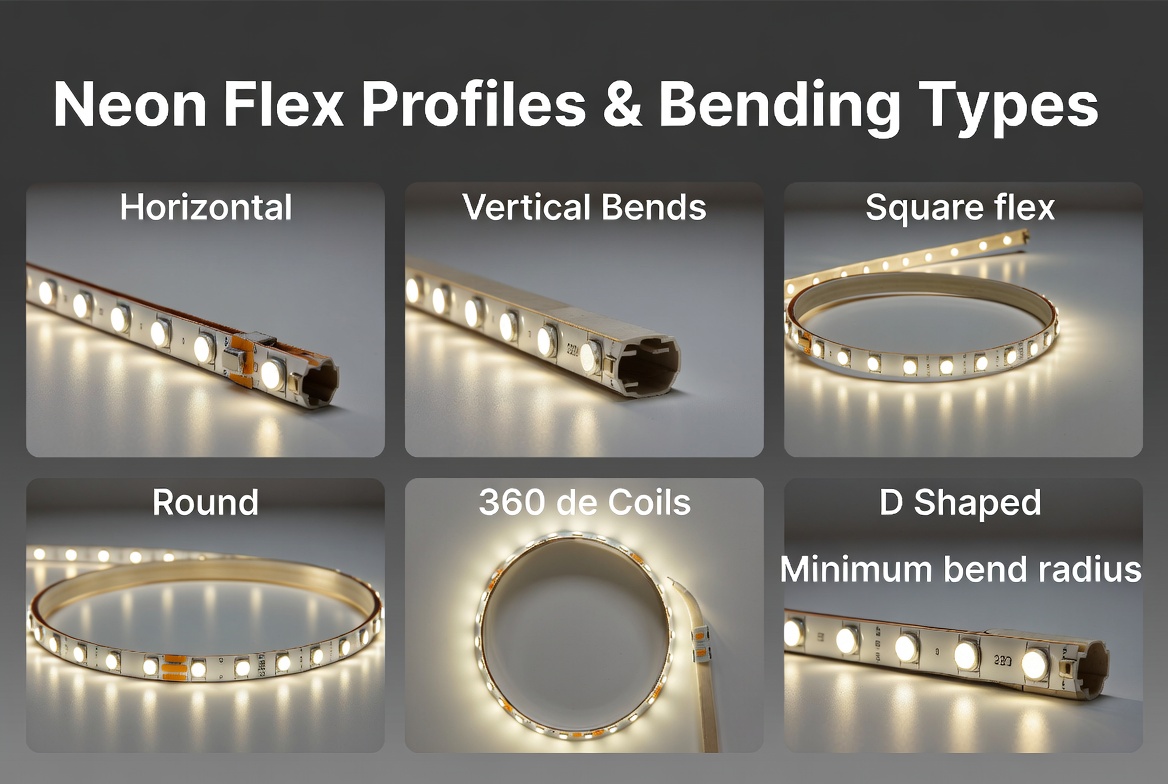
Top‑view neon flex bends vertically and is suited for front‑facing outlines and straightforward façade edges. Side‑view products bend horizontally along their length and follow curves, lettering and complex architectural contours. Round or 360‑degree profiles create cylindrical light lines ideal for special features such as spires, columns or floating outlines in open spaces.
A common expert recommendation is to map façade geometry first, then assign bending types and mounting systems per segment, rather than choosing one profile for the entire building. This segmentation improves both visual coherence and installation efficiency.
For building owners and contractors, the evaluation process benefits from a structured approach that aligns visual goals with technical constraints and long‑term maintenance realities.
1. Define visual objectives: clarify whether the outline should be subtle, bold, dynamic or seasonally adaptive.
2. Map façade geometry: document edges, curves, logos, and any architectural details that will carry the light lines.
3. Choose bending types and profiles: assign top‑bend, side‑bend or round neon flex per segment based on curvature and viewing angles.
4. Set performance targets: specify lumen output, color, ingress protection level and expected operating hours.
5. Align control strategy: decide between simple on/off and dimming, basic color change, or integration into smart building platforms.
6. Validate with mock‑ups: build test segments using representative materials and mounting hardware to confirm visual results on site.
Manufacturers with strong OEM/ODM capabilities, such as Farwise, can support these steps by customizing dimensions, optics, cabling and connectors, which often removes friction between design intent and real‑world installation constraints.
From a consultant's view, the most enduring outline projects achieve a balance between energy efficiency, maintenance simplicity and brand expression. Neon flex is attractive because it combines low voltage, relatively low power per meter and high luminous impact, but long‑term success depends on intelligent product selection and robust system design.
- Energy: architectural LED solutions cut power consumption substantially compared with traditional neon and discharge lamps while enabling dynamic control that optimizes usage patterns.
- Longevity: quality neon flex built on silicone and high‑density LED arrays minimizes replacement events and keeps visual identity consistent for years.
- Identity: tailored color temperatures, brand colors and outline rhythms help buildings stand out in increasingly crowded urban nightscapes.
For companies operating across furniture, residential and commercial segments, a unified lighting strategy that spans interior strip lights and exterior outline neon flex simplifies prototyping, certification and large‑scale rollout.
Q1: Is LED neon flex suitable for both indoor and outdoor building outlines?
Yes, many neon flex products are designed with IP67 or higher protection and robust silicone housings, making them suitable for indoor and outdoor use when correctly installed with compatible drivers and accessories.
Q2: How long can a single run of LED neon flex be in façade applications?
Typical runs range from a few meters to tens of meters, depending on voltage, power and manufacturer recommendations; longer lines can be formed by segmenting runs and feeding from multiple points to maintain uniform brightness.
Q3: Can outline lighting be integrated with smart building control systems?
Yes, modern architectural lighting commonly links neon flex and other fixtures to building automation layers, allowing scheduled scenes, remote monitoring and energy‑optimization routines across façades and public areas.
Q4: What maintenance is required for LED neon flex on building outlines?
Routine maintenance generally involves visual inspection for mechanical damage, checking connectors and drivers, and replacing individual segments if wear or failures occur, aided by modular design and accessible mounting channels.
Q5: How do project teams avoid glare and visual fatigue from bright outlines?
Designers use diffused optics, controlled brightness levels, careful positioning and time‑of‑day dimming strategies to keep outlines visually strong but comfortable for nearby residents and road users.
1. ColorsLED – "Best Weather‑Resistant LED Neon Flex Outdoor Lights" (2025). [Link]
2. NPHIS LED – "Top Bend LED Neon Flex for Building Outline & Linear Lighting". [Link]
3. KEYFINE – "How To Use RGB LED Neon Flex for Building Facade Lighting" (2026). [Link]
4. Stripsledlight – "Outdoor LED Neon Flex Mounting Solutions for Architects and Installers" (2025). [Link]
5. ABNewswire – "Predictions for New Technologies and Trends in the LED Lighting Industry" (2026). [Link]
6. Semiconductor Insight – "Architectural LED Lighting Market: Global Industry Size, Growth Drivers, Emerging Trends and Competitive Outlook Analysis 2026–2034" (2026). [Link]
7. Heliflex – "LED Neon Flex Side Bend Profiles". [Link]
8. OpenPR – "5 LED Profile Innovations Redefining Architectural Lighting" (2026). [Link]
9. SignliteLED – "Flex LED Neon Strips for Building Facade Lighting" (2025). [Link]
10. Starled Technology – "LED Neon Flex Light Singapore" (2025). [Link]
11. 360iResearch – "Architectural Lighting Market Size & Share 2026–2032" (2026). [Link]
12. Wiedamark – "Flex Neon – WDM Lighting" (2025). [Link]
13. Creative Displays – "Commercial Building Outlines: Top Professional Lighting Techniques for Maximum Visual Impact" (2025). [Link]
14. US Luminaire – "Flexible Neon LED Signage and Outline Lighting". [Link]
15. LEDYI Lighting – "LED Neon Flex – Flexible & Efficient Linear Lighting". [Link]